
Tree Care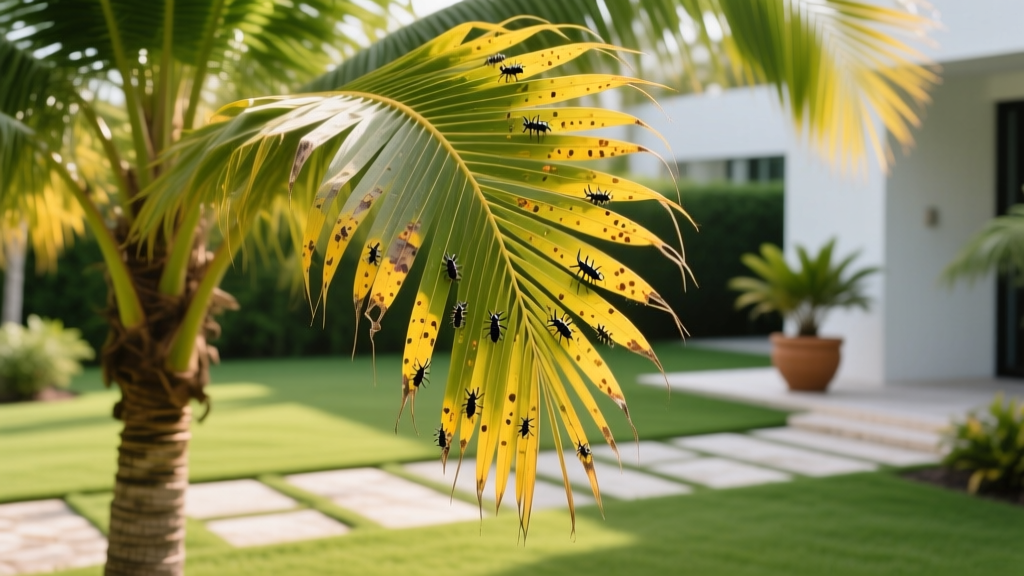
Palm Landscape Troubleshooting: Fix Yellowing and Pests
The Diagnostic Approach to Palm Landscapes
A failing palm landscape rarely deteriorates overnight. By the time canopy dieback or severe chlorosis becomes visible from the street, the underlying physiological or environmental failure has been compounding for months. Palms are monocots; unlike broadleaf trees, they cannot compartmentalize decay or regenerate damaged apical meristems. Once the central bud is compromised, the palm is dead. Effective palm landscape management requires shifting from reactive cosmetic fixes to proactive physiological diagnostics.
This guide provides a structured framework for diagnosing the three most critical failure points in residential and commercial palm landscapes: nutritional imbalances, soil hydrology failures, and biotic threats. According to the University of Florida IFAS Extension, over 70% of palm decline cases submitted to diagnostic labs are rooted in abiotic soil and nutrient issues rather than infectious diseases.
Nutrient Deficiencies: The Visual Matrix
Palms have highly specific macronutrient and micronutrient requirements that standard turfgrass fertilizers cannot meet. Applying a generic 16-4-8 lawn fertilizer to a palm landscape will almost certainly induce severe magnesium and potassium deficiencies due to the high nitrogen-to-potassium ratio. For established landscapes, an 8-2-12-4 (N-P-K-Mg) palm-special fertilizer with coated micronutrients is the baseline standard.
| Nutrient | Visual Symptom | Frond Location | Targeted Correction |
|---|---|---|---|
| Potassium (K) | Translucent yellow/orange spotting, necrotic margins, 'pencil-pointing' on leaflets. | Oldest (lowest) fronds | Apply 1.5 lbs of potassium sulfate per 100 sq ft of canopy area. Do not use potassium chloride. |
| Magnesium (Mg) | Broad yellow banding along the outer edges of the leaf, leaving a green center. | Older fronds | Apply kieserite or magnesium sulfate. Ensure fertilizer has a 3:1 K:Mg ratio. |
| Manganese (Mn) | 'Frizzletop' — severely stunted, distorted, and yellowed new growth with necrotic streaks. | Newest (highest) fronds | Foliar spray of manganese sulfate (3 lbs per 100 gallons of water). Soil application is ineffective in high-pH soils. |
| Iron (Fe) | Uniform, bright yellow chlorosis of the entire frond, including the petiole. | Newest fronds | Chelated iron (Fe-EDDHA) soil drench. Standard Fe-EDTA fails in soils with pH above 7.0. |
Critical Mistake Alert: Homeowners frequently confuse Manganese (Mn) and Magnesium (Mg) deficiencies because the names sound similar. Applying Epsom salts (Magnesium sulfate) to a palm suffering from Manganese deficiency (frizzletop) will not cure the issue and may worsen it by antagonizing potassium uptake. Always identify the frond location: old fronds indicate mobile nutrients (K, Mg); new fronds indicate immobile nutrients (Mn, Fe).
Soil Hydrology and Root Zone Diagnostics
Palms require consistent moisture but are highly susceptible to Phytophthora root rot in saturated soils. In newly developed subdivisions, heavy clay subsoils and construction compaction create perched water tables that suffocate palm roots. Before applying fungicides for suspected root rot, verify the soil percolation rate.
The 12-Inch Percolation Test
- Dig a hole exactly 12 inches deep and 6 inches wide within the palm's dripline (avoiding major structural roots).
- Fill the hole with water and allow it to drain completely to saturate the surrounding soil profile.
- Refill the hole to the top and measure the water level drop after exactly 60 minutes.
- Diagnostic Threshold: A drop of less than 1 inch per hour indicates severe drainage failure. A drop of 1 to 3 inches is marginal; 4+ inches is optimal for most palm species.
Solution for Compacted Soils: Do not simply top-dress with sand, which creates a concrete-like layer when mixed with clay. Instead, utilize vertical mulching. Use a 2-inch auger to drill holes 18 inches deep in a grid pattern every 2 feet under the canopy. Backfill the holes with a 50/50 mix of expanded shale and coarse pine bark. This creates permanent macropores for gas exchange and water infiltration without severing the root mass.
Pest and Disease Triage
When abiotic factors are ruled out, biotic threats must be addressed immediately. The International Society of Arboriculture (ISA) emphasizes that chemical interventions are only viable when applied at the exact correct phenological stage of the pest or pathogen.
Palmetto Weevil (Rhynchophorus cruentatus)
The palmetto weevil is the largest weevil in North America and a lethal threat to stressed palms, particularly Sabal, Canary Island Date, and Bismarck palms. Adult weevils are attracted to the volatile compounds released by fresh pruning wounds or mechanical trunk damage.
- Diagnosis: Look for notched, chewed edges on emerging spear leaves, oozing sap at the trunk base, and the presence of large (1.5-inch) black or red-and-black weevils in the crown.
- Treatment: Soil drenches of Imidacloprid take 4-6 weeks to translocate to the crown, which is too slow for an active infestation. For active attacks, use a systemic trunk injection of Emamectin benzoate or a high-rate Dinotefuran (Safari) basal trunk spray. Expect to pay $40-$60 per tree for professional trunk injection services.
- Prevention: Never prune green fronds during the peak weevil flight season (May through August). If pruning is mandatory, immediately seal the cut petiole bases with a permethrin-based wound paint.
Lethal Bronzing (Phytoplasma)
Formerly known as Texas Phoenix Palm Decline, Lethal Bronzing is a fatal bacterial disease vectored by planthoppers. It devastates Coconut, Date, and Cabbage palms. The Texas A&M AgriLife Extension notes that the disease spreads rapidly in high-density plantings.
- Diagnosis: Premature dropping of green fruit (inflorescence necrosis), followed by a rapid, uniform bronzing and browning of the canopy starting from the bottom up. The spear leaf will collapse and pull out easily.
- Treatment: There is no cure. Once the spear leaf collapses, the palm must be removed and the stump ground below grade to prevent vector attraction. Asymptomatic palms in a 100-foot radius can be protected via prophylactic Oxytetracycline hydrochloride trunk injections administered every 4 months. Budget $15 to $25 per tree, per injection cycle.
The '9-to-3' Pruning Protocol
Improper pruning is a leading cause of long-term decline in palm landscapes. The outdated practice of 'hurricane cutting' (stripping the palm down to a pencil-point of vertical green fronds) severely starves the palm of potassium and reduces the trunk caliper, creating a permanent weak point prone to windthrow.
The Clock-Face Rule: Imagine the palm canopy as a clock face viewed from the side. Only remove fronds that drop below the 9 o'clock and 3 o'clock horizontal lines. Fronds pointing upward (between 9 and 3) are actively photosynthesizing and translocating nutrients to the apical meristem. Removing them forces the palm to cannibalize nutrients from its own trunk tissue.
When removing dead fronds, cut the petiole flush with the trunk base. Do not leave 'boots' (petiole bases) attached, as they harbor nesting rodents and weevils. Use sterilized pruning saws (wiped with 70% isopropyl alcohol between every single tree) to prevent the mechanical transmission of Fusarium wilt, particularly in Canary Island Date palms.
Frequently Asked Questions
Why are my newly planted palms turning brown at the tips?
Tip burn in newly transplanted palms is typically a symptom of transplant shock and root desiccation, not a disease. The severed root ball cannot supply enough water to support the full canopy. Do not fertilize a newly planted palm for the first 60 days. Instead, apply a 2-inch layer of organic mulch (keeping it 6 inches away from the trunk) and water deeply every 48 hours for the first month to establish the peripheral root zone.
Can I use Epsom salts to fix all yellowing palm fronds?
No. Epsom salt is magnesium sulfate. It will only correct a magnesium deficiency, which presents as yellow banding on the oldest, lowest fronds. If the yellowing is on the new growth at the top of the canopy, it is likely a manganese or iron deficiency, which requires entirely different chemical treatments. Blindly applying Epsom salts can disrupt the soil's cation exchange capacity and lock out other vital nutrients.
How deep should I plant a palm tree?
Palms must never be planted deeper than they grew in the nursery container. The root initiation zone (the bulge at the base of the trunk) must be level with or slightly above the surrounding grade. Planting a palm even 2 inches too deep will smother the root initiation zone, leading to chronic moisture stress, trunk constriction, and eventual death within 2 to 3 years.

