
Tree Care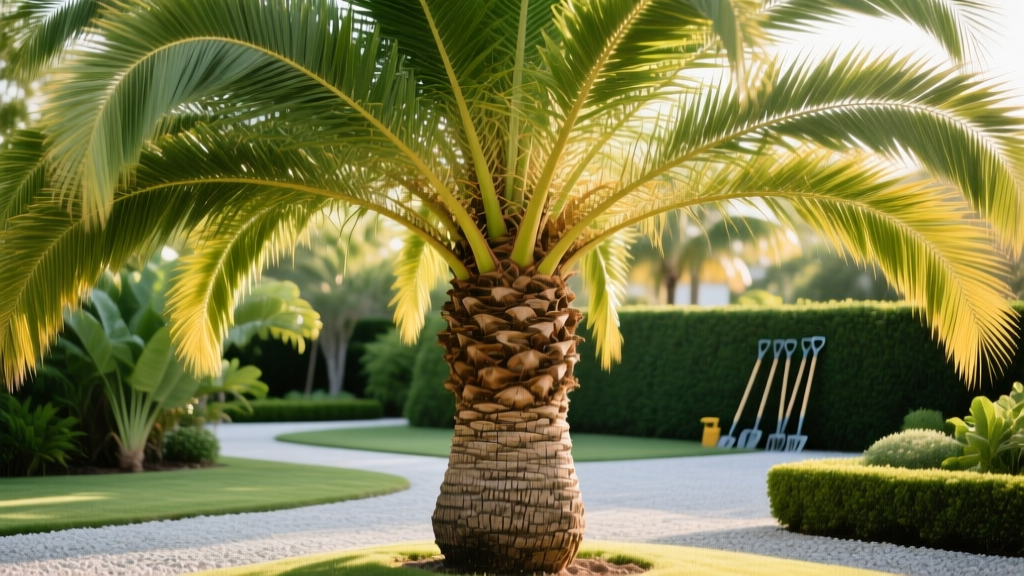
21 Surprising Palm Tree Facts for Identification and Care
The Botanical Reality: Palms Are Not True Trees
When homeowners discuss landscaping, palms are universally grouped with trees. However, understanding the biological reality of the Arecaceae family is the first step toward proper identification and care. These plants operate on entirely different physiological rules than the oaks, maples, and pines in your yard.
Monocot vs. Dicot: Palms are monocots, making them more closely related to grasses, lilies, and corn than to traditional dicot trees. This single biological fact dictates everything from how they grow to how they must be pruned.
1. Palms lack a vascular cambium. True trees have a cambium layer that allows them to heal wounds and grow wider over time. Palms do not. Once a palm trunk is gouged or damaged, the wound is permanent and will never callus over, making trunk protection critical during landscaping.
2. The 'trunk' is actually a stem. Because they lack secondary woody growth, the vertical structure of a palm is a massive, hardened stem. Its rigidity comes from densely packed vascular bundles embedded in a fibrous matrix, not from rings of solid wood.
3. Roots are adventitious and fibrous. Palms do not develop deep, woody taproots or massive lateral anchor roots. Instead, they produce thousands of thin, fibrous, non-woody roots from a root initiation zone at the base of the trunk. These roots typically stay within the top 12 to 36 inches of soil but can spread outward up to 50 feet.
4. The root initiation zone must breathe. Piling mulch or soil over the base of a palm trunk (volcano mulching) will suffocate the root initiation zone, leading to fatal root rot. Always keep mulch at least 6 inches away from the visible trunk base.
5. Growth happens exclusively at the apical meristem. Also known as the 'bud' or 'heart,' this single growing point at the top center of the canopy is the only place the palm generates new tissue. If the apical meristem is damaged by frost, lightning, or improper pruning, the entire palm will die.
Species Identification and Hardiness Data
Not all palms are tropical. Identifying the exact species in your yard dictates your winterization strategy and fertilization schedule. The structural shape of the leaf—either fan-shaped (palmate) or feather-like (pinnate)—is the primary visual identifier for genus classification.
| Species (Common Name) | Leaf Type | Min. Cold Hardiness | Growth Rate | Salt Tolerance |
|---|---|---|---|---|
| Needle Palm (Rhapidophyllum hystrix) | Palmate | -5°F (-20°C) | Very Slow | Moderate |
| Windmill Palm (Trachycarpus fortunei) | Palmate | 5°F (-15°C) | Slow | Low |
| Sabal Palmetto (Sabal palmetto) | Palmate | 10°F (-12°C) | Moderate | High |
| Queen Palm (Syagrus romanzoffiana) | Pinnate | 20°F (-6°C) | Fast | Low |
| Coconut Palm (Cocos nucifera) | Pinnate | 30°F (-1°C) | Fast | Very High |
6. Crownshafts indicate self-cleaning species. Palms like the Royal Palm (Roystonea regia) and Christmas Palm feature a smooth, green extension of the trunk called a crownshaft. These species naturally shed dead fronds, whereas species with persistent leaf bases (boots) require manual pruning.
7. Leaf scars tell the palm's history. The diamond-shaped or horizontal patterns on a palm trunk are leaf scars. In species like the Canary Island Date Palm, these scars form a dense, fibrous mat that can harbor pests if not maintained, while Sabal palms retain the structural 'boots' of old fronds for decades.
8. True dwarf palms are rare. Many palms sold as 'dwarf' varieties (like the Dwarf Palmetto) are simply slow-growing or naturally compact shrub-like species. They will still eventually reach their genetic maximum spread, which must be factored into hardscape clearance planning.
9. Trunk caliper dictates maturity, not height. When purchasing palms for immediate landscape impact, measure the trunk diameter (caliper) at 3 feet above the ground. A palm with a 12-inch caliper is significantly more established and transplant-resilient than a spindly 20-foot palm with a 4-inch caliper.
10. Flowering structures (inflorescences) emerge below the crown. Unlike many trees that bloom at the tips of branches, palm flower stalks push out from within the canopy, often emerging just below the lowest living frond or from within the crownshaft.
Environmental Resilience and Survival Mechanics
Palms evolved in harsh, dynamic environments, developing unique structural defenses that make them incredibly resilient to extreme weather events that would snap traditional hardwoods.
11. Palm trunks are engineered for hurricane flex. The fibrous, non-woody interior of a palm stem acts like a bundle of cables. In sustained winds exceeding 100 mph, the trunk bends drastically rather than snapping, while the pinnate fronds fold together to reduce wind drag.
12. They possess high fire resistance. Palms rarely have low-hanging lateral branches to act as 'ladder fuels' for ground fires. Furthermore, the inner trunk holds immense moisture, making mature palms highly resistant to catching fire compared to resinous pines or dry eucalyptus.
13. Salt spray tolerance is localized to specific genera. Coastal homeowners must select carefully. While Sabal and Coconut palms thrive in direct oceanfront salt spray, Queen and Areca palms will suffer severe leaf necrosis and stunted growth just a few blocks inland from the salt zone.
14. Palms can survive temporary inundation. Many native swamp palms (like the Cabbage Palm) have specialized pneumatophores (aerial roots) or highly aerated trunk tissue that allows them to survive weeks of standing water after severe tropical storms without suffocating the root system.
'The greatest threat to a palm during a hurricane is not the wind, but the improper pruning done by humans months prior. A structurally sound palm is a survivor.'
Advanced Care, Maintenance, and Pathology
Maintaining a palm requires abandoning traditional tree care logic. Applying arborist techniques meant for oaks and elms to a palm will often trigger fatal physiological responses.
CRITICAL WARNING: Never perform 'hurricane cutting' or 'rooster tailing' on a palm. Removing all green fronds and leaving only a few upright spears starves the apical meristem, causes 'pencil-pointing' (narrowing) of the trunk, and severely weakens the tree against wind. According to the University of Florida IFAS Extension, only fronds that are completely brown and dead should be removed.
15. The '9-to-3' pruning rule is the gold standard. When looking at the palm from the side, imagine a clock face. Only prune fronds that hang below the horizontal plane (below 9 o'clock and 3 o'clock). Any frond pointing upward or horizontal must remain, even if it has slight yellowing.
16. Yellowing oldest fronds indicates Potassium (K) deficiency. If the tips of the lowest, oldest fronds turn yellow or necrotic while new growth remains green, the palm is pulling mobile potassium from older tissue to feed the bud. This requires immediate application of a potassium-rich supplement.
17. 'Frizzle top' is a Manganese (Mn) crisis. New fronds emerging short, chlorotic, and severely deformed signal manganese deficiency, common in high-pH alkaline soils. Foliar sprays of manganese sulfate provide a quick fix, but soil acidification is required for long-term resolution.
18. Standard tree fertilizer will harm palms. Palms require a specific 8-2-12-4 (N-P-K-Mg) ratio. The UF IFAS guidelines for palm nutrition mandate that 100% of the nitrogen, potassium, and magnesium must be in a slow-release, coated prill form to prevent nutrient leaching in sandy soils.
19. Boron toxicity is a hidden killer. While palms need trace boron, the window between deficiency and fatal toxicity is incredibly narrow. Never use household borax or high-boron weed-and-feed products near the palm's drip line; toxicity causes the new spear to bend sharply and halt growth entirely.
20. Lethal Yellowing is spread by planthoppers. This fatal phytoplasma disease turns the canopy bright yellow before collapsing the spear. It is highly prevalent in Coconut and Christmas palms. Planting resistant species like the Malayan Dwarf or Maypan hybrid is the only reliable preventative strategy in endemic zones.
21. Fusarium Wilt demands strict tool sterilization. This soil-borne fungus enters through pruning wounds and clogs the vascular bundles, killing one side of the frond while the other remains green. To prevent spreading Fusarium from an infected Canary Island Date Palm to a healthy one, pruning saws must be soaked for 10 minutes in 70% isopropyl alcohol or a 1:3 bleach solution between every single cut.
Summary Action Plan for Homeowners
- Identify: Determine your exact species and its specific cold-hardiness threshold.
- Prune: Remove only fully dead, brown fronds hanging below the 9-to-3 horizontal line.
- Feed: Apply an 8-2-12-4 slow-release palm special fertilizer in early spring and late summer.
- Protect: Keep mulch off the trunk base and sterilize all pruning equipment to prevent pathogen transfer.

