Tree Care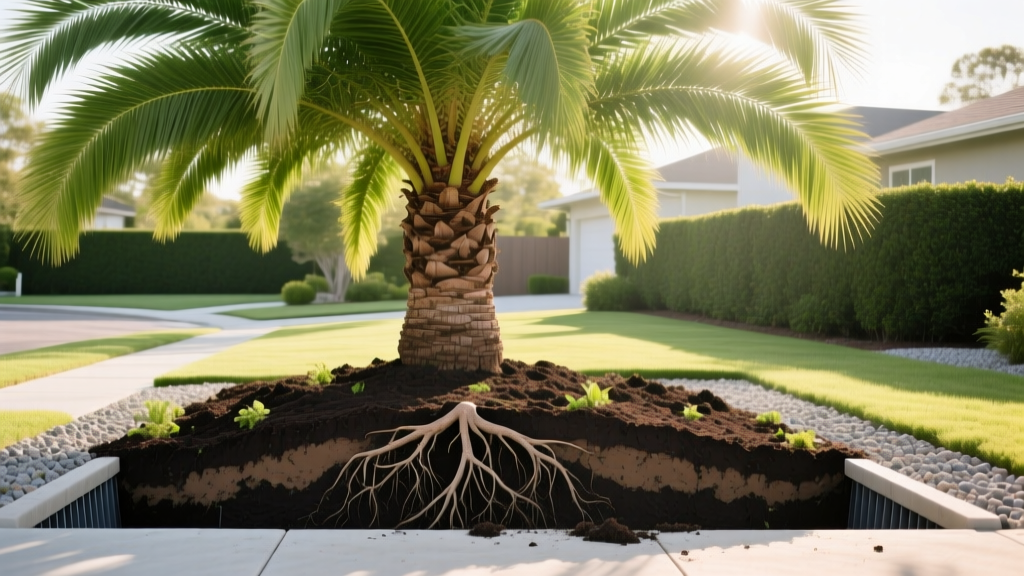
Mastering the Palm Tree Plant: Depth, Soil, and Establishment
The Anatomy of a Successful Palm Tree Plant
Installing a palm requires a fundamentally different approach than planting a traditional dicot shade tree. Palms are monocots; they lack a vascular cambium layer, meaning their trunks cannot expand to heal wounds, and their root systems do not regenerate if suffocated. Executing a flawless palm tree plant hinges on three non-negotiable variables: exact planting depth, unamended backfill, and structural bracing. A 15-gallon nursery specimen typically costs between $120 and $250, while mature boxed palms easily exceed $800. Protecting this investment requires strict adherence to botanical best practices rather than generalized landscaping rules.
⚠️ The Golden Rule of Palm Depth: Never plant a palm deeper than it grew in the nursery container. Burying the root initiation zone (the swollen base where the trunk meets the roots) even two inches below grade will cause 'deep planting decline,' leading to trunk rot, nutrient starvation, and eventual death within 12 to 18 months.
Species Selection and Site Matching Matrix
Before breaking ground, match your palm species to the microclimate and soil drainage profile of your yard. Selecting the wrong species for heavy clay soils is the leading cause of establishment failure.
| Species | Cold Hardiness | Soil Tolerance | Best Use Case |
|---|---|---|---|
| Sabal Palm (Sabal palmetto) | 11°F (-11°C) | High (Tolerates clay, sand, salt) | Coastal properties, street medians |
| Windmill Palm (Trachycarpus fortunei) | 5°F (-15°C) | Medium (Requires good drainage) | Northern transitional zones, patios |
| Queen Palm (Syagrus romanzoffiana) | 20°F (-6°C) | Low (Fails in heavy alkaline clay) | Tropical landscapes, pool enclosures |
| Pygmy Date Palm (Phoenix roebelenii) | 25°F (-4°C) | Medium (Needs consistent moisture) | Understory planting, large containers |
Step-by-Step Planting Protocol
Follow this exact sequence to ensure optimal root initiation and avoid the most common installation errors documented by arborists.
Step 1: Excavation and Soil Assessment
Dig a hole exactly the same depth as the nursery root ball, but twice as wide. If your native soil is heavy clay, do not amend the backfill with peat moss or compost. Amending the planting hole creates a 'bathtub effect' where water pools in the loose organic matter and drowns the palm roots. According to the Clemson University Home & Garden Information Center, palms establish best when backfilled with the exact native soil excavated from the hole, as this prevents settling and encourages roots to adapt to local conditions.
Step 2: Positioning the Root Ball
Use a leveling board placed across the top of the hole. The top of the root ball should sit exactly flush with the bottom of the board. For poorly drained sites, plant the palm 2 to 3 inches above grade and mound the native soil up to the trunk base. Never lift a palm by its trunk; always support the root ball with heavy machinery or a canvas sling to prevent tearing the delicate root initiation zone.
Step 3: Backfilling Without Compaction
Shovel the native soil back into the hole in 4-inch layers. Use a hose to wash water into the backfill, which naturally settles the soil and eliminates air pockets without the mechanical compaction that restricts root growth. Do not step on or tamp the backfill.
Post-Plant Establishment: Bracing and Hydration
Because palms lack a taproot and rely on a dense mat of adventitious roots that take months to anchor into surrounding soil, mechanical support is mandatory for the first 6 to 12 months.
The 120-Degree Bracing System
Construct a bracing system using three 2x4 wooden stakes. Position them at 120-degree angles around the trunk, roughly 3 feet from the base. Wrap the trunk tightly with a specialized palm strap, burlap, or old carpet to protect the bark. Secure the 2x4s to the trunk wrap using heavy-duty ratchet straps or thick rope. Never drive nails, screws, or lag bolts directly into a palm trunk. Palms cannot compartmentalize decay like oak or maple trees; a single nail wound can introduce Ganoderma zonatum, a lethal and incurable fungal pathogen.
First-Year Watering Matrix
Palms require deep, infrequent watering to push roots downward. Shallow daily sprinkling promotes surface rooting and drought vulnerability.
- Weeks 1-2: Water daily. Apply 1 gallon of water per inch of trunk caliper.
- Weeks 3-6: Water every other day. Maintain the same volume per application.
- Months 2-6: Water twice a week, increasing volume by 20% to encourage deep soil penetration.
"The most common mistake homeowners make is treating a newly planted palm like a houseplant. Palms need heavy, deep-cycle irrigation to establish their adventitious root network in native soil. If the top 2 inches of soil are wet but the root ball is dry at 12 inches deep, the palm will slowly starve."
Common Establishment Failures and Corrections
Monitor your palm tree plant closely during the first 90 days. Catching these symptoms early can save the specimen.
Symptom: Lower fronds turning yellow and collapsing while the central spear remains green.
Diagnosis: Transplant shock and potassium deficiency. Palms naturally cannibalize older fronds to support new growth.
Correction: Do not prune the yellow fronds; the palm is extracting mobile nutrients from them. Apply a slow-release palm-specific fertilizer (8-2-12-4 ratio) at the drip line.
Diagnosis: Transplant shock and potassium deficiency. Palms naturally cannibalize older fronds to support new growth.
Correction: Do not prune the yellow fronds; the palm is extracting mobile nutrients from them. Apply a slow-release palm-specific fertilizer (8-2-12-4 ratio) at the drip line.
Symptom: The central spear (the newest, unopened leaf) pulls out easily and smells foul.
Diagnosis: Spear rot caused by overwatering or planting too deeply, leading to bacterial/fungal infection in the meristem.
Correction: Immediately reduce watering frequency. Drench the central bud with a copper-based fungicide. If the rot has reached the growing point, the palm cannot be saved.
Diagnosis: Spear rot caused by overwatering or planting too deeply, leading to bacterial/fungal infection in the meristem.
Correction: Immediately reduce watering frequency. Drench the central bud with a copper-based fungicide. If the rot has reached the growing point, the palm cannot be saved.
Symptom: Trunk appears severely tapered or 'penciled' near the soil line.
Diagnosis: The palm was planted too deep, causing the lower trunk tissue to rot and constrict vascular flow.
Correction: Carefully excavate the soil away from the trunk base to expose the root initiation zone. Allow the area to dry and air out.
Diagnosis: The palm was planted too deep, causing the lower trunk tissue to rot and constrict vascular flow.
Correction: Carefully excavate the soil away from the trunk base to expose the root initiation zone. Allow the area to dry and air out.
Frequently Asked Questions
Should I remove the burlap and wire basket before planting?
Yes. While some deciduous trees can be planted with treated burlap left intact, palm root balls must be completely freed of all synthetic burlap, wire baskets, and twine. Any material left around the root ball will restrict the outward growth of the new adventitious roots and eventually girdle the base.
When is the best time of year to execute a palm tree plant?
The optimal planting window is early summer, just as soil temperatures consistently exceed 75°F (24°C). Palms require warm soil to initiate new root growth. Planting in late fall or winter leaves the palm dormant and vulnerable to cold damage before it can anchor itself. For comprehensive seasonal timing data, refer to the Arbor Day Foundation's planting guidelines, adjusting for your specific USDA hardiness zone.
Do I need to stake a small, 5-gallon palm?
Generally, palms under 8 feet tall with a trunk caliper of less than 2 inches do not require heavy wooden bracing. However, they should be secured using three short ground stakes and wide canvas straps to prevent wind rock, which tears the fragile new roots trying to establish in the surrounding soil.