
Tree Care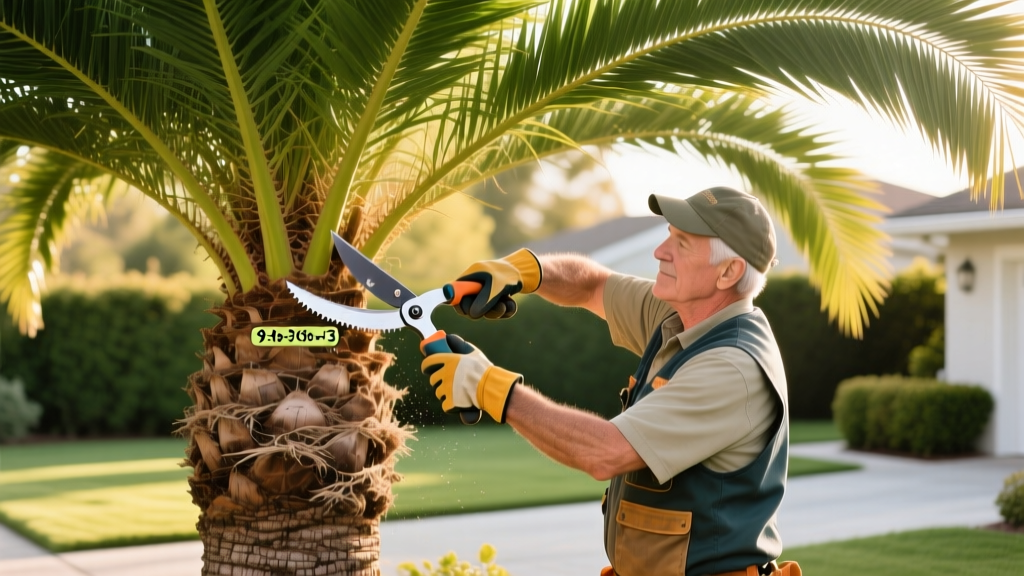
Palm Tree Pruning Guide: Mastering the 9-to-3 Clock Rule
Most homeowners and uncertified landscapers inadvertently destroy palm trees through severe over-pruning. The widespread misconception that stripping a palm down to a few vertical fronds protects it from hurricane winds actually weakens the trunk, starves the root system, and invites fatal pathogens. Unlike broadleaf trees, palms lack a vascular cambium layer, meaning they cannot heal wounds or widen their trunks to compensate for structural damage. Proper palm tree maintenance requires a strict adherence to botanical physiology rather than aesthetic preference.
The Fatal Mistake: Why 'Hurricane Cutting' Kills Palms
'Hurricane cutting' or 'pencil-pointing' refers to the aggressive removal of all green, photosynthesizing fronds, leaving only a small tuft of upright leaves at the apex. This practice is devastating. The apical meristem—the single growing point at the top of the palm—relies entirely on the energy produced by the existing canopy. When green fronds are removed, the palm is forced to cannibalize its own trunk tissue for energy.
This results in 'tapering,' where the trunk narrows severely just below the canopy, creating a permanent structural weak point. According to the University of Florida IFAS Extension, over-pruned palms exhibit significantly reduced trunk diameter, stunted root growth, and a heightened susceptibility to windthrow during actual storms. Furthermore, the exposed trunk tissue becomes highly vulnerable to sunscald and insect borers.
The 9-to-3 Clock Rule: Step-by-Step Canopy Assessment
To maintain structural integrity and physiological health, arborists follow the 9-to-3 clock rule. Imagine the palm canopy as a clock face, with 12 o'clock pointing straight up and 6 o'clock pointing straight down at the trunk.
Core Directive: Only remove fronds that hang below the horizontal line connecting the 9 o'clock and 3 o'clock positions. Fronds above this line, even if they appear slightly yellowed, bent, or damaged, must remain on the tree until they are completely brown and dead.
- Establish the Horizontal Plane: Stand 20 feet back from the palm and visually draw a horizontal line through the center of the canopy.
- Identify Target Fronds: Locate fronds where the petiole (leaf stem) originates below the 9 o'clock or 3 o'clock position.
- Verify Tissue Death: Ensure the target frond is entirely brown. If the base of the petiole is still green, the tree is still extracting water and nutrients from it. Leave it alone.
- Execute the Cut: Cut the petiole as close to the trunk as possible without gouging the trunk tissue. Do not leave 'boots' (petiole bases) unless the specific palm species (like a Sabal palm) naturally retains them.
Tool Selection and Sterilization Protocol
The most dangerous aspect of palm tree pruning is the transmission of Fusarium oxysporum, a soil-borne and tool-borne fungal pathogen that causes Fusarium wilt. This disease is 100% fatal to highly susceptible species such as Canary Island date palms (Phoenix canariensis) and Queen palms (Syagrus romanzoffiana). The fungus spreads via sap residue on unsterilized saw blades.
Recommended Tool Matrix
| Tool Model | Use Case | Required Sterilant |
|---|---|---|
| Silky Gomboy 240mm | Petioles under 1 inch thick | 70% Isopropyl Alcohol |
| Corona BP 7100D Loppers | Fronds 1 to 1.5 inches thick | Quaternary Ammonium (Consan 20) |
| Silky Hayauchi 24ft Pole Saw | Canopies over 15 feet high | 70% Isopropyl Alcohol |
Critical Warning: Never use household bleach (sodium hypochlorite) to sterilize pruning tools. Bleach pits and corrodes high-carbon steel blades within minutes, creating micro-grooves where fungal spores hide and survive chemical contact. Furthermore, bleach is highly phytotoxic and will burn the exposed vascular tissue of the palm tree. Always use 70% isopropyl alcohol or a commercial quaternary ammonium disinfectant, and spray the blade between every single tree.
For comprehensive industry standards on pruning cuts and tool sanitation, refer to the Tree Care Industry Association's ANSI A300 Pruning Standards, which dictate the exact angles and collar placements required to prevent trunk decay.
Diagnosing Nutrient Deficiencies Before You Prune
Homeowners frequently mistake nutrient deficiencies for disease or natural aging, leading them to prematurely prune off fronds that the tree desperately needs. Palms are highly efficient at nutrient scavenging; when the soil lacks essential minerals, the palm will actively mobilize and translocate nutrients from its oldest (lowest) fronds to support the new spear (the newest emerging frond at the apex).
Potassium (K) Deficiency
- Visual Symptoms: Translucent yellow-orange flecking that progresses to necrotic (dead) margins on the oldest fronds.
- Action: Do NOT prune. The tree is reabsorbing remaining potassium. Pruning accelerates the deficiency and will eventually kill the apical meristem.
Magnesium (Mg) Deficiency
- Visual Symptoms: Broad yellow bands along the outer edges of the leaflets, leaving the center of the frond green.
- Action: Do NOT prune. Leave the frond until it is 100% brown. The yellow tissue is still feeding the new growth.
Post-Pruning Fertilization Schedule
Because pruning removes biomass and forces the palm to generate new tissue, it must be supported with the correct nutrient profile. Standard lawn fertilizers (like 16-4-8) are detrimental to palms, as they provide excessive nitrogen and insufficient potassium and magnesium, exacerbating the exact deficiencies that cause frond death.
Apply an 8-2-12-4 (N-P-K-Mg) controlled-release 'palm special' fertilizer. According to the UF IFAS Fertilization of Palm Trees guidelines, the optimal application rate is 1.5 pounds of fertilizer per 100 square feet of canopy area. Broadcast the granules evenly under the entire drip line of the palm, keeping the fertilizer at least 6 inches away from the trunk base to prevent root burn. Apply this formulation three times a year (spring, summer, and early fall) to maintain consistent nutrient availability in the soil profile.
DIY vs. Professional Palm Maintenance Costs (2026 Pricing)
Deciding whether to prune your palm tree yourself or hire an ISA-certified arborist depends on the tree's height, the species' susceptibility to Fusarium, and your willingness to adhere to strict sterilization protocols.
2026 Cost Breakdown:
Professional Service: $85 to $175 per tree for standard canopy cleaning (under 20 feet). Includes ISA-certified labor, proper ANSI A300 cuts, and commercial-grade tool sterilization. Add $50-$100 if a crane or bucket truck is required for heights exceeding 30 feet.
DIY Approach: Initial tool investment of roughly $140 (Silky saw, loppers, alcohol, spray bottle). Ongoing cost of $45 for a 50lb bag of 8-2-12-4 fertilizer. DIY is highly cost-effective for single-story palms but carries a high risk of fatal pathogen transmission if sterilization steps are skipped.
Mastering the 9-to-3 clock rule and understanding the physiological reasons behind frond retention will extend the lifespan of your palm tree by decades. Never sacrifice the long-term health of the apical meristem for a temporary, overly manicured aesthetic.

