
Tree Care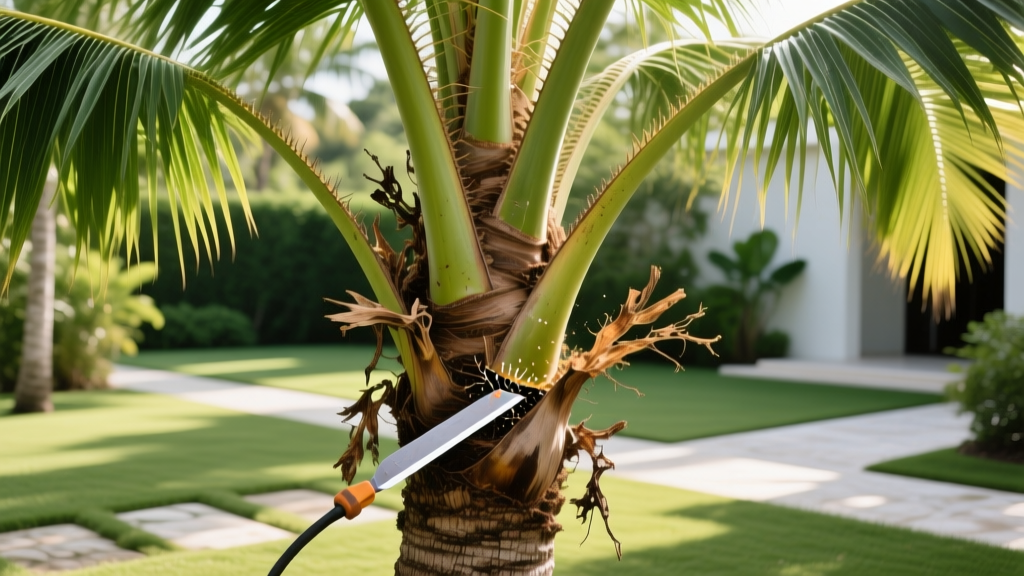
How to Prune and Care for a Palm Tree: A Complete Guide
Homeowners frequently search for 'pam tree' care tips when typing quickly on mobile devices, but proper palm tree maintenance requires precise, species-specific knowledge rather than generic landscaping advice. Unlike broadleaf trees, palms are monocots; they do not possess a vascular cambium layer, meaning they cannot heal over pruning wounds or regenerate damaged trunks. A single mistake with a chainsaw or an incorrect fertilizer application can permanently stunt growth or invite lethal pathogens.
This guide provides exact, actionable protocols for pruning, fertilizing, and diagnosing palm trees, updated with the latest 2026 ANSI A300 arboricultural standards and current soil science metrics.
Understanding Your Palm Species and Cold Hardiness
Before applying any care regimen, you must identify your palm's cold hardiness and growth habit. Applying tropical care routines to a cold-hardy species, or vice versa, is the leading cause of homeowner palm failure. The table below outlines the three most common landscape categories and their specific environmental thresholds.
| Category | Common Species | USDA Zones | Min Temp Tolerance | Water Requirement |
|---|---|---|---|---|
| Cold-Hardy | Sabal palmetto, Trachycarpus fortunei | 7b - 11 | 10°F to 15°F | Low to Moderate |
| Subtropical | Phoenix roebelenii, Syagrus romanzoffiana | 9a - 11 | 25°F to 30°F | Moderate |
| Tropical | Roystonea regia, Dypsis lutescens | 10b - 13 | 40°F (Foliage damage) | High |
Step-by-Step Palm Tree Pruning Protocol
Over-pruning is the most destructive practice in palm care. The outdated 'hurricane cut' or 'pencil point' pruning method—where all green fronds are removed, leaving only a tiny tuft at the top—starves the palm of potassium and severely weakens the trunk. According to the University of Florida IFAS Extension, you should only remove fronds that are completely brown and dead, or those pointing below the 9 o'clock and 3 o'clock horizontal plane.
WARNING: Never use climbing spikes (gaffs) to ascend a palm tree unless it is being completely removed. Spikes create thousands of puncture wounds that serve as direct entry points for Fusarium wilt and Thielaviopsis trunk rot. Always use an aerial lift or friction-based climbing saddle.
Recommended Tools for 2026
Ditch the cheap hardware store loppers. Palms require razor-sharp, sterilized blades to prevent crushing the vascular bundles.
- Hand Pruning (Fronds under 1 inch): Corona FL 3460 bypass pruners or Felco 2. Wipe blades with 70% isopropyl alcohol between every single cut to prevent cross-contamination.
- Sawing (Fronds 1-3 inches): Silky Gomboy 210mm folding saw. The impulse-hardened teeth slice through fibrous palm petioles without binding or tearing.
- Heavy Duty (Trunks over 4 inches): Stihl HTA 86 battery-powered pole pruner for safe ground-level removal of high canopy debris.
Soil Chemistry, Fertilization, and Watering Metrics
Palms are notorious for specific micronutrient deficiencies, particularly magnesium, manganese, and boron. Standard lawn fertilizers (like a 20-0-5 turf blend) will actively harm palms by exacerbating potassium-to-magnesium imbalances, leading to fatal leaf necrosis.
The 8-2-12-4Mg Fertilizer Standard
You must use a palm-specific fertilizer with an NPK ratio of 8-2-12, plus 4% Magnesium (Mg), and coated micronutrients. Lesco Professional 8-2-12 Palm Fertilizer remains the industry benchmark. The nitrogen, potassium, and magnesium must all be in slow-release, coated forms (like Polymer-Coated Sulfate of Potash) to prevent rapid leaching in sandy soils.
Application Rates and Timing:
- Measure the canopy drip line (the area directly beneath the outermost fronds).
- Apply 1.5 pounds of 8-2-12 fertilizer per 100 square feet of canopy area.
- Keep the fertilizer at least 6 inches away from the trunk base to prevent root burn.
- Apply three times per year: early spring (March), early summer (June), and early fall (September). Do not fertilize late in the fall, as pushing new growth before winter freezes will kill the emerging spear.
Deep Watering Techniques
Newly planted palms require daily watering for the first 45 days. Use a slow-drip soaker hose wrapped around the root ball, delivering roughly 15 to 20 gallons per session. Once established, water deeply twice a week during dry spells, ensuring the top 12 inches of soil are moistened. Palms hate 'wet feet'; if your soil has high clay content, amend the planting zone with 30% expanded shale or perlite to guarantee drainage.
Diagnosing and Treating Common Palm Diseases
Early intervention is critical. Once systemic diseases reach the apical meristem (the central growing bud), the palm cannot be saved. Consult the Clemson University Home & Garden Information Center for regional pathogen tracking, but use this decision matrix for immediate field diagnosis.
| Symptom Presentation | Probable Pathogen / Issue | Actionable Treatment Protocol |
|---|---|---|
| Yellowing of oldest fronds, progressing upward; 'frizzled' new growth. | Potassium Deficiency | Apply 8-2-12-4Mg palm special immediately. Results take 6-12 months to show in the canopy. |
| Sudden collapse of the central spear; foul, fermented odor at the bud. | Bud Rot (Phytophthora palmivora) | Remove dead tissue. Apply Subdue MAXX (mefenoxam) as a preventative drench. If spear pulls out easily, remove the entire tree. |
| One-sided frond death; vascular tissue inside petiole shows black/brown streaks. | Fusarium Wilt | No cure. Remove tree immediately. Do not plant another palm or susceptible species in the exact same soil. |
| White, powdery webbing on leaf undersides; stippled, yellowing foliage. | Spider Mites or Scale Insects | Apply horticultural oil or insecticidal soap. For severe scale, use a systemic dinotefuran trunk injection. |
'The most critical rule in palm pathology is sanitation. Pruning tools used on a Fusarium-infected palm will transmit the fungus to the next palm you cut. Tools must be soaked in a 1:3 pine oil-to-water solution or 70% alcohol for a minimum of 10 minutes between trees.' — International Society of Arboriculture (ISA) Best Management Guidelines
Frequently Asked Questions
Why do search results often show 'pam tree' instead of palm tree?
This is simply a common mobile typographical error. When typing quickly, the 'l' and 'm' are often transposed or omitted. If you are searching for care guides, pest control, or pruning advice, always ensure you are reading literature specifically designated for Arecaceae (the palm family), as broadleaf tree advice regarding wound sealants and deep root fertilization will damage palms.
Should I use pruning paint or wound sealer on palm cuts?
Absolutely not. Palms do not compartmentalize decay like hardwood trees. Applying tar, paint, or commercial wound sealers to a palm pruning scar traps moisture against the cut, accelerating rot and inviting fungal pathogens directly into the trunk. Always leave palm cuts exposed to dry naturally in the sun.
How do I protect a tropical palm from an unexpected freeze?
If a hard freeze is forecasted, wrap the trunk tightly with burlap or frost cloth, and tie it securely. For smaller specimens, drape a string of non-LED incandescent holiday lights around the trunk beneath the burlap to generate ambient heat. Most importantly, pull the fronds upward and tie them together around the central spear to protect the vulnerable apical meristem from ice accumulation.

