
Tree Care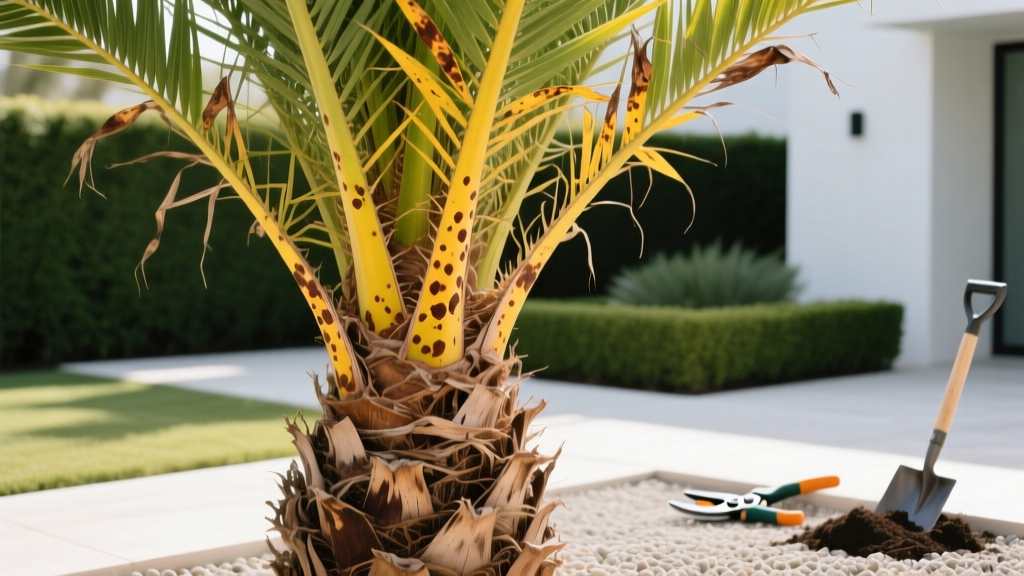
Phoenix Tree Problems: Diagnosing and Curing Common Palm Diseases
The "Phoenix Tree" Clarification: Palms, Not Hardwoods
When homeowners search for "phoenix tree" care, they are almost exclusively referring to palms within the Phoenix genus. This includes the towering Canary Island Date Palm (Phoenix canariensis), the True Date Palm (Phoenix dactylifera), the Senegal Date Palm (Phoenix reclinata), and the popular landscape shrub, the Pygmy Date Palm (Phoenix roebelenii). Unlike broadleaf hardwoods, these monocots possess a single terminal bud. If that bud dies, the entire tree dies. Diagnosing problems early is not just about aesthetics; it is about preventing total structural loss.
In 2026, the most critical threats to Phoenix palms remain vascular fungal infections, severe micronutrient lockouts, and phytoplasma bacterial diseases. Misdiagnosing a fatal vascular wilt as a simple watering issue will cost you a mature specimen that could cost $2,500 to replace. Below is a clinical framework for identifying and treating the most destructive Phoenix palm problems.
Diagnostic Matrix: Identifying Your Phoenix Palm's Decline
Use this rapid-triage matrix to match visual symptoms to their underlying pathology. Never apply fungicides to a nutrient deficiency, and never fertilize a tree suffering from vascular wilt.
| Visual Symptom | Probable Diagnosis | Severity | Immediate First Step |
|---|---|---|---|
| One-sided frond death (left half brown, right half green) | Fusarium Wilt (Fusarium oxysporum) | Fatal | Stop pruning; isolate tools; call arborist |
| Translucent yellow-orange spotting on oldest (lowest) fronds | Potassium (K) Deficiency | Moderate | Apply 8-0-12-4Mg controlled-release fertilizer |
| Broad yellow bands on frond margins, green center | Magnesium (Mg) Deficiency | Moderate | Apply magnesium sulfate or palm-specific blend |
| Premature fruit drop, dead flower stalks, bronze foliage | Texas Phoenix Palm Decline (TPPD) | Fatal (if untreated) | Schedule OTC trunk injections immediately |
| Sudden collapse of the central spear leaf | Bud Rot (Phytophthora) or Weevil damage | Fatal | Pull-test the spear; apply systemic insecticide/fungicide |
Fatal Threat: Fusarium Wilt in Canary Island Date Palms
Fusarium wilt, caused by the soil-borne and tool-borne fungus Fusarium oxysporum f. sp. canariensis, is the most devastating disease affecting Phoenix canariensis. The hallmark symptom is "one-sided death." You will observe that the leaflets on one side of the midrib turn brown and necrotic, while the opposite side remains perfectly green. As the disease progresses up the canopy, it eventually reaches the terminal bud, killing the tree.
WARNING: The Pruning Saw Vector
The primary way Fusarium spreads between healthy Phoenix palms is through contaminated pruning saws. The fungus embeds in the teeth of the saw blade. If you prune a diseased tree and then prune a healthy one without sterilization, you have effectively inoculated the healthy tree. According to the University of Florida IFAS Extension, chainsaws cannot be adequately sterilized because the fungus hides in the chain links and guide bar grooves.
The Only Solution: Strict Sanitation and Removal
There is no chemical cure for Fusarium wilt once it is inside the vascular system. If your Phoenix palm exhibits confirmed one-sided dieback, the tree must be removed to prevent the soil-borne pathogen from spreading to adjacent palms. In 2026, professional removal of a 30-foot Canary Island Date Palm, including stump grinding and root zone excavation, typically costs between $1,200 and $1,800.
Tool Sterilization Protocol: For routine maintenance on healthy Phoenix palms, abandon chainsaws. Use manual pruning saws with interchangeable blades. After every single cut, or at minimum between every tree, soak the saw blade for 10 minutes in a 70% isopropyl alcohol solution or a 10% bleach solution (note: bleach will rapidly corrode steel, making alcohol or commercial quaternary ammonium disinfectants the preferred choice for University of Arizona Cooperative Extension recommended tool care).
Nutritional Crises: Potassium and Magnesium Deficiencies
Phoenix palms are heavy feeders, particularly of potassium (K) and magnesium (Mg). In alkaline soils (common in the US Southwest and Florida), these nutrients become chemically locked and unavailable to the roots, even if they are present in the soil.
The Exact Fertilizer Prescription
Do not use standard lawn fertilizers (like 16-4-8) on Phoenix palms. The high nitrogen and low potassium ratio will actually accelerate potassium deficiency by forcing rapid, nutrient-starved growth. You must use a specialized palm fertilizer with an N-P-K-Mg ratio of 8-0-12-4Mg.
- Nitrogen (8%): Must be 100% controlled-release (e.g., polymer-coated urea like Osmocote or Nutricote) to prevent leaching in sandy soils.
- Phosphorus (0%): Palms require very little phosphorus; excess P blocks the uptake of magnesium and iron.
- Potassium (12%): Must also be controlled-release (e.g., polymer-coated sulfate of potash).
- Magnesium (4%): Sourced from magnesium sulfate (Epsom salts) for immediate availability.
Application Rate: Apply 1.5 pounds of this 8-0-12-4Mg blend per 100 square feet of canopy area. Broadcast it evenly from the trunk out to the drip line. Do not pile fertilizer against the trunk, as this will cause trunk rot. Expect to spend roughly $45 to $60 for a 50 lb bag of professional-grade palm fertilizer (such as Lesco or Carl Pool brands) in 2026.
Texas Phoenix Palm Decline (TPPD): The Bacterial Killer
TPPD is caused by a phytoplasma (a bacteria-like organism without a cell wall) transmitted by planthopper insects. It specifically targets Phoenix species, particularly Phoenix dactylifera and Phoenix canariensis. The initial symptom is the premature dropping of all fruit, followed by the necrosis of the inflorescence (the flower stalk). Within months, the oldest fronds turn a distinct bronze or reddish-brown and collapse.
Trunk Injection Therapy
Because phytoplasmas live exclusively within the tree's phloem, soil drenches and foliar sprays are entirely useless. The only proven treatment is direct trunk injection of Oxytetracycline hydrochloride (OTC). Using a closed-system hydraulic injection tool (such as the Arborjet QUIK-jet or TREE I.V. system), an arborist drills small holes into the trunk's vascular bundles and forces the antibiotic directly into the sap stream.
Cost and Maintenance: OTC injections do not cure the tree; they suppress the phytoplasma population to sub-lethal levels. The tree will require re-injection every 4 to 6 months for the rest of its life. Expect to pay a certified arborist between $150 and $250 per injection cycle, depending on the trunk diameter and regional labor rates.
"The most common mistake homeowners make with declining Phoenix palms is assuming they need more water. Overwatering a palm suffering from TPPD or Fusarium wilt accelerates root asphyxiation and invites secondary root rot pathogens like Pythium. Always check soil moisture at a 12-inch depth before irrigating."
Step-by-Step Triage Plan for a Declining Phoenix Palm
If your Phoenix tree is showing signs of stress, follow this exact diagnostic sequence before spending money on treatments:
- Perform the Spear Pull Test: Grasp the newest, unopened central leaf (the spear) and pull gently. If it slides out with a foul, rotting odor, the terminal bud is dead. The tree cannot be saved and must be removed.
- Inspect the Trunk: Look for weeping, dark, sticky lesions or perfectly round, dime-sized bore holes. Bore holes indicate South American Palm Weevils. Treat immediately with emamectin benzoate trunk injections.
- Analyze Frond Progression: If the damage is strictly on the lowest, oldest fronds, it is a mobile nutrient deficiency (Potassium/Magnesium). If the damage is in the newest, uppermost fronds, it is an immobile nutrient deficiency (Iron/Manganese) or a lethal bud infection.
- Check for One-Sided Dieback: If any single frond shows necrosis on only one side of the midrib, halt all pruning and treat the tree as a biohazard for Fusarium wilt.
Frequently Asked Questions
Can I save a Pygmy Date Palm (Phoenix roebelenii) that has frozen?
Pygmy date palms are highly susceptible to frost damage below 25°F. If the fronds turn entirely brown after a freeze, do not cut them off immediately. The dead frond tissue insulates the terminal bud against subsequent freezes. Wait until spring when new green spear growth emerges, then prune the dead tissue. Apply a copper-based fungicide to the crown to prevent secondary bacterial infections in the damaged tissue.
Why are the roots of my potted Phoenix palm pushing out of the container?
Phoenix palms develop massive, thick root systems. When root-bound, the roots will crack terracotta pots or lift the trunk out of plastic nursery containers. Repot the palm into a container at least 4 inches wider in diameter, using a well-draining cactus/palm mix (50% sand, 50% peat/perlite). Never bury the trunk deeper than its original soil line, as this causes fatal trunk rot.
Summary: The Phoenix Palm Survival Rules
1. Never use a chainsaw to prune a Canary Island Date Palm; use sterilized manual saws to prevent Fusarium wilt.
2. Feed with 8-0-12-4Mg controlled-release fertilizer; standard lawn fertilizers will induce fatal potassium deficiencies.
3. Inject, don't spray for Texas Phoenix Palm Decline and Palm Weevils; systemic trunk injections are the only viable delivery method.
4. When in doubt, test the spear. A loose, foul-smelling central spear means the tree is already dead.

