
Tree Care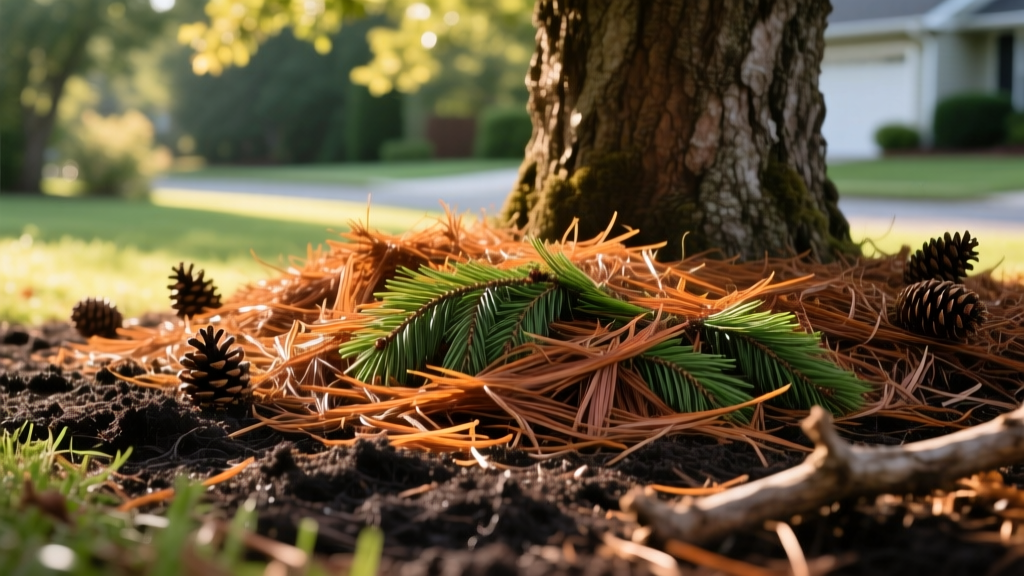
Using Pine Needles as Mulch: Depth, Soil pH Myths, and Tree Benefits
When managing soil moisture and temperature around established trees, the choice of mulch dictates long-term root health. Pine needles—commercially harvested and sold as "pine straw"—are a premier organic mulch for tree care. Unlike fresh, green pine needles which are still attached to the tree, pine straw consists of naturally shed, brown needles that have already undergone initial off-gassing of volatile acids. Their interlocking structure creates a porous, breathable mat that resists compaction, prevents soil crusting, and allows optimal gas exchange for tree roots.
The Soil pH Myth: Do Pine Needles Make Soil Acidic?
The most persistent misconception in landscaping is that applying pine needles as mulch will drastically lower soil pH, making the ground too acidic for most plants. This stems from the fact that fresh, green pine needles have a highly acidic pH (typically between 3.2 and 3.8). However, the chemistry changes entirely once the needles fall, turn brown, and weather on the forest floor.
Science Check: According to soil scientists, brown pine straw has a nearly neutral pH of 6.0 to 6.5. While the decomposition process does release minute amounts of organic acids, the buffering capacity of most mineral soils easily neutralizes this. A 3-inch layer of pine straw will not alter the pH of the underlying soil profile in any measurable way over a single season.
Because pine straw does not acidify the soil, it is safe to use around alkaline-loving trees, neutral-preferring shrubs, and acid-loving plants alike. If you specifically need to lower soil pH for trees like Pin Oaks or Dogwoods, you must use elemental sulfur or aluminum sulfate; pine straw alone will not achieve the required chemical shift.
Pine Needles as Mulch vs. Hardwood Bark: A Data Comparison
Choosing between pine straw and shredded hardwood bark requires analyzing longevity, slope stability, and moisture dynamics. The table below breaks down the performance metrics of common tree mulches based on a standard 3-inch application depth.
| Material | Cost per 100 sq ft | Longevity | Slope Washout Resistance | Moisture Retention |
|---|---|---|---|---|
| Pine Straw | $18 - $24 | 9 - 12 Months | Excellent (Interlocks up to 30% slopes) | High (Permeable, reduces evaporation) |
| Shredded Hardwood | $12 - $18 | 6 - 9 Months | Moderate (Washes away on >15% slopes) | Moderate (Can form hydrophobic crust) |
| Pine Bark Nuggets | $22 - $30 | 24+ Months | Poor (Floats and washes away easily) | Low (Large air gaps allow evaporation) |
While shredded hardwood is initially cheaper, pine straw requires less frequent replenishment. Furthermore, Penn State Extension notes that shredded hardwood mulches can tie up nitrogen in the upper soil layer as they decompose, whereas pine straw decomposes slowly enough that nitrogen immobilization is negligible.
Step-by-Step Application for Tree Health
Improper mulching—often called "volcano mulching"—suffocates root flares and invites fungal pathogens. Follow this precise framework to apply pine needles as mulch correctly:
- Clear the Competing Turf: Use a half-moon edger or a mattock to remove grass in a 3-foot to 5-foot radius around the tree trunk. Do not use a string trimmer, which can girdle the tree bark.
- Expose the Root Flare: Carefully brush away existing soil and old mulch until the root flare (the point where the trunk widens and transitions into roots) is fully visible. The Arbor Day Foundation strictly mandates that the root flare must never be buried.
- Apply the Donut Layer: Spread the pine straw in a uniform layer 2 to 4 inches deep. Stop applying mulch exactly 3 inches away from the tree bark to create a dry "donut hole" that prevents bark rot and rodent habitation.
- Water to Settle: Pine straw is highly buoyant when first applied. Use a garden hose to thoroughly soak the newly laid mulch. This initiates the interlocking process, binding the needles together into a cohesive mat that will resist wind displacement.
When NOT to Use Pine Straw (Edge Cases & Failure Modes)
Despite its benefits, pine needles as mulch are not universally applicable. Avoid pine straw in the following scenarios:
- High-Wind Corridors: Before pine straw settles and interlocks (which takes about two weeks and a few heavy rain events), strong winds can blow the needles across your lawn. In open, windy plains, opt for heavier shredded hardwood or compost.
- Wildfire Interface Zones (WUI): Dried pine straw is highly combustible. If you live in a fire-prone region, maintain a strict 5-foot non-combustible zone (using gravel or bare soil) around your home and trees near structures.
- Heavy Termite Activity: While pine straw is less attractive to subterranean termites than hardwood bark due to its resin content, it is still an organic material that retains moisture. If your property has a known, active termite infestation, keep all organic mulches at least 12 inches away from structural foundations.
Sourcing and Pricing in 2026
Pine straw is typically sold in wire-bound or twine-bound bales weighing between 35 and 45 pounds. In 2026, expect to pay between $7 and $11 per bale at landscape supply yards, depending on your proximity to the Southeastern United States (the primary harvesting region for longleaf and slash pine).
Coverage Math: One standard bale covers approximately 25 to 30 square feet at a 3-inch settled depth. To calculate your required bale count, measure the square footage of your tree rings (Area = π × r²), subtract the trunk area, and divide by 25. Always purchase 10% extra to account for uneven terrain and settling.
Frequently Asked Questions
Do pine needles attract snakes or rodents?
Pine straw does not inherently attract snakes. However, if applied too thickly (over 5 inches) and pushed directly against a tree trunk, it provides cover for voles and mice, which can chew on the tree's bark during winter. Maintaining the 3-inch trunk clearance prevents this issue.
Can I use the pine needles falling from my own yard trees?
Yes, but with a caveat. Freshly fallen needles from your own pines will take longer to settle and may temporarily tie up surface nitrogen if mixed directly into the soil. Use them only as a top-dressing mulch, never as a soil amendment tilled into the root zone.
How often do I need to replenish pine needle mulch?
Inspect your tree rings bi-annually. In most climates, a top-dressing of 1 to 1.5 inches of fresh pine straw is required every 10 to 12 months to maintain the optimal 3-inch total depth and ensure continuous weed suppression.

