
Tree Care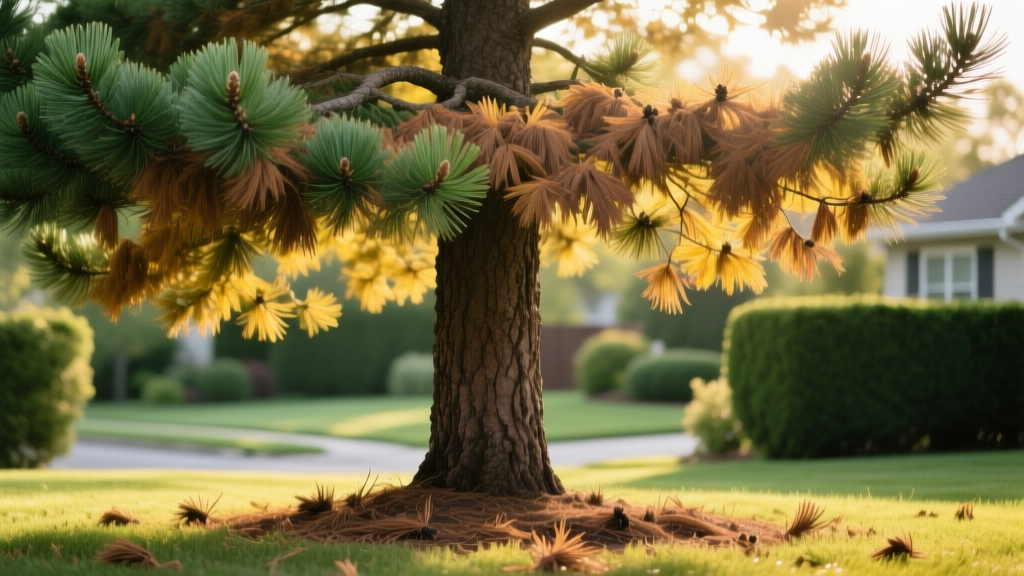
Pine Tree Needles Turning Brown: Diagnosis and Rescue Fixes
The 30-Second Triage: Is Your Pine Tree Dying or Dormant?
When homeowners notice pine tree needles turning brown, the immediate assumption is often a fatal disease or severe drought. However, pines have a natural senescence cycle that mimics pathological decline. Before purchasing fungicides or calling an arborist, perform this rapid visual triage to determine if the browning is a natural seasonal process or an active crisis.
Natural Needle Drop (Senescence)
Pines do not keep their needles forever. Depending on the species, needles live for 2 to 5 years. In autumn, pines will naturally shed their oldest, innermost needles. If the browning is restricted to the interior of the canopy (closest to the trunk) while the outer tips remain vibrant green, your tree is simply undergoing its annual turnover. This typically accounts for 20% to 30% of the total needle mass and requires zero intervention.
Pathological Browning (Active Crisis)
If the browning is occurring at the branch tips (new growth), appearing in isolated patches across the outer canopy, or accompanied by resin bleeding on the bark, you are dealing with an environmental stressor, fungal pathogen, or insect infestation. Tip browning indicates that the vascular system is failing to push water and nutrients to the extremities, requiring immediate diagnosis and treatment.
Diagnostic Matrix: Identifying the Culprit
Use the following matrix to cross-reference your tree's specific symptoms. Accurate identification prevents the misapplication of expensive treatments, such as using insecticides on a fungal issue.
| Symptom Profile | Needle Location | Secondary Signs | Primary Suspect |
|---|---|---|---|
| Uniform browning from tip down | Outer canopy / Branch tips | Brittle needles, dry soil, winter winds | Winter Desiccation (Winter Burn) |
| Brown spots with dark distinct bands | Random across canopy | Tiny black fruiting bodies on dead needles | Dothistroma or Lophodermium Needlecast |
| Yellowing progressing to brown tips | Entire tree or one side | Soil pH above 7.0, compacted clay soil | Iron Chlorosis / Soil Alkalinity |
| Needles covered in white, waxy flecks | Underside of needles | Sooty mold on branches, stunted new growth | Pine Needle Scale (Chionaspis pinifoliae) |
| Rapid browning of entire branches | Lower branches moving upward | Pitch tubes on bark, sawdust at base | Ips Bark Beetles or Pine Wilt Nematode |
Environmental Stressors: Drought, Winter Burn, and Soil pH
Environmental factors are responsible for over 60% of pine browning cases in residential landscapes. Unlike deciduous trees, pines retain their foliage through winter, making them highly susceptible to moisture loss when the ground is frozen.
Winter Desiccation (Winter Burn)
When winter winds strip moisture from pine needles faster than the frozen root system can replace it, the needle tips desiccate and turn brown. This damage often doesn't become visible until early spring. The Fix: Apply an anti-transpirant like Bonide Wilt Stop (approx. $18 per 32oz concentrate) in late November and again in late January. Spray when temperatures are above 40°F to coat the needles in a breathable polymer film, reducing moisture loss by up to 80%. For newly planted pines, wrap the root zone with a 3-inch layer of arborist wood chips to insulate the soil and delay freezing.
Soil Compaction and pH Imbalance
Pines thrive in slightly acidic soil with a pH between 5.0 and 6.5. In new housing developments, builders often leave behind compacted, alkaline subsoil (pH 7.5+). In high-pH soils, iron becomes chemically locked up, leading to iron chlorosis—needles turn pale yellow, then brown at the tips, and eventually drop. The Fix: Conduct a soil test ($15-$30 via your local university extension). If pH is above 7.0, apply Espoma Soil Acidifier (elemental sulfur). Apply 1 lb per 100 square feet of drip-line area to drop the pH by approximately 0.5 points. Combine this with deep-core aeration using a 2-inch soil auger to break up clay compaction and restore oxygen to the mycorrhizal fungi network critical for pine root health.
Fungal Pathogens: Needlecast and Rust Diseases
If your pine tree needles are turning brown and you spot tiny, black, pimple-like structures (fruiting bodies) on the dead needles, you are likely dealing with a fungal needlecast disease. According to the Morton Arboretum, pathogens like Dothistroma pini and Lophodermium seditiosum thrive in wet, humid springs, infecting new needles that then brown out the following year.
Targeted Fungicide Application
Fungicides will not cure already brown, dead needles; they only protect new growth. You must use a preventive approach. Product: Use a Copper Octanoate fungicide (e.g., Bonide Liquid Copper Fungicide, $15-$20) or a Chlorothalonil-based product. Timing: Apply the first spray in mid-spring when new candles (shoots) are half their mature length. Apply a second spray 3 to 4 weeks later. Mixing Rate: Typically 2.0 fl oz of liquid copper per gallon of water. Ensure complete coverage, spraying until the liquid drips from the needles.
⚠️ Sanitation Warning: Fungal spores overwinter in fallen brown needles. You must rake and destroy all dropped needles beneath the tree before applying fungicides. Leaving infected debris on the mulch will render your chemical treatments entirely ineffective, as the spores will simply splash back onto the lower branches during rainstorms.
Insect Pests: Pine Needle Scale and Bark Beetles
Insect damage often presents as browning, but the underlying mechanism is sap depletion or vascular girdling. Pine needle scale appears as tiny white, waxy scales on the needles, sucking chlorophyll and causing the needle to yellow and brown. For severe scale infestations, the Penn State Extension recommends targeting the 'crawler' stage of the insect's life cycle.
The Crawler Stage Treatment
Adult scales are protected by their waxy armor, making systemic insecticides less effective. You must spray when the eggs hatch and the young 'crawlers' are exposed. Timing: This occurs at approximately 250 to 500 Growing Degree Days (GDD) in late spring, often coinciding with the bloom of common lilacs. Treatment: Apply a 2% rate of dormant/summer horticultural oil (e.g., Bonide All Seasons Horticultural Oil). Mix 5 tablespoons per gallon of water. Coat the undersides of the needles thoroughly. Repeat in 7 to 10 days to catch late-hatching crawlers.
If you notice 'pitch tubes' (small globs of white or reddish resin) on the bark alongside rapid, total browning of branches, your tree is under attack by Ips or Southern Pine Beetles. By the time pitch tubes are visible, the tree's vascular system is usually destroyed. According to the USDA Forest Service, preventive trunk sprays with Bifenthrin are the only viable defense; once beetles are inside the bark, removal of the tree is the only option to protect surrounding pines.
The 72-Hour Rescue Protocol for Declining Pines
If your tree is showing active tip browning and you have ruled out natural senescence, execute this immediate rescue protocol to stabilize the root system and halt further decline.
- Hydrate the Deep Root Zone (Hour 1): Surface watering is useless for pines. Attach a Ross Root Feeder ($35) to your garden hose. Insert the spike 12 to 18 inches into the soil at the tree's drip line (the outer edge of the canopy). Inject water for 60 seconds per insertion point, moving every 2 feet in a circle around the tree. This bypasses compacted topsoil and delivers moisture directly to the feeder roots.
- Apply Mycorrhizal Inoculant (Hour 24): Stress depletes the symbiotic fungi that help pine roots absorb water. Drench the root zone with a liquid mycorrhizal product (e.g., Plant Success Orca, $25) mixed at 1 tsp per gallon of water. This accelerates root recovery and nutrient uptake.
- Prune Deadwood with Sterilized Tools (Hour 48): Using bypass pruners, snip off completely brown, dead branch tips. Critical: Wipe your pruner blades with 70% isopropyl alcohol between every single cut. Fungal pathogens and bacterial cankers are easily transmitted via pruning tools, turning a localized issue into a whole-tree infection.
- Mulch and Protect (Hour 72): Apply a 3-inch layer of coarse pine bark mulch from the trunk out to the drip line. Keep the mulch exactly 3 inches away from the trunk flare to prevent root rot. This regulates soil temperature, retains the deep moisture you just applied, and suppresses competing grass weeds that steal water from the pine.
Arborist Insight: Never apply high-nitrogen synthetic fertilizers (like standard lawn fertilizers) to a browning, stressed pine. Pushing rapid, succulent new growth on a compromised root system will drain the tree's remaining carbohydrate reserves and make the new needles highly attractive to aphids and fungal spores. Focus on root hydration and soil biology first; fertilize only after the tree has stabilized and produced healthy new candles the following spring.

