
Tree Care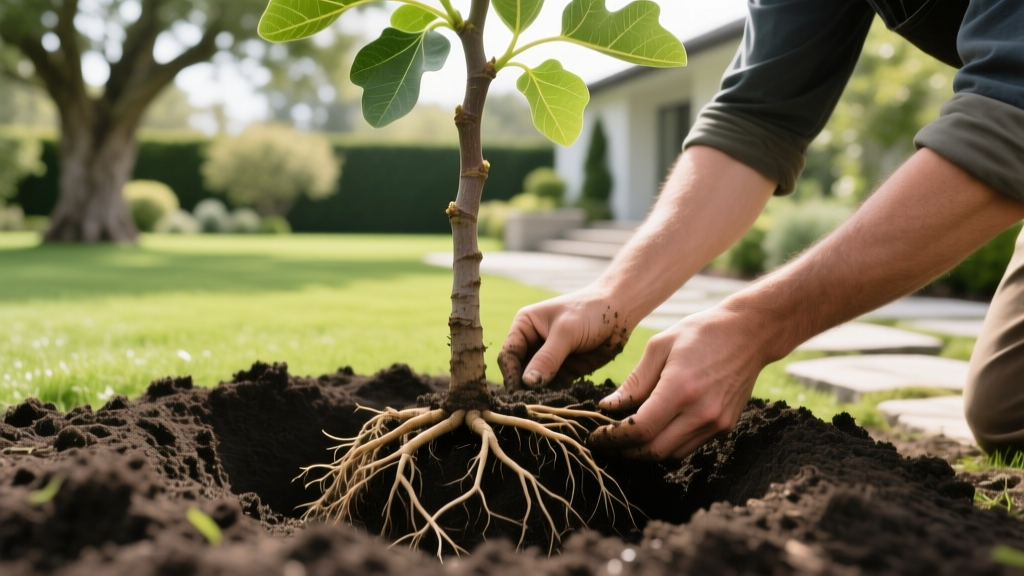
How to Plant a Fig Tree for Maximum Fruit Yield and Root Health
The Anatomy of Fig Tree Establishment
Fig trees (Ficus carica) are notoriously aggressive growers, yet their long-term fruiting capacity and structural integrity are entirely dictated by the first 90 days of establishment. Understanding how to plant a fig tree requires moving beyond basic hole-digging and focusing on root architecture, microclimate thermal mass, and soil drainage dynamics. According to the Clemson University Home & Garden Information Center, improper planting depth and poor soil drainage are the primary catalysts for Phytophthora root rot, which can kill a young fig before it produces its first breba crop.
This guide provides a precise, data-driven framework for establishing fig trees in both in-ground and container environments, tailored for USDA Hardiness Zones 6 through 9, with specific overwintering protocols for colder zones.
Bare-Root vs. Potted Fig Trees: Procurement Metrics
Before breaking ground, you must select the right nursery stock. The decision between bare-root and potted figs impacts your planting window, initial cost, and root preparation requirements.
| Attribute | Bare-Root (Dormant) | Potted (5-Gallon Nursery) |
|---|---|---|
| Average Cost | $25 - $40 | $55 - $85 |
| Planting Window | Late winter to early spring (pre-bud break) | Spring or early fall (avoid peak summer heat) |
| Root Preparation | Soak in water for 12-24 hours; prune damaged tips | Aggressive outer root shaving required to prevent girdling |
| Establishment Speed | Slower initial top growth; focuses on root expansion | Faster top growth; higher risk of transplant shock if root-bound |
Step-by-Step: How to Plant a Fig Tree In-Ground
Step 1: Microclimate and Spacing Geometry
Figs thrive in full sun (minimum 8 hours of direct light), but in marginal climates (Zones 6 and 7a), microclimate selection is critical for winter survival. Plant the tree 12 to 18 inches away from a south-facing or southwest-facing brick or stone wall. This wall acts as a thermal mass, absorbing solar radiation during the day and radiating heat at night, effectively raising the localized hardiness zone by half a step.
For standard, multi-trunk bush formations, space fig trees 15 to 20 feet apart. If you are training the tree as an espalier against a fence or wall, reduce spacing to 8 to 10 feet. According to the University of Florida IFAS Extension, restricting lateral space naturally limits vegetative vigor, pushing the tree to allocate energy into fruit production rather than excessive canopy growth.
Step 2: The Root Shaving Protocol (Crucial for Potted Trees)
Nursery-grown figs develop dense, circling roots that will eventually strangle the main trunk if left uncorrected. Remove the tree from its 5-gallon pot and use a sterilized hori hori knife or pruning saw to shave off the outer 1 inch of the root ball on all sides and the bottom. This severs circling roots and stimulates the growth of new, outward-facing feeder roots.
Step 3: Excavation and the Bathtub Effect Warning
Dig a hole that is exactly as deep as the root ball, but 2.5 times as wide. In heavy clay soils, rough up the sides of the hole with a digging fork to prevent glazing, which creates an impermeable barrier that traps water.
Critical Warning: The Bathtub Effect
Never amend the backfill soil with heavy compost, peat moss, or manure when planting in-ground figs in clay-heavy soils. Amending the hole creates a textural interface where water pools in the loose, amended soil rather than draining into the surrounding native clay. This drowns the roots and invites fatal fungal pathogens. Always backfill with the native soil you excavated.
Never amend the backfill soil with heavy compost, peat moss, or manure when planting in-ground figs in clay-heavy soils. Amending the hole creates a textural interface where water pools in the loose, amended soil rather than draining into the surrounding native clay. This drowns the roots and invites fatal fungal pathogens. Always backfill with the native soil you excavated.
Step 4: Setting the Root Flare
Locate the root flare—the point where the trunk widens and transitions into the root system. The root flare must sit 1 to 2 inches above the surrounding grade. Soil settles over time; if you plant the flare flush with the ground today, it will sink below grade within six months, leading to basal stem rot. Backfill the hole in 3-inch increments, tamping down firmly with your boot to eliminate air pockets.
Container Planting Framework for Cold Climates (Zones 4-6)
In regions where winter temperatures routinely drop below 10°F, in-ground planting is a liability. Container cultivation allows you to move cultivars like 'Chicago Hardy' or 'Brown Turkey' into an unheated garage or basement during dormancy. The goal of container fig culture is intentional root restriction, which dwarfs the canopy and accelerates fruiting.
The 3-Part Potting Matrix
Standard potting soil retains too much moisture and breaks down into sludge within two seasons. Mix a custom, highly aerated substrate using the following ratio by volume:
- 33% Pine Bark Fines: Provides long-term structure and slow-release acidity.
- 33% Coarse Perlite (Horticultural Grade): Ensures rapid drainage and oxygenation.
- 34% Sphagnum Peat Moss or Coco Coir: Retains necessary moisture and nutrients.
Start with a 5-gallon container (e.g., a fabric smart pot, which costs roughly $12 and air-prunes the roots naturally). Upgrade to a 15-gallon container in year three. A 15-gallon fabric pot restricts the root mass just enough to keep the tree at a manageable 6-foot height while still yielding 15 to 20 pounds of fruit annually.
Post-Planting Hydration and Mulching Matrix
Figs are drought-tolerant once established, but the first 90 days require a strict hydration schedule to push roots into the surrounding native soil. Apply a 3-inch layer of arborist wood chips over the root zone, keeping the mulch exactly 4 inches away from the trunk to prevent collar rot.
| Timeframe | Watering Frequency | Volume per Session | Application Method |
|---|---|---|---|
| Days 1 - 14 | Every 2 days | 2 - 3 gallons | Slow trickle directly at the base |
| Days 15 - 45 | Twice per week | 4 - 5 gallons | Wider radius to encourage outward root growth |
| Days 46 - 90 | Once per week | 5 - 8 gallons | Deep soak covering the entire mulched drip line |
Common Establishment Failures and Diagnostic Fixes
Even with precise planting, environmental variables can disrupt establishment. Monitor your tree for these specific failure modes during the first growing season:
- Root-Knot Nematodes (Meloidogyne spp.): If the tree exhibits stunted growth and yellowing leaves despite adequate water, excavate a small section of feeder roots. If you see distinct, bead-like galls on the roots, nematodes are present. Fix: There is no chemical cure for home growers. Remove the tree, solarize the soil with clear 6-mil plastic for 6 weeks during peak summer, and replant with a nematode-resistant rootstock like 'LSU Purple'.
- Frost Heave in Young Trees: In late winter, freezing and thawing cycles can push shallow-rooted bare-root figs out of the soil, exposing the crown. Fix: Firmly press the tree back into place and mound 6 inches of soil over the base for the first winter. Remove the mound in spring once the soil warms to 55°F.
- Excessive Vegetative Vigor (No Fruit): If your tree grows 4 feet in a single season but produces zero figs, you have likely over-fertilized with nitrogen or planted in soil that is too rich. Fix: Stop all fertilization. Fig trees require very little nitrogen; excess nitrogen forces the tree to produce leaves at the expense of fruit bud initiation.

