Tree Care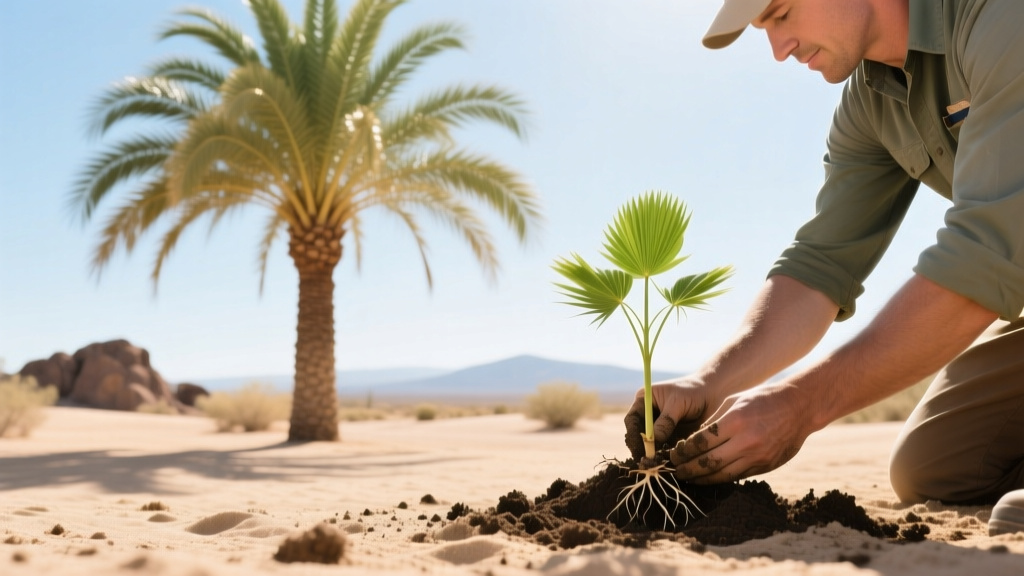
How to Plant and Maintain an Arizona Palm Tree: A Complete Guide
Understanding the 'Arizona Palm' Species Profile
When homeowners refer to an 'arizona palm tree,' they are typically talking about one of two iconic *Washingtonia* species that dominate the desert landscapes of Phoenix, Tucson, and surrounding valleys. While they share similar silhouettes, their physiological needs and mature dimensions differ significantly. Selecting the right species for your specific microclimate is the first critical step in long-term desert landscaping success.
Species Breakdown: Filifera vs. Robusta
- California Fan Palm (*Washingtonia filifera*): The only palm native to the Southwest. It features a thicker, grayish trunk, a shorter mature height (40-50 feet), and higher tolerance for the extreme alkalinity and frost pockets found in higher-elevation Arizona zones like Prescott.
- Mexican Fan Palm (*Washingtonia robusta*): The most widely planted urban palm in Maricopa County. It grows much faster, reaching 80-100 feet, with a distinctly thinner, reddish-brown trunk that often leans gracefully. It is slightly more sensitive to prolonged freezes below 22°F.
Step-by-Step Planting Protocol for Arid Caliche Soils
The greatest threat to a newly installed palm in Arizona is not the heat; it is the soil structure. Much of the state's urban soil contains 'caliche'—a rock-hard layer of calcium carbonate that prevents drainage and root penetration. Failing to address caliche during installation will result in root girdling and eventual toppling during monsoon winds.
- Test for Caliche: Dig a test hole 2 feet deep. Fill it with water. If the water does not drain within 12 hours, you have struck a caliche pan.
- Excavate and Fracture: Dig your planting hole exactly as deep as the root ball, but 2 to 3 times as wide. If you hit caliche, you must use a rotary hammer drill or a pickaxe to fracture the hardpan layer at the bottom and sides of the hole to allow water escape.
- Avoid the 'Bathtub Effect': Do not amend the backfill soil with heavy compost or peat moss. If you surround a palm root ball with highly organic soil in a caliche bowl, the organic matter holds water like a sponge, rotting the roots. Backfill with the native soil you excavated, mixing in no more than 10% organic compost.
- Set the Grade: Plant the palm so the root flare sits exactly at or 1 inch above the surrounding grade. Planting an arizona palm tree too deep suffocates the adventitious root zone and invites fatal *Phytophthora* root rot.
Beating Iron Chlorosis in High-pH Alkaline Dirt
Arizona soils routinely test at a pH of 7.8 to 8.5. At this alkalinity, iron becomes chemically locked up and unavailable to the palm's roots, resulting in severe iron chlorosis (yellowing of new fronds while veins remain green). Standard hardware-store iron sulfates will instantly bind to the calcium in your soil and become useless.
The EDDHA Solution
To cure chlorosis in high-pH soils, you must use Fe-EDDHA chelated iron (often sold under brand names like Sequestraene 138 or Miller's FerriPlus). Unlike EDTA chelates, EDDHA remains stable and bioavailable in soils with a pH up to 9.0. Expect to pay between $45 and $65 per pound for commercial-grade Fe-EDDHA as of 2026. Apply 1 to 2 ounces per inch of trunk diameter, dissolving it in water and drenching the root zone in early spring before the summer heat spike.
For general maintenance, use a specialized palm fertilizer with an N-P-K-Mg ratio of 8-2-12-4. The high potassium and magnesium levels are non-negotiable for preventing 'frizzle top' and necrotic spotting on older fronds. According to research published by the University of Arizona College of Agriculture and Life Sciences, broadcast application of this specific ratio at 1.5 pounds per 100 square feet of canopy area, three times a year (March, May, September), yields optimal desert growth.
Seasonal Watering Matrix: Drip Irrigation Standards
Overwatering is a primary killer of established desert palms. Palms require deep, infrequent soakings that push water down to a depth of 24 to 36 inches to encourage drought-resistant taproots. Shallow, daily watering creates a weak, surface-level root mat that will fail during high-wind haboobs.
| Season | Frequency | Emitter Setup (2 GPH) | Target Soil Depth |
|---|---|---|---|
| Winter (Dec-Feb) | Every 21-28 days | 4 emitters at 3ft radius | 24 inches |
| Spring (Mar-May) | Every 14 days | 6 emitters at 4ft radius | 30 inches |
| Summer (Jun-Sep) | Every 7-10 days | 8 emitters at 5ft radius | 36 inches |
| Fall (Oct-Nov) | Every 14-21 days | 6 emitters at 4ft radius | 30 inches |
Note: Always run a soil probe 24 hours after a watering cycle to verify you are reaching the target depth. Adjust run-times based on your specific soil clay content.
Pruning Protocol: Avoiding the Fatal 'Hurricane Cut'
Many commercial landscaping services in Arizona severely over-prune palms, stripping them down to a few upright fronds in a shape resembling a mohawk. Known in the industry as a 'hurricane cut' or 'pencil point,' this practice is highly detrimental to the tree's health.
WARNING: The Dangers of Over-Pruning
Removing green fronds starves the palm of essential carbohydrates and potassium. Furthermore, the International Society of Arboriculture warns that severe over-pruning exposes the sensitive central meristem (the 'spear') to extreme sun scald and invites the devastating South American Palm Weevil. Never remove fronds that are above the horizontal plane.
Removing green fronds starves the palm of essential carbohydrates and potassium. Furthermore, the International Society of Arboriculture warns that severe over-pruning exposes the sensitive central meristem (the 'spear') to extreme sun scald and invites the devastating South American Palm Weevil. Never remove fronds that are above the horizontal plane.
The '9 o'clock to 3 o'clock' Rule
When pruning your arizona palm tree, visualize the canopy as a clock face. Only remove dead, brown fronds, or green fronds that are hanging below the 9 o'clock and 3 o'clock horizontal positions. The upward-pointing and horizontal green fronds must remain intact to photosynthesize and protect the central growing bud from the brutal July UV index.
2026 Cost Breakdown: Procurement and Installation
Budgeting for a mature palm installation requires factoring in heavy equipment and specialized transport. Prices below reflect current 2026 market rates for the Phoenix metropolitan area:
- 15-Foot *Washingtonia robusta* (Mexican Fan Palm): $250 – $400 for the specimen.
- 25-Foot *Washingtonia filifera* (California Fan Palm): $600 – $900 (native species command a premium due to slower growth rates).
- Delivery and Crane Service: $350 – $600. Palms over 12 feet require a boom truck or crane to lift over walls and avoid damaging the trunk with chains.
- Labor and Soil Amendments: $200 – $400 for a two-person crew to dig, fracture caliche, set the grade, and install the initial drip irrigation ring.
- Total Installed Cost: Expect to pay between $800 and $1,200 per tree for a standard 15-foot specimen, fully planted and irrigated.
By respecting the unique alkaline soil chemistry and adhering to deep-watering principles, your desert palm will establish a robust root system capable of thriving in the arid Southwest for decades.