
Tree Care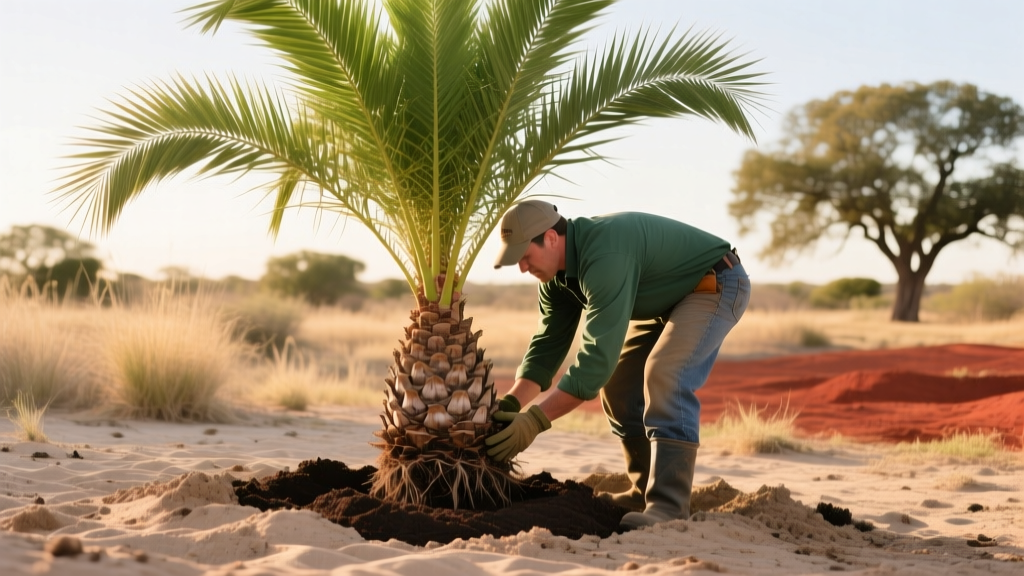
Planting Palm Trees in Texas: A Regional Seasonal Timing Guide
Texas spans a massive geographical area with drastically different microclimates, making a single "best time to plant" rule impossible. While the USDA Plant Hardiness Zone Map classifies the state anywhere from Zone 6b in the Panhandle to Zone 10a in the Lower Rio Grande Valley, viable palm cultivation is generally restricted to Zones 8a through 10a. The success of your palm installation hinges entirely on aligning your planting schedule with local soil temperatures and regional frost dates.
Planting a palm too early in cold soil stalls root initiation, leaving the tree vulnerable to being uprooted by severe spring thunderstorms. Planting too late exposes the transplant to extreme August heat before the root ball can establish adequate water uptake. This guide provides a precise, zone-by-zone seasonal calendar and the exact soil protocols required for Texas landscapes in 2026.
The Texas Climate Matrix: Matching Palms to Hardiness Zones
Before consulting the calendar, you must select a species capable of surviving your specific zone's absolute minimum winter temperatures. The Texas A&M Forest Service emphasizes matching tree species to local hardiness as the primary defense against winter kill.
| Region / Zone | Avg. Winter Low | Recommended Palm Species | Cold Hardiness Rating |
|---|---|---|---|
| North TX (Zone 8a) | 10°F to 15°F | Windmill (Trachycarpus fortunei), Dwarf Palmetto (Sabal minor) | High (Survives brief dips to 5°F) |
| Central TX (Zone 8b/9a) | 15°F to 25°F | Pindo (Butia odorata), Sabal (Sabal mexicana) | Moderate-High |
| Gulf Coast (Zone 9a/9b) | 20°F to 30°F | Queen (Syagrus romanzoffiana), Date (Phoenix dactylifera) | Moderate |
| South TX (Zone 10a) | 30°F to 35°F | Royal (Roystonea regia), Coconut (Cocos nucifera) | Low (Frost tender) |
Seasonal Timing: The Regional Planting Calendar
The golden rule for palm transplantation is that soil temperature at a 6-inch depth must consistently read above 65°F. Palms are monocots; they do not generate new root tissue from old, severed roots. They must push entirely new roots from the root initiation zone at the base of the trunk. This biological process halts completely in cold soil.
North Texas (Dallas/Fort Worth Metroplex): Mid-April to Late May
In Zone 8a, the threat of late spring freezes persists through March. Wait until the second week of April to begin planting. This window provides 6 to 8 weeks of moderate temperatures (75°F–85°F) before the brutal July heat sets in. Windmill palms are your safest bet here, but they still require the full 60-day establishment window before summer drought stress.
Central Texas (Austin/San Antonio): Late March to Mid-May
Zone 8b and 9a experience faster soil warming. Target the window between March 25 and May 15. Pindo palms and the Texas-native Sabal mexicana thrive when planted in this corridor. Avoid planting after June 1; the combination of 100°F+ ambient temperatures and high evapotranspiration rates will desiccate a newly planted palm before its vascular system can adapt.
Gulf Coast & South Texas: Early March to Late April
For Houston, Corpus Christi, and the Rio Grande Valley, the planting window shifts earlier. March 1 to April 30 is ideal. The high humidity of the Gulf Coast aids in frond hydration, but the heavy, poorly draining clay soils common in Houston require aggressive soil amendment (detailed below) to prevent root rot during heavy spring rains.
⚠️ WARNING: The Late Summer Trap
Nurseries often discount palm trees heavily in late July and August to clear inventory. Do not buy and plant these trees. A palm planted in August in Texas will suffer severe transplant shock, frond burn, and highly likely mortality. The root system cannot establish fast enough to support the canopy's water demands during peak summer evaporation. Wait for the following spring.
Soil Preparation Protocols for Texas Geology
Texas soils present unique challenges. The Blackland Prairie features heavy, alkaline clay that suffocates palm roots, while the Hill Country features shallow caliche rock. You cannot simply dig a hole and drop the root ball in; doing so creates a "bathtub effect" where water pools in the loose backfill and drowns the palm.
The Anti-Bathtub Planting Method
- Dig Wide, Not Deep: Excavate a hole exactly as deep as the root ball, but three times as wide. The root initiation zone must sit exactly at grade or 1 inch above grade. Never bury the trunk.
- Scarify the Walls: Use a pickaxe to aggressively scratch and break up the smooth, compacted clay walls of the planting hole. This allows new roots to penetrate the native soil rather than circling inside the hole.
- The 50/30/20 Backfill Mix: Do not use 100% native clay. Mix 50% native soil, 30% coarse builder's sand (never fine play sand, which compacts), and 20% pine bark compost. For highly alkaline soils (pH > 7.5), substitute 10% of the mix with elemental sulfur to lower the pH.
- Avoid Blind Amendments: Always run a soil test through the Texas A&M AgriLife Extension before adding chemical pH adjusters. Palms are highly sensitive to manganese toxicity in artificially acidified soils.
2026 Installation Cost Breakdown
Budgeting for a palm installation requires factoring in species rarity, trunk height, and the heavy equipment needed for transport. Prices below reflect Q1 2026 nursery and landscaping averages in the Texas market.
| Item / Service | Specifications | Estimated Cost (2026) |
|---|---|---|
| Windmill Palm | 15-gallon container, 4-5 ft trunk | $180 - $260 |
| Sabal Mexicana | 30-gallon container, 6-8 ft trunk | $450 - $750 |
| Pindo Palm | Field-grown, balled & burlapped, 10 ft | $900 - $1,400 |
| Crane / Equipment Fee | Required for field-grown over 8 ft | $350 - $600 per half-day |
| Professional Labor | Certified arborist/landscaper install | $85 - $135 per hour |
Field-Grown vs. Container-Grown: Which Should You Choose?
When sourcing palms from Texas or Florida wholesalers, you will encounter two distinct cultivation methods. Understanding the difference dictates your watering schedule and survival expectations.
- Container-Grown: Grown in plastic pots from a young age. These palms have a dense, circling root system confined to the pot. Advantage: Lighter, easier to plant without heavy machinery, cheaper. Disadvantage: You must manually shave the outer 1 inch of the root ball with a pruning saw before planting to sever circling roots, otherwise, the palm will eventually girdle itself and die 3 to 5 years post-planting.
- Field-Grown (Balled and Burlapped): Dug directly from nursery soil. Advantage: Larger, more mature specimens available; roots are naturally structured. Disadvantage: Up to 70% of the root system is severed during the digging process. These palms require aggressive canopy reduction (removing 50% of the lower fronds) at the time of planting to balance the lost root mass, and they require heavy staking for a minimum of 14 months.
Post-Planting Care: The Critical First 90 Days
The first three months dictate the long-term structural integrity of the palm. Follow this strict protocol:
Watering Metrics
For the first 30 days, apply 15 to 20 gallons of water directly to the root ball every 48 hours. Use a slow-drip soaker hose coiled tightly around the base of the trunk. From days 31 to 60, reduce frequency to twice a week. From days 61 to 90, transition to a deep, once-weekly soaking to encourage roots to chase moisture downward into the native Texas soil.
Nutritional Support
Do not apply standard lawn fertilizer (high nitrogen, low potassium) to a newly planted palm. Texas soils are notoriously deficient in magnesium and potassium. Apply a specialized palm fertilizer with an NPK ratio of 8-2-12-4 (the final number representing 4% Magnesium). Apply 1 tablespoon per square foot of canopy spread, broadcasting it evenly under the drip line, and water it in immediately. Wait 6 weeks after planting before the first fertilizer application to avoid burning the delicate new root tips.
Structural Guying
Any palm with a trunk height exceeding 8 feet must be stabilized. Do not drive stakes directly into the root ball. Instead, use a 3-point guy-wire system. Wrap the trunk in burlap to protect the bark, attach three aircraft cables, and anchor them to the ground at a 45-degree angle, 6 feet away from the trunk. Leave the guys in place for 12 to 18 months until the palm cannot be rocked by hand.

