
Tree Care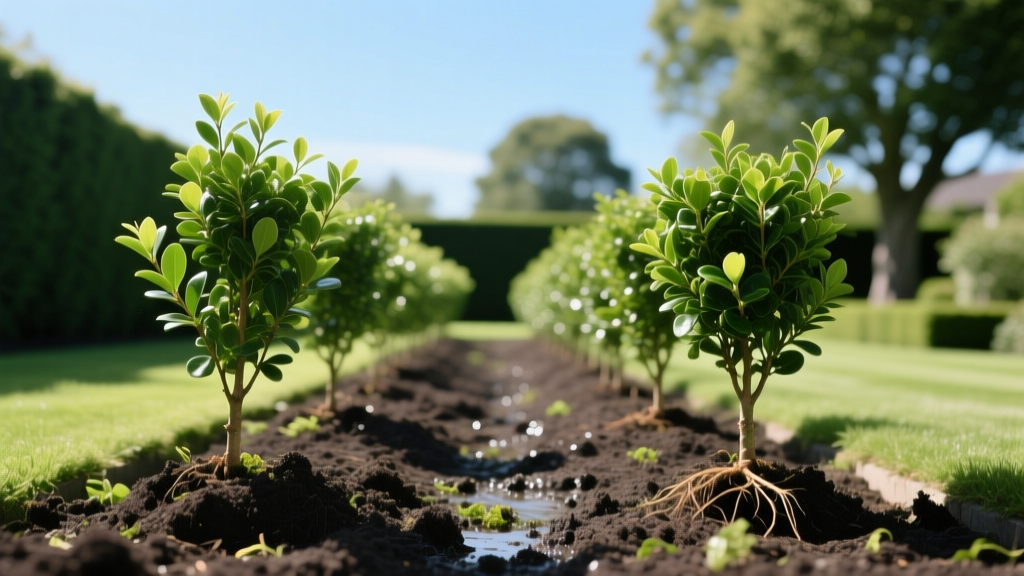
Planting Quick Growing Hedges for Privacy: Spacing & Soil
The Biological Reality of Fast Privacy Screens
When homeowners search for quick growing hedges for privacy, they are often sold an illusion of instant seclusion. While certain species can add 3 to 5 feet of vertical growth annually, achieving a dense, impenetrable visual barrier requires precise establishment techniques. Planting a hedge is not simply digging holes and dropping in nursery pots; it is an exercise in applied mathematics, soil hydrology, and long-term canopy management. In 2026, with 15-gallon nursery stock for premium privacy cultivars ranging from $95 to $160 per plant, avoiding establishment failures is critical for your budget and your property line.
The most common failure mode in rapid-growth hedges is the "overcrowding trap." Homeowners space plants too closely to force an immediate screen, which leads to severe root competition, inner-canopy dieback from light deprivation, and catastrophic fungal outbreaks due to zero airflow. This guide provides the exact agronomic protocols for selecting, spacing, and establishing a high-performance privacy hedge.
Top Species for Rapid Privacy Screens
Not all fast growers are created equal. Leyland Cypress (x Cuprocyparis leylandii) was once the industry standard, but its extreme susceptibility to Seiridium canker and root rot has led the Clemson Home & Garden Information Center to recommend alternatives for humid climates. Below is a comparison matrix of the most reliable rapid-growth species available today.
| Species / Cultivar | Avg. Annual Growth | Mature Height | USDA Zones | Primary Vulnerability |
|---|---|---|---|---|
| Thuja 'Green Giant' | 3 - 4 ft | 40 - 60 ft | 5 - 7 | Bagworms, winter desiccation |
| Prunus 'Schipkaensis' (Skip Laurel) | 2 - 3 ft | 10 - 15 ft | 6 - 9 | Shot hole fungus, scale insects |
| Bambusa multiplex 'Alphonse Karr' | 3 - 5 ft | 25 - 30 ft | 8 - 11 | Freezing below 25°F, mites |
| Juniperus 'Spartan' | 1 - 2 ft | 15 - 20 ft | 4 - 9 | Phomopsis blight, cedar-apple rust |
For most temperate climates (Zones 5-7), Thuja 'Green Giant' remains the undisputed champion. According to NC State Extension, this hybrid exhibits superior resistance to leaf blight and tolerates a wider range of soil pH levels than traditional arborvitae.
The Mathematics of Hedge Spacing
To calculate the optimal spacing for a dense privacy screen, use the Mature Width / 2 Rule. If a cultivar's listed mature width is 12 feet, space the center of each trunk 6 feet apart. This allows the lateral branches to interlock perfectly within 24 to 36 months without choking the root systems.
Warning: The Overcrowding Trap
Never space 'Green Giant' arborvitae closer than 4 feet on center. Spacing them 2 feet apart will yield a solid screen in year one, but by year three, the overlapping root zones will exhaust the localized soil nutrients, and the lack of lateral airflow will create a microclimate ideal for Cercospora needle blight.
Trench Planting vs. Individual Holes
For hedges exceeding 50 linear feet, continuous trench planting is vastly superior to digging individual holes. A continuous trench creates a uniform moisture zone and allows lateral roots to expand without hitting the compacted walls of isolated clay pockets.
Step-by-Step Trenching Protocol
- Mark and Cut: Use a string line and marking paint to outline a trench exactly 24 inches wide. Cut the sod along the lines with a flat spade.
- Excavation Depth: Dig to a depth of 18 inches for standard 15-gallon nursery pots. The root flare of the plant must sit exactly 1 inch above the surrounding grade to prevent crown rot.
- Break the Hardpan: Use a digging fork to fracture the compacted clay at the bottom of the trench to a depth of 6 inches. This ensures deep drainage and encourages downward root anchoring.
- The 80/20 Backfill Rule: Do not fill the trench with 100% compost or potting soil. This creates a "bathtub effect" where water pools in the loose soil and drowns the roots. Mix 80% native excavated soil with 20% finished compost.
- Root Preparation: Before placing the plants, use a utility knife to make four vertical slices down the sides of the root ball, and an X across the bottom. This severs circling nursery roots that will eventually girdle and strangle the trunk.
First-Year Establishment Watering Protocol
Hand-watering a 100-foot hedge is unsustainable and usually results in uneven moisture distribution. Install a dedicated drip irrigation zone before applying mulch.
- Emitter Spacing: Use 1-gallon-per-hour (GPH) pressure-compensating emitters spaced every 12 inches along a 1/2-inch poly tubing mainline.
- Watering Schedule: For the first 90 days, run the system for 45 minutes every other day. This delivers roughly 0.75 gallons per emitter, pushing water deep into the 18-inch root zone.
- The Mulch Donut: Apply 2 to 3 inches of double-shredded hardwood mulch over the drip lines. Crucially, keep the mulch at least 3 inches away from the actual trunks. Mulch piled against the bark (volcano mulching) invites pathogenic fungi and rodent girdling.
Pruning for Density: The A-Frame Technique
A common mistake with quick growing hedges is shearing them into a flat-topped rectangle. This shades out the lower branches, causing the bottom third of the hedge to turn brown and die back within two seasons. Always prune your hedge into an A-frame or trapezoid shape. The base of the hedge should be 6 to 12 inches wider than the top. This geometry ensures that sunlight reaches the lowest lateral branches, maintaining a thick, green screen all the way to the soil line.
Fertilization Timing
Do not fertilize at the time of planting; nursery root balls already contain sufficient slow-release prills. In the spring of the second year, apply a granular 16-4-8 slow-release fertilizer at a rate of 3 pounds per 100 square feet of bed area. Broadcast it evenly under the drip line and water it in immediately to prevent nitrogen burn on the foliage.
Frequently Asked Questions
How fast will a 15-gallon 'Green Giant' reach 15 feet tall?
Assuming optimal soil prep, consistent drip irrigation, and an annual spring fertilization, a 15-gallon 'Green Giant' (which typically starts at 8-10 feet tall) will reach a solid 15-foot privacy screen in approximately 18 to 24 months.
Can I plant a privacy hedge over a septic drain field?
No. Fast-growing privacy species like arborvitae and willows have aggressive, moisture-seeking root systems that will infiltrate and destroy septic distribution pipes. If you must screen a drain field, use shallow-rooted ornamental grasses or a trellis with annual climbing vines.
Why are the interior needles of my newly planted hedge turning brown?
Interior needle drop is often a natural shedding process as the plant redirects energy to the outer canopy. However, if the browning is accompanied by webbing or small brown cone-like structures, you likely have a bagworm infestation. Treat immediately with a Btk (Bacillus thuringiensis var. kurstaki) biological spray while the larvae are young.

