
Tree Care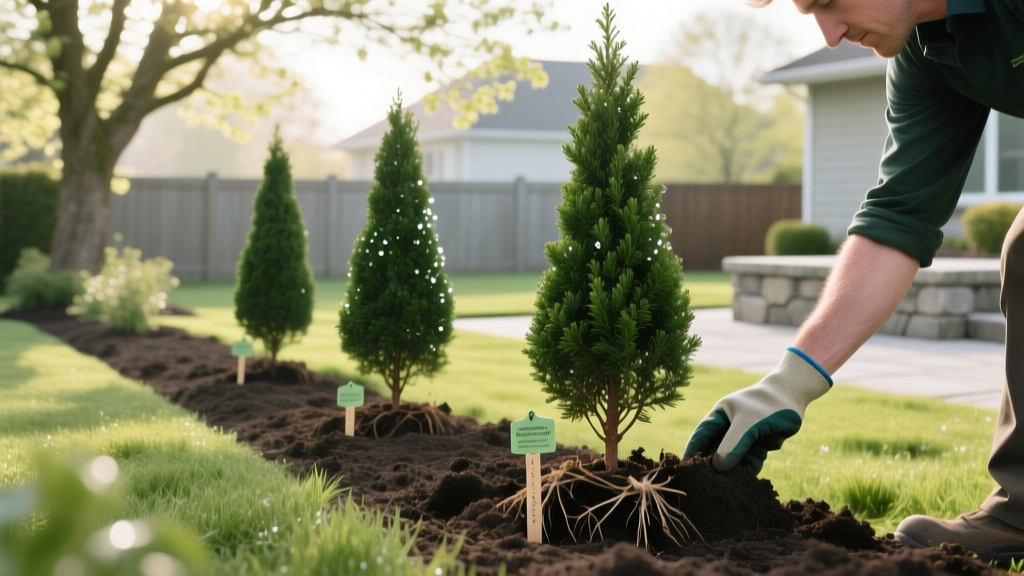
How to Plant and Space Thuja Green Giant Privacy Trees Correctly
Why Thuja Green Giants Dominate Privacy Landscaping
The Thuja standishii x plicata ‘Green Giant’ is the undisputed heavyweight of fast-growing evergreen screens. Capable of adding 3 to 5 feet of vertical growth annually under optimal conditions, these hybrids reach mature heights of 40 to 60 feet with a 12- to 18-foot spread. Unlike Leyland Cypress, Green Giants exhibit superior resistance to Cercospora needle blight and tolerate heavy snow loads without splitting. However, their aggressive growth habit and massive mature root systems mean that improper planting or overly tight spacing will lead to stunted growth, disease, and premature dieback. This guide provides the exact arboricultural protocols for installing Thuja Green Giant privacy trees to ensure rapid establishment and long-term vigor.
⚠️ CRITICAL WARNING: Overhead and Underground Hazards
Never plant Green Giants within 20 feet of overhead power lines. Their mature height of 60 feet will inevitably breach utility easements, resulting in aggressive municipal pruning that destroys the tree's natural pyramidal form. Additionally, call 811 to mark underground utilities before digging, as their lateral root systems will aggressively seek out and infiltrate cracked septic or irrigation lines.
Pre-Planting Site Assessment and Soil Percolation
Green Giants thrive in full sun to partial shade (minimum 6 hours of direct sunlight) and require well-draining soil with a pH between 5.5 and 7.0. Before purchasing your trees, you must verify soil drainage to prevent Phytophthora root rot, the number one killer of newly planted arborvitae.
The 4-Hour Percolation Test
- Dig a test hole 12 inches deep and 12 inches wide in your planned planting zone.
- Fill the hole completely with water and let it drain overnight to saturate the surrounding soil.
- Refill the hole to the top and measure the water level.
- The water must drop at least 1 inch per hour. If the hole does not fully drain within 4 hours, your soil is heavily compacted or clay-dominant. You will need to plant the trees slightly above grade (mounded) or install French drains before proceeding.
The Exact Spacing Matrix for Thuja Green Giants
Nursery tags often recommend spacing these trees 5 to 6 feet apart. While this creates a solid wall of foliage in 24 months, it forces the trees to compete fiercely for water and nutrients, ultimately restricting their mature width and increasing susceptibility to spider mites due to poor air circulation. Use the matrix below to choose your spacing based on your timeline and budget.
| Privacy Timeline | Spacing Distance | Trees per 100 Linear Ft | Est. 2026 Material Cost* |
|---|---|---|---|
| Immediate (1-2 Years) | 5 to 6 feet | 17 to 20 | $1,100 - $1,900 |
| Balanced (3-4 Years) | 8 feet | 13 | $845 - $1,235 |
| Long-Term Health (5+ Years) | 12 to 15 feet | 7 to 9 | $455 - $855 |
*Cost estimates based on 2026 nursery pricing for 5-to-6-foot balled-and-burlapped (B&B) specimens ($65–$95 each). Container-grown 4-foot trees average $45–$75.
Step-by-Step Planting Protocol: Avoiding the Bathtub Effect
The most common cause of Green Giant failure is the "bathtub effect." This occurs when a tree is planted in a hole amended with loose, rich compost, surrounded by dense native clay. Water pools in the loose backfill, drowning the roots. Follow these steps to ensure proper establishment.
Step 1: Digging and Sizing the Hole
Dig a hole that is 2.5 times wider than the root ball, but exactly the same depth. The goal is to provide loose soil for lateral root expansion while keeping the tree sitting on undisturbed, solid earth at the bottom to prevent sinking.
Step 2: Locating the Root Flare
Before placing the tree, brush away the top layer of soil from the root ball until you find the root flare—the exact point where the trunk widens and transitions into roots. If the trunk looks like a telephone pole going straight into the dirt, it is planted too deep. The root flare must sit 1 to 2 inches above the surrounding grade to allow for soil settling.
Step 3: Root Preparation
- For B&B Trees: Cut away all synthetic burlap and wire baskets. Natural burlap can be left in the hole but must be pulled away from the top third of the root ball.
- For Container Trees: Use a sterilized utility knife to shave off the outer 1 inch of the root ball. This severs circling roots that will eventually girdle and strangle the tree as it matures.
Step 4: Backfilling and Mulching
Backfill the hole using only the native soil you just dug out. Do not mix in potting soil or heavy compost. Tamp the soil gently with your boot to eliminate large air pockets, then water deeply to settle it. Apply a 2- to 3-inch layer of shredded hardwood mulch in a "donut" shape, keeping the mulch at least 3 inches away from the trunk to prevent bark rot and rodent damage.
First-Year Watering and Fertilization Regimen
Newly planted Thuja Green Giants lack the established root mass to draw moisture from deep soil profiles. During the first growing season, they require exactly 1 to 1.5 inches of water per week. In practical terms, this means applying 5 to 10 gallons of water per tree, twice a week, using a slow-drip method or a soaker hose left on for 45 minutes.
Arborist Tip: Avoid high-nitrogen liquid fertilizers in the first year. Instead, apply a slow-release granular fertilizer with an NPK ratio of 12-4-8 or 10-8-6 (such as Osmocote or Espoma Tree-tone) in early spring, broadcasting it evenly from the trunk out to the drip line at a rate of 1 cup per inch of trunk caliper.
Pest Defense and Winterizing Strategies
While Green Giants are robust, they are not immune to environmental stress and specific pests. According to the University of Minnesota Extension, winter desiccation and bagworms are the primary threats to arborvitae health in temperate zones.
Winterizing (Zones 5 and Colder)
Evergreens continue to lose moisture through their stomata during winter, even when the ground is frozen. To prevent fatal winter burn:
- Water the trees deeply in late November before the ground freezes.
- Apply an anti-desiccant spray (like Wilt Stop) to the foliage in early December when temperatures are above 40°F.
- For young trees exposed to harsh prevailing winds, wrap them loosely in burlap (never plastic) to reduce wind shear.
Bagworm and Spider Mite Management
Bagworms (Thyridopteryx ephemeraeformis) construct protective silk-and-needle cases that make them immune to contact pesticides once mature. Inspect your trees in late May and early June. If you spot small, moving cases, treat the foliage immediately with a biological insecticide containing Spinosad or Bacillus thuringiensis (Bt). For spider mites, which cause the inner foliage to turn a dusty bronze, a strong blast of water from a hose in early morning is often sufficient to disrupt their life cycle without resorting to miticides.
For comprehensive botanical data on this specific hybrid's hardiness and disease resistance profiles, consult the NC State University Plant Toolbox. Proper installation and vigilant first-year care will transform your Green Giants into an impenetrable, disease-free privacy screen that adds significant property value for decades.

