
Tree Care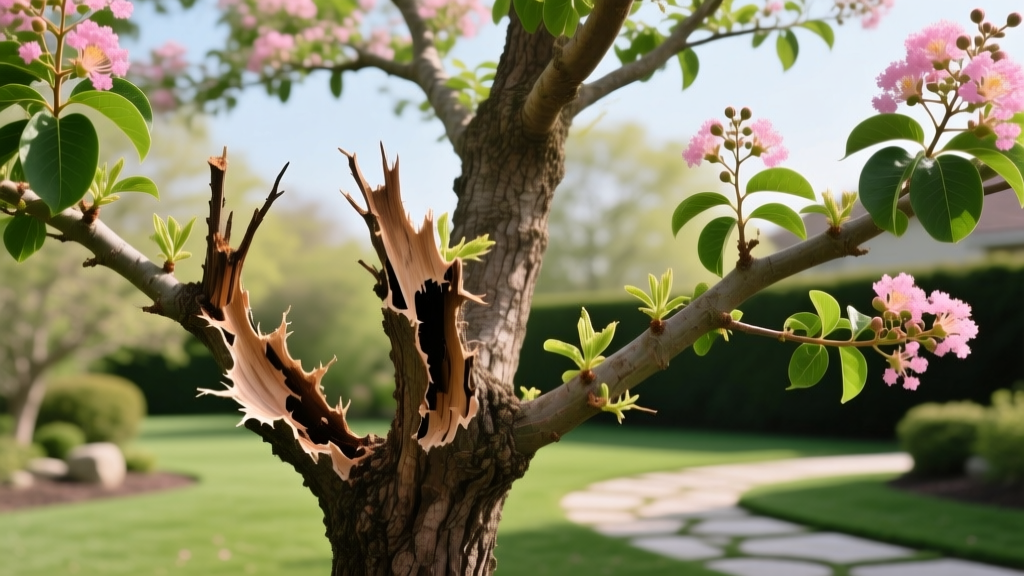
When Cutting Back Crepe Myrtles Goes Wrong: A Pruning Guide
The Myth of "Crape Murder" and Why Beginners Over-Prune
Walk through almost any suburban neighborhood in the American South during late winter, and you will see the aftermath of a widespread landscaping mistake: Lagerstroemia indica (crepe myrtle) trees hacked down to blunt, ugly stumps. In the landscaping industry, this practice is grimly referred to as "crape murder." Many beginners assume that aggressively cutting back crepe myrtles is necessary to stimulate massive spring blooms, mimicking the hard pruning required for hybrid tea roses or butterfly bushes. This is a fundamental misunderstanding of tree biology.
Crepe myrtles are trees and large shrubs, not herbaceous perennials. When you top or pollard a crepe myrtle, you are not encouraging better flowers; you are triggering a survival response. The tree pushes out dozens of weak, epicormic "water sprouts" from the cut sites. These whips lack the structural integrity to hold heavy summer bloom panicles, often snapping under their own weight or during mild thunderstorms. Furthermore, according to Clemson University Cooperative Extension, topped crepe myrtles actually bloom up to four weeks later than properly pruned trees, and the total number of flower clusters is often reduced.
⚠️ Beginner Warning: Never use hedge trimmers or chainsaws to "shape" the canopy of a crepe myrtle. Shearing destroys the natural, multi-stemmed architectural beauty of the tree and creates hundreds of jagged entry points for wood-decaying fungi and the notorious crepe myrtle aphid (Tinocallis kahawaluokalani).
The Biology of Lagerstroemia: Understanding Apical Dominance
To understand why cutting back crepe myrtles fails, you must understand apical dominance. The terminal bud at the tip of a branch produces auxin, a hormone that suppresses the growth of lateral buds further down the stem. When you chop off the top of the branch, you remove the auxin source. The tree panics and forces every dormant lateral node below the cut to sprout simultaneously.
This results in the infamous "knuckle" or "fist"—a swollen, disfigured mass of callus tissue at the topping cut where dozens of shoots emerge. Because these shoots are attached only to the outer bark and callus tissue rather than the deep structural wood, they are incredibly fragile. Proper pruning respects the tree's natural growth habit, selectively removing branches to improve airflow and light penetration without destroying the hormonal balance of the canopy.
Proper Pruning vs. Topping: A Decision Matrix
Before making a single cut, evaluate your objective. Use this matrix to determine if your planned action constitutes proper horticultural pruning or destructive topping.
| Pruning Action | Cut Location & Angle | Structural Outcome | Bloom & Health Impact |
|---|---|---|---|
| Thinning (Proper) | Flush to the branch collar, or 1/4" above an outward-facing lateral bud at 45°. | Maintains natural vase shape; removes crossing/rubbing limbs. | Increases airflow (reduces powdery mildew); larger, stronger blooms. |
| Topping / Pollarding (Wrong) | Arbitrary cut through the middle of an internode, usually flat or jagged. | Creates swollen "fists"; forces weak, upright water sprouts. | Delayed blooming; high risk of branch breakage; increases aphid habitat. |
| Suckering Removal (Proper) | Flush to the base of the trunk or root crown. | Directs energy to the main canopy; highlights exfoliating bark. | Prevents a messy, shrub-like base; improves trunk aesthetics. |
Step-by-Step Corrective Pruning: Rehabilitating a Mutilated Tree
If you purchased a home with previously topped crepe myrtles, or if you made the mistake of cutting back crepe myrtles in the past, do not try to fix it all in one winter. A severe "rehabilitation prune" can shock the tree and cause bark splitting. The University of Florida IFAS Extension recommends a phased, three-year approach to restore the tree's natural architecture.
Year 1: Assessment and Thinning
- Leave the Fists: Do not attempt to cut off the swollen knuckles in Year 1. The tree needs the foliage on those water sprouts to generate carbohydrates for recovery.
- Remove the Weak: Out of the 10-15 whips growing from a single fist, select the 2 or 3 that are growing in the most natural, outward direction. Prune the rest flush to the fist.
- Clear the Trunk: Remove all root suckers and lower lateral branches up to 18-24 inches from the ground to expose the beautiful, peeling cinnamon-and-gray bark.
Year 2: The Drop-Crotch Cut
- Locate a strong, healthy lateral branch growing outward just below the swollen fist.
- Make a "drop-crotch" cut just outside the branch collar of that lateral branch, removing the entire fist and the weak whips above it.
- This redirects the tree's vascular flow into the structurally sound lateral branch.
Year 3: Final Shaping
- By Year 3, the new lateral branches should be thick enough to support blooms. Perform standard thinning cuts to remove any inward-growing or crossing branches.
- Step back 20 feet to evaluate the overall vase shape before making any final aesthetic cuts.
"The best pruning cut for a crape myrtle is often no cut at all. If you plant the right cultivar in the right space, you will rarely need to prune anything other than dead wood and root suckers."
— Dr. Gary Knox, UF/IFAS Environmental Horticulture
Essential Tools: Bypass Pruners and Curved Saws
Using the wrong tool is the fastest way to introduce disease vectors like powdery mildew (Erysiphe lagerstroemiae) into your tree. Never use anvil pruners on crepe myrtles; the flat crushing action destroys the delicate cambium layer, leading to dieback.
- Hand Pruners (Under 3/4" wood): Invest in the Felco 2 Classic Bypass Pruner (approx. $55-$60). The hardened steel blade makes razor-sharp, 45-degree angled cuts without pinching the bark.
- Loppers (3/4" to 1.5" wood): The Corona BP 3180 ComfortGEL Bypass Lopper (approx. $45) provides the leverage needed for thicker water sprouts without crushing the stem.
- Pruning Saw (Over 1.5" wood): For removing large, previously topped trunks during Year 2 rehab, use a Silky Gomboy 240 Curved Saw (approx. $65). The Japanese pull-saw teeth cut on the pull stroke, leaving a glass-smooth wound that the tree can compartmentalize (CODIT) rapidly.
Seasonal Timing: When to Put the Saw Away
Timing is critical. Pruning too early in the winter can stimulate new growth that will be killed by a late frost. Pruning too late wastes the tree's stored energy. According to Texas A&M Agrilife Extension, the ideal window is late winter, just before the tree breaks dormancy but after the threat of hard freezes has passed.
- USDA Zone 7: Late February to early March.
- USDA Zone 8: Mid-February.
- USDA Zone 9: Late January to early February.
A good visual cue is to wait until you see the very first tiny buds swelling on the branches (they will look like small, tight, reddish-green dots). Once you see those buds, your window for structural pruning is open. Stop cutting back crepe myrtles entirely once spring foliage emerges, as summer pruning will only remove the current year's flower buds and stress the tree during peak heat.