
Tree Care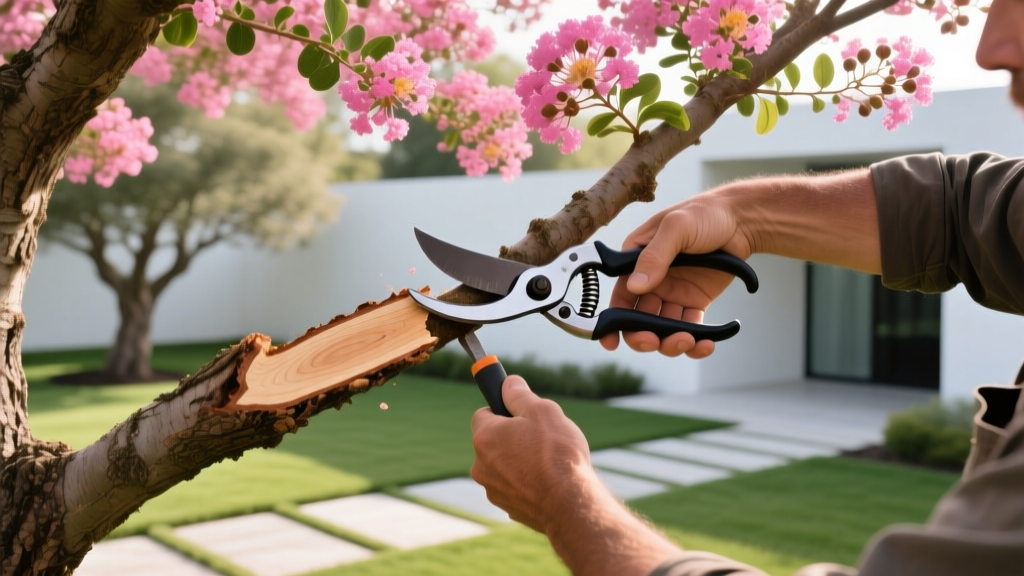
Pruning a Crepe Myrtle Tree: Stop Crape Murder and Boost Blooms
The Anatomy of a Healthy Crepe Myrtle Canopy
The most pervasive mistake in southern landscaping is "crape murder"—the severe, indiscriminate topping of crepe myrtle trunks that results in ugly, knobby growths and weak, whip-like branches. Lagerstroemia indica and its hybrids naturally develop a graceful, multi-stemmed vase shape. When you approach pruning a crepe myrtle tree, the objective is to enhance this natural architecture, not to force it into a unnatural hedge or pollarded stub.
WARNING: The Physiological Cost of Topping
Topping removes the tree's primary canopy, destroying its ability to photosynthesize efficiently. The resulting "watersprouts" (rapid, vertical shoots) are structurally weak, highly susceptible to wind breakage, and produce smaller, fewer flower panicles that often droop under their own weight due to inadequate stem caliper.
Timing Your Cuts: When to Prune for Maximum Blooms
Crepe myrtles bloom on new wood. Therefore, pruning must occur during the dormant season before spring bud swell. Pruning too early in the fall can stimulate new growth that will be killed by the first hard frost. Pruning too late in the spring removes emerging flower buds, directly sacrificing your summer bloom cycle.
Dormancy Pruning Windows by USDA Zone
- Zones 6-7 (Upper South): Late February through mid-March. Wait until the threat of severe ice storms has passed, as open wounds can invite freeze damage.
- Zones 8-9 (Deep South & Gulf Coast): January through mid-February. These regions experience shorter dormancy; prune as soon as the tree drops its leaves and enters full dormancy.
- Zone 10 (South Florida): Late December to January. Crepe myrtles here may not fully defoliate; prune when growth visibly halts and bark hardens.
Step-by-Step: Pruning a Crepe Myrtle Tree Correctly
Proper pruning requires a systematic approach, moving from the base of the tree to the canopy. According to the Clemson University Home & Garden Information Center, structural integrity must always take precedence over aesthetic shaping.
Phase 1: Base and Trunk Cleanup
- Remove Root Suckers: Cut any shoots emerging from the root flare or below the soil line flush with the root. Do not leave stubs, as they will sprout multiple new suckers.
- Eliminate Epicormic Sprouts: Remove small, twiggy growths along the lower 3 to 4 feet of the main trunks. This highlights the beautiful, exfoliating bark characteristic of mature cultivars like 'Natchez' or 'Muskogee'.
Phase 2: Canopy Structural Pruning
- The Three Ds: Remove all Dead, Damaged, and Diseased wood first. Cut back to healthy, green tissue.
- Resolve Crossing Branches: Where two branches rub together, remove the one that is less structurally sound or grows inward toward the center of the canopy. Friction wounds invite Cercospora leaf spot and wood-decay fungi.
- Thin Inward Growth: Remove branches growing toward the center of the vase. The goal is an open center that allows UV penetration and air circulation, which drastically reduces powdery mildew incidence.
- Make Precision Cuts: Always cut at a 45-degree angle, exactly 1/4 inch above an outward-facing bud or lateral branch. Use a Silky Gomboy 210mm saw (fine teeth, 14 TPI) for branches over 1.5 inches to prevent bark tearing, and Felco F-2 bypass pruners for smaller twigs.
Rehabilitating a "Murdered" Crepe Myrtle
If you have inherited a property with severely topped crepe myrtles, rehabilitation is possible but requires a 3-to-5-year commitment. The University of Florida IFAS Extension outlines specific drop-crotching techniques to reverse the damage without shocking the tree into decline.
| Rehabilitation Strategy | Execution Method | Timeline & Expected Result |
|---|---|---|
| Selective Thinning (Preferred) | Select 2 to 3 of the strongest, best-angled watersprouts emerging from the knuckle. Cut all other sprouts flush with the knuckle. | Years 1-3. The selected sprouts will thicken, eventually hiding the knuckle and restoring a natural branch hierarchy. |
| Drop-Crotching | Cut the main trunk back to a lateral branch that is at least 1/3 the diameter of the trunk being removed, bypassing the knuckle entirely. | Immediate visual improvement. Requires a large, mature lateral branch to be present below the topping cut. |
| Total Replacement | Cut all trunks to 6 inches above grade and allow new basal shoots to form new trunks, or grind the stump and replant a modern, disease-resistant cultivar. | Years 4-7 for full canopy. Recommended only if the knuckles are severely rotted or the tree is a highly susceptible older cultivar. |
Cost Note: Hiring an ISA-certified arborist to perform a multi-year rehabilitation pruning typically costs between $150 and $350 per tree in 2026, depending on canopy size and the severity of the knuckle damage. Avoid "mow-and-blow" landscaping companies that charge $40 to aggressively top the trees, as this will only compound the physiological damage.
Tool Sanitation: Preventing Pathogen Spread
Crepe myrtles are highly susceptible to fungal pathogens, particularly powdery mildew (Erysiphe lagerstroemiae) and Cercospora leaf spot. Pruning tools act as mechanical vectors for these spores.
Expert Protocol: Wipe your bypass blades with a rag soaked in 70% isopropyl alcohol between every single tree, and after every cut on a diseased branch. Avoid 10% bleach solutions unless absolutely necessary; bleach rapidly corrodes high-carbon steel blades and ruins the pivot tension on premium pruners like Felco or ARS. If you must use bleach, rinse with water and apply a light coat of 3-in-One oil immediately after your pruning session.
Common Edge Cases and Mistakes to Avoid
The "Lion's Tailing" Error
Lion's tailing occurs when a homeowner strips all the lower lateral branches off a trunk, leaving only a tuft of foliage at the very top. While this might look "tidy," it removes the trunk's natural taper and structural support. During high-wind events or summer thunderstorms, lion-tailed crepe myrtles are highly prone to catastrophic trunk failure. Always maintain a distribution of lateral branches along the lower half of the trunk to provide wind-load damping.
Over-Mulching at the Root Flare
While not a pruning cut, pruning often coincides with landscape bed maintenance. Never pile mulch against the base of the crepe myrtle trunks ("volcano mulching"). This keeps the bark perpetually moist, inviting root collar rot and encouraging the very root suckers you just spent hours pruning away. Maintain a 3-inch mulch layer, but keep it 4 inches away from the trunk flare.
Final Canopy Assessment
When you finish pruning a crepe myrtle tree, step back 20 feet and evaluate the silhouette. You should be able to easily toss a softball through the canopy without it hitting a branch. The structure should resemble a series of elegant, upward-curving arms rather than a dense, impenetrable sphere. By respecting the tree's natural growth habit and utilizing precise, sanitized cuts, you ensure a spectacular, structurally sound bloom cycle for the upcoming summer.

