
Tree Care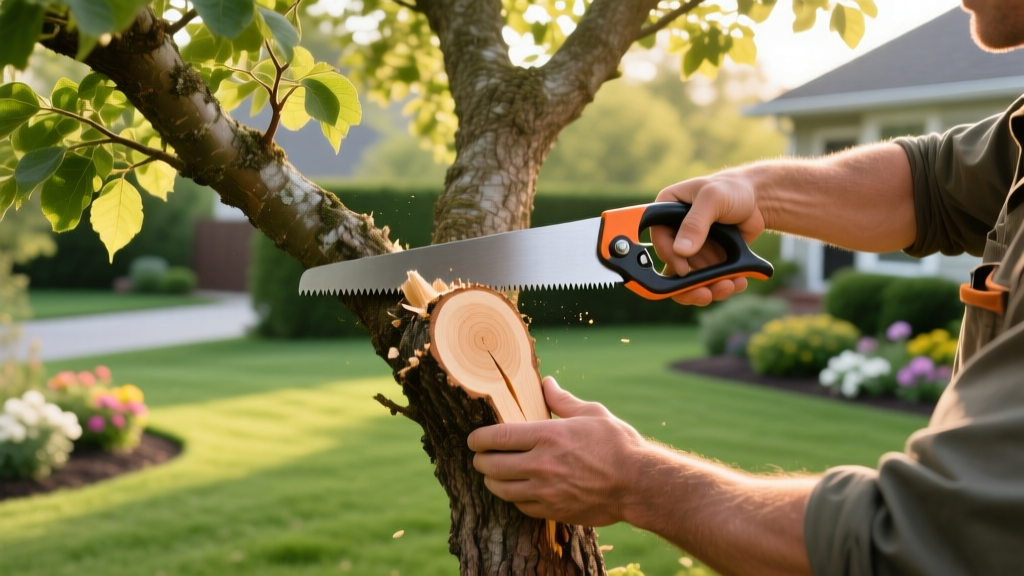
Pruning Definition and Structural Guide for Yard Trees
Beyond the Basic Pruning Definition: The Biology of Wounds
Most homeowners operate under a flawed pruning definition, assuming it simply means removing dead or overgrown branches to tidy up the yard. In professional arboriculture, the true pruning definition is the strategic, biologically informed removal of specific plant parts to manipulate growth hormones, improve structural integrity, and manage long-term risk. Every cut you make is a wound. Understanding how a tree reacts to that wound is the difference between extending a tree's lifespan by decades and initiating a slow, fatal decay cycle.
Unlike humans, trees do not heal; they compartmentalize. When you make a cut, the tree relies on a biological process called Compartmentalization of Decay in Trees (CODIT), a model pioneered by Dr. Alex Shigo. The tree builds four chemical and physical 'walls' around the injury to isolate the damaged tissue and prevent fungal pathogens from invading the healthy heartwood. If your pruning cuts violate the branch collar—the swollen area where the branch meets the trunk—you destroy the tree's natural defense zone, allowing decay to bypass Wall 4 and enter the main trunk.
⚠️ Critical Warning: The Flush Cut Fallacy
Never make a 'flush cut' (cutting perfectly flat against the trunk). According to the Morton Arboretum, flush cuts remove the branch bark ridge and the branch collar, drastically increasing the size of the wound and destroying the tree's ability to seal the injury. Always cut just outside the collar at a slight angle.
Thinning vs. Heading: A Physiological Comparison Matrix
To properly apply the pruning definition to your landscape, you must understand the two primary types of cuts. Thinning cuts remove an entire branch back to its point of origin, while heading cuts remove only a portion of a branch, forcing the tree to push out dense, weakly attached 'water sprouts' below the cut. The University of Minnesota Extension strongly advises against heading cuts on mature shade trees due to the structural weakness they introduce.
| Cut Type | Physiological Response | Structural Impact | Best Use Case |
|---|---|---|---|
| Thinning Cut | Maintains apical dominance; redirects energy to remaining lateral branches. | Reduces wind sail effect without triggering weak epicormic growth. | Crown reduction, deadwood removal, crossing branch elimination. |
| Heading Cut | Breaks apical dominance; forces multiple lateral buds to break simultaneously. | Creates dense, poorly attached clusters of new shoots prone to splitting. | Formal hedge shearing, establishing scaffold branches in year-1 saplings only. |
Precision Tooling: What the Pros Actually Use
Applying the correct pruning definition requires tools that make surgical, clean cuts. Ragged tears from dull blades crush the cambium layer, expanding the wound surface area and inviting pests like the emerald ash borer or oak wilt beetles. Skip the big-box store bargain bins and invest in professional-grade steel.
- Bypass Hand Pruners (Under 3/4 inch): The Felco F-2 Classic (approx. $65) remains the industry standard. Its hardened steel blade holds an edge through hundreds of cuts, and every component is replaceable. Always use bypass (scissor-action) pruners, never anvil pruners, which crush the vascular tissue of live wood.
- Pruning Saws (1 inch to 5 inches): The Silky Gomboy 210mm (approx. $48) features impulse-hardened Japanese teeth that pull-cut through green wood like butter, leaving a glass-smooth finish that requires no wound sealant. Avoid cheap bow saws that tear the bark on the exit stroke.
- Long-Reach Poles (Up to 14 feet): The Jameson FG-Series Fiberglass Pole Pruner (approx. $180) provides dielectric protection if you are inadvertently working near service drops, though you should never prune within 10 feet of power lines yourself.
The 3-Cut Method: Preventing Bark Tearing on Heavy Limbs
When removing branches larger than 2 inches in diameter, the weight of the falling wood will inevitably strip the bark down the trunk if you attempt a single cut. This destroys the living phloem and cambium layers far below the actual pruning site. To honor the biological pruning definition, you must use the 3-cut method to relieve the weight before making the final collar cut.
- Cut 1: The Undercut. Measure 12 to 18 inches out from the trunk. Saw upward from the bottom of the branch, going about one-third of the way through the wood. This severs the bark fibers on the underside.
- Cut 2: The Relief Cut. Move 2 inches further out from your first cut (away from the trunk). Saw straight down from the top. The branch will snap and fall cleanly, leaving a manageable 12-inch stub without tearing the trunk bark.
- Cut 3: The Final Collar Cut. Locate the branch bark ridge (the raised, rough bark where the branch meets the trunk) and the branch collar (the swollen base). Make your final cut just outside the collar, angling slightly downward to match the angle of the collar. Leave no stub, but do not cut into the trunk tissue.
"Wound dressings, pruning paints, and sealants do not prevent decay. In fact, they often trap moisture and fungal spores against the exposed wood, accelerating the very rot you are trying to prevent. Let the tree use its natural CODIT response to seal the wound." — Arbor Day Foundation
Economic Thresholds: DIY vs. ISA-Certified Arborist
While understanding the pruning definition empowers you to handle annual maintenance on young trees and small ornamentals, mature shade trees present severe safety and biological risks. In 2026, the cost of hiring an International Society of Arboriculture (ISA) Certified Arborist typically ranges from $175 to $250 per hour for a two-person crew equipped with a bucket truck and chipper.
When to Absolutely Call a Professional:
- Height & Reach: Any branch requiring a ladder. Ladder pruning accounts for the vast majority of amateur chainsaw and pruning saw injuries.
- Proximity to Targets: Branches hanging over roofs, vehicles, or high-voltage utility lines.
- Disease Management: If you are pruning oaks in regions where Oak Wilt is prevalent (typically the Midwest and Texas). Pros know the exact seasonal blackout dates (usually April through July) to prevent sap-feeding beetles from transmitting the Bretziella fagacearum fungus into fresh cuts.
- Crown Reductions: Reducing the overall height or spread of a mature tree requires highly specific drop-crotch thinning cuts. Topping a tree (a severe violation of the pruning definition) will result in a hazardous, rotting shell within five years.
Frequently Asked Questions
Should I prune my trees in the fall or the spring?
Neither is ideal for most species. The optimal time for structural pruning is late winter, just before the spring bud break (typically late February to early March, depending on your hardiness zone). Pruning in the fall is dangerous because fungal spores are highly active, and the tree's compartmentalization processes slow down as it enters dormancy, leaving the wound vulnerable to infection all winter.
How much of the live canopy can I safely remove in one year?
A strict rule of arboriculture is to never remove more than 15% to 20% of a mature tree's live foliage in a single season. For younger, vigorously growing trees, you can push this to 25%. Over-pruning starves the root system, as the tree relies on the leaves to produce the carbohydrates necessary to generate the chemical defenses required to close your pruning wounds.

