
Tree Care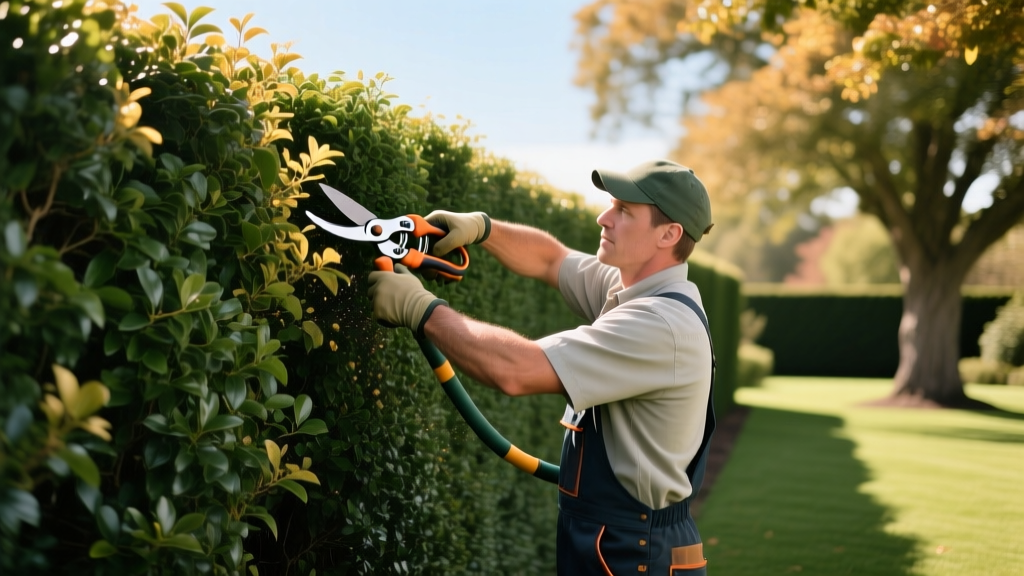
Pruning Hedges: A Seasonal Framework for Dense Privacy Screens
Most homeowners shear hedges into flat-topped rectangles, inadvertently triggering apical dominance that starves lower branches of sunlight. The inevitable result is a privacy screen that is thick at the canopy but completely bare and leggy at the base. Properly pruning hedges requires moving beyond simple shaping to understand plant hormones, light penetration angles, and species-specific regeneration limits. This guide provides a precise, measurement-driven framework for maintaining hedges that remain dense from the soil line to the terminal leader.
The Biology of Hedge Density: Overcoming Apical Dominance
When you prune the terminal (top) bud of a shrub, you disrupt the flow of auxins—plant hormones that suppress lateral growth. This encourages the side buds to break dormancy and push new foliage. However, if the top of the hedge remains as wide as or wider than the bottom, the upper canopy intercepts the majority of solar radiation. The lower branches, shaded out and deprived of photosynthetic energy, will slowly abort their foliage and die back.
According to research published by the University of Minnesota Extension, maintaining a tapered profile is non-negotiable for long-term hedge health. You must mechanically force sunlight to reach the lower 12 inches of the shrub to sustain basal density.
Professional Tool Matrix for Hedge Maintenance
Selecting the right tool prevents stem crushing, which invites fungal pathogens like Seiridium canker. For stems under 1/4 inch, powered hedge trimmers are efficient. For stems between 1/4 inch and 1 inch, manual bypass loppers are mandatory to ensure clean, angled cuts that heal rapidly.
| Tool Type | Model / Specification | Blade Length | Best Application | Avg. Price |
|---|---|---|---|---|
| Cordless Trimmer | Stihl HSA 56 (AK System) | 18 inches | Small to medium boxwood and yew | $199 |
| Cordless Trimmer | Makita XHU02Z (18V LXT) | 22 inches | Tall privet and arborvitae screens | $239 |
| Manual Lopper | Felco 211-60 Bypass | 24-inch handles | Thick woody stems up to 1 inch | $85 |
| Gas Trimmer | Echo HCR-1500 | 20 inches | Heavy commercial, overgrown hedges | $450 |
The A-Frame Taper: Exact Measurements for Light Penetration
To guarantee sunlight reaches the base of your hedge, you must cut an A-frame (or trapezoidal) profile. The universal metric for this taper is the 2-inch rule: for every 1 foot of vertical height, the base of the hedge must be 2 inches wider than the top on each side.
Calculating Your Taper
- 3-Foot Hedge: If the top is 12 inches wide, the base must be 24 inches wide (12 + 6 inches per side).
- 6-Foot Hedge: If the top is 24 inches wide, the base must be 48 inches wide (24 + 12 inches per side).
- 10-Foot Hedge: If the top is 30 inches wide, the base must be 70 inches wide (30 + 20 inches per side).
⚠️ Critical Warning on Late-Fall Pruning:
Never prune hedges within 6 weeks of your region's first expected frost date. Late-season pruning stimulates tender new flush growth that will not have time to lignify (harden off) before freezing temperatures arrive. This results in severe winter dieback, leaving you with brown, dead branch tips the following spring. Consult the Royal Horticultural Society (RHS) seasonal guidelines to align your final summer cut with local frost schedules.
Species-Specific Pruning Protocols
Not all hedge species respond to pruning identically. Misjudging a species' regenerative capacity can permanently ruin a privacy screen.
Arborvitae (Thuja occidentalis)
Arborvitae will not regenerate foliage from old, brown, inner wood. When pruning, never cut past the green outer canopy into the dead zone. Limit your cuts to the current season's light green growth. If an arborvitae hedge becomes too wide, you cannot drastically reduce its width without leaving permanent bare patches.
Boxwood (Buxus sempervirens)
Boxwood tolerates heavy pruning but is highly susceptible to boxwood blight and volutella canker when air circulation is poor. Instead of using powered shears which create a dense, impenetrable outer shell, use hand pruners to 'thin' the interior. Remove 10% to 15% of the inner branches down to the main stems annually to allow airflow and light into the center of the shrub.
Yew (Taxus baccata)
Yew is the exception to the conifer rule. It possesses dormant adventitious buds hidden beneath its bark. You can perform severe rejuvenation pruning on a yew hedge, cutting it back to bare, brown wood in early spring, and it will successfully flush new green growth from the old trunks within a single season.
Corrective Action for 'Bare Bottom' Hedges
If you have inherited a hedge that is already bare at the base due to years of improper flat-topped shearing, follow this three-year corrective framework:
- Year 1 (Early Spring): Reduce the overall height of the hedge by 20%. This lowers the distance nutrients must travel and reduces the shading effect on the lower trunk. Do not attempt to widen the base yet.
- Year 2 (Early Spring): Implement the A-frame taper aggressively. Cut the top canopy narrower than it currently is, and leave the lower branches completely untouched to maximize their light exposure. Apply a balanced 10-10-10 granular fertilizer at the drip line.
- Year 3 (Mid-Summer): Once new lateral shoots emerge from the lower bare stems, begin lightly tip-pruning these new shoots to force them to branch and thicken.
Frequently Asked Questions
How often should I prune a fast-growing privet hedge?
Fast-growing species like Ligustrum (privet) typically require three pruning sessions per year: an initial structural cut in late winter, a heavy shearing in early summer after the first major flush, and a light touch-up in late summer. Avoid pruning in autumn.
Should I disinfect my hedge trimmer blades between shrubs?
Yes. If you are pruning species susceptible to bacterial or fungal diseases (like boxwood or Leyland cypress), wipe the blades with a 70% isopropyl alcohol solution or a 10% bleach solution between plants. This prevents the mechanical transmission of pathogens like Calonectria pseudonaviculata (boxwood blight).
Can I use string trimmers to edge the base of my hedge?
Never use a nylon string trimmer near the base of a hedge. 'String trimmer blight' occurs when the nylon line strips the bark from the main trunks, severing the phloem tissue. This girdles the plant, cutting off nutrient transport and causing sudden, unexplained branch dieback. Use manual shears or a dedicated mechanical edger with a physical guard instead.

