
Tree Care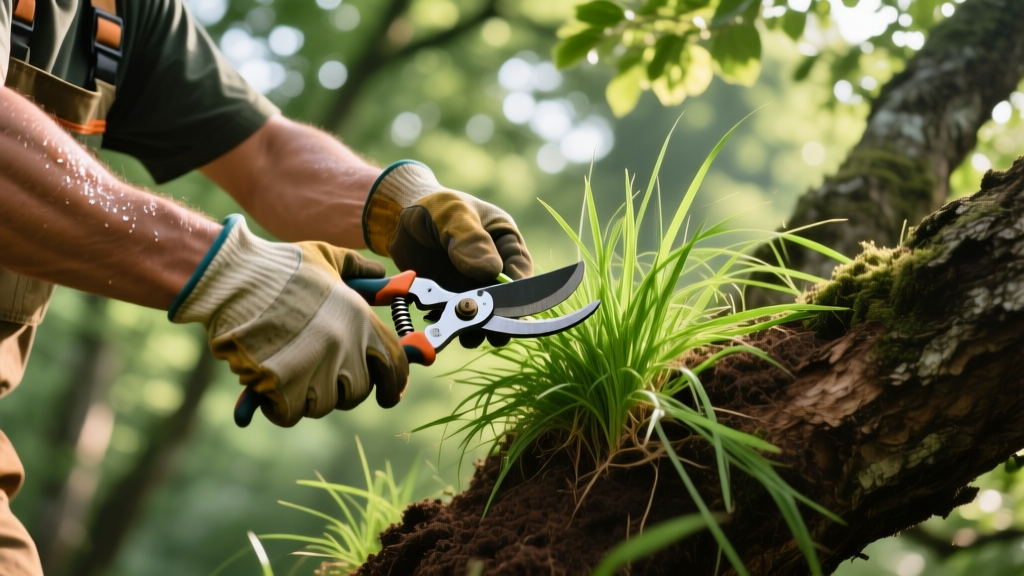
Expert Guide to Pruning Ornamental Grasses in Tree Canopy Beds
The Intersection of Tree Care and Herbaceous Maintenance
When managing complex landscape beds, arborists and groundskeepers frequently encounter ornamental grasses planted in the understory or drip lines of mature trees. While woody tree pruning relies on understanding apical dominance, branch collars, and lateral meristems, pruning ornamental grasses requires an entirely different physiological approach. Grasses grow from a basal plate (the crown) located at or just below the soil surface. Applying tree-pruning logic to grasses—or using aggressive techniques that disturb the surrounding soil—can lead to crown rot, stunted spring emergence, and severe damage to the shallow feeder roots of the canopy trees above.
This guide provides a specialized framework for pruning ornamental grasses situated in tree root zones, focusing on exact timing, tool sanitation, and root-safe execution to maintain the health of the entire landscape bed.
The Biology of the Cut: Herbaceous Crowns vs. Woody Meristems
Unlike trees, which can compartmentalize decay behind a branch collar, ornamental grasses lack woody defense mechanisms. The growing points of grasses are concentrated in the crown. If you cut too deeply into the basal plate during late winter dormancy, you expose the hollow culms to moisture accumulation. According to research from the University of Minnesota Extension, this trapped moisture is the primary vector for fungal crown rot, which can kill a mature Miscanthus clump in a single wet spring.
Furthermore, the soil immediately surrounding these grass clumps is often densely populated with the fine, non-woody absorptive roots of nearby trees. Heavy foot traffic, aggressive raking, or deep soil cultivation during the grass cut-back process can sever these critical tree roots, compromising the tree's drought tolerance and nutrient uptake for the upcoming growing season.
Seasonal Timing Matrix for Popular Landscape Grasses
Timing is the most critical variable in grass maintenance. Cutting warm-season grasses too early in autumn removes their winter architectural interest and exposes the crown to freeze-thaw heaving. Cutting cool-season grasses too late in spring severs the new growth tips, resulting in a blunt, brown-tipped appearance that persists for months.
| Grass Species (Common Name) | Classification | Ideal Pruning Window | Target Cut Height | Tree Bed Consideration |
|---|---|---|---|---|
| Miscanthus sinensis (Maiden Grass) | Warm-Season | Mid-March to Early April | 4 to 6 inches | Leave stubble to trap insulating snow over tree roots |
| Pennisetum alopecuroides (Fountain Grass) | Warm-Season | Early April (Post-frost) | 3 to 5 inches | Avoid pulling dead culms; slice cleanly to protect shallow soil |
| Panicum virgatum (Switchgrass) | Warm-Season | Late March | 6 to 8 inches | Deep taproot; surface soil around crown is highly compacted |
| Hakonechloa macra (Japanese Forest Grass) | Cool-Season | Late Feb to Early March | 2 to 3 inches | Often planted near Japanese Maples; use hand shears to avoid bark nicks |
| Calamagrostis acutiflora (Feather Reed) | Cool-Season | Late February | 3 to 4 inches | Dense clump; requires binding before cutting to prevent debris drop |
Tool Selection and Cross-Contamination Protocols
Because tree care professionals often transition from pruning woody species (which may harbor pathogens like Fire Blight, Oak Wilt, or Cytospora canker) to cutting back herbaceous grasses, tool sanitation is non-negotiable. Pathogens can easily transfer from infected tree sap on your blades into the freshly cut, open vascular tissue of the ornamental grass crowns.
Recommended 2026 Tool Loadout
- ARS HS-KR1000 Long-Reach Hedge Shears (~$75): The 1000mm handles allow you to reach the center of massive, 6-foot-wide Miscanthus clumps without stepping into the tree's critical root zone and compacting the soil.
- Milwaukee M18 22-Inch Hedge Trimmer (~$229 bare tool): For commercial properties with extensive understory plantings, this battery-powered trimmer slices through thick, fibrous warm-season culms without the vibration fatigue of gas models. Keep the blade parallel to the ground to maintain an even cutting plane.
- Felco 2 Classic Bypass Pruners (~$60): Essential for precision cleanup around the base of the clump and for snipping rogue tree suckers that emerge in the grass bed.
Sanitation Protocol: Avoid 10% bleach solutions, which cause micro-pitting on high-carbon steel bypass blades, creating microscopic harbors for bacteria. Instead, use 70% isopropyl alcohol or a commercial quaternary ammonium disinfectant. Spray the blades thoroughly and allow a minimum of 30 seconds of contact time before moving from a diseased tree to an ornamental grass clump.
Step-by-Step Execution: Protecting Tree Feeder Roots
Executing the cut safely requires a methodical approach that prioritizes the structural integrity of both the grass crown and the surrounding tree root system. Follow this sequence for optimal results:
- Bind the Clump: Wrap a heavy-duty bungee cord or biodegradable jute twine tightly around the grass clump, about 12 to 18 inches above the soil line. This prevents the fibrous debris from scattering across the tree bed, which can smother emerging spring bulbs and trap excess moisture against the trunks of nearby trees.
- Make the Primary Cut: Using your ARS shears or hedge trimmer, make a clean, horizontal cut at the species-specific height outlined in the timing matrix. Do not cut at an angle; flat cuts shed water more effectively when the remaining stubble is exposed to late-winter rain.
- Extract and Clear: Lift the bound clump away from the crown. Crucial Step: Do not use a steel-tined garden rake to clean up the remaining loose debris around the base. Steel tines will aggressively scarify the soil and sever the delicate, hair-like feeder roots of the canopy tree. Instead, use a flexible poly-leaf rake or a commercial backpack blower on a low-throttle setting to clear the crown.
- Inspect for Crown Division Needs: If the center of the grass clump appears dead, hollow, or dominated by tree root intrusion, it is time to divide the plant. Use a sharp, flat spade to slice through the basal plate. Avoid using a mattock or pickaxe, as the violent soil displacement will cause massive trauma to the adjacent tree root network.
Warning: The Volcano Mulching Trap
Never pile the chopped ornamental grass debris directly against the trunks of the trees in the bed. As the grass breaks down, it retains immense amounts of moisture and generates heat. Piling this material against a tree trunk (volcano mulching) invites Phytophthora root rot and provides a hidden habitat for bark-girdling voles. Compost the grass debris in a dedicated bin, or use it to mulch distant, non-woody garden beds.
Never pile the chopped ornamental grass debris directly against the trunks of the trees in the bed. As the grass breaks down, it retains immense amounts of moisture and generates heat. Piling this material against a tree trunk (volcano mulching) invites Phytophthora root rot and provides a hidden habitat for bark-girdling voles. Compost the grass debris in a dedicated bin, or use it to mulch distant, non-woody garden beds.
Managing Soil Moisture and Fertilization in Shared Beds
After pruning, the immediate impulse is often to fertilize and water the newly cut grasses. However, when these grasses share a bed with mature trees, you must balance the needs of both. According to Penn State Extension, ornamental grasses generally require very little supplemental nitrogen; excessive nitrogen causes weak, floppy culms that collapse under the weight of summer rain.
If the tree above is a heavy feeder (such as a mature Norway Maple or Ash), applying a slow-release, low-nitrogen organic fertilizer (like a 4-3-4 NPK ratio) lightly over the grass bed in mid-April will support the grass without triggering excessive, weak top-growth. Water deeply but infrequently to encourage both the grass and the tree to drive their roots deeper into the soil profile, rather than competing for surface moisture.
Frequently Asked Questions
Can I burn ornamental grasses in the tree bed to clear debris?
No. While controlled burning is sometimes used in commercial prairie restoration, doing this in a residential landscape bed will severely damage the cambium layer of nearby trees. The intense, localized heat can scorch the bark of thin-barked species like Beech and Japanese Maples, and will bake the shallow feeder roots in the top two inches of the soil.
What if the tree roots have completely infiltrated the grass crown?
If a nearby tree has sent major structural roots directly through the ornamental grass crown, do not attempt to sever the tree roots to save the grass. The grass will eventually lose the competition for water and nutrients. Carefully dig up the grass, divide the outer edges where roots are less entangled, and replant the divisions further away from the tree's drip line, replacing the center with shade-tolerant groundcover that does not require aggressive annual pruning.

