
Tree Care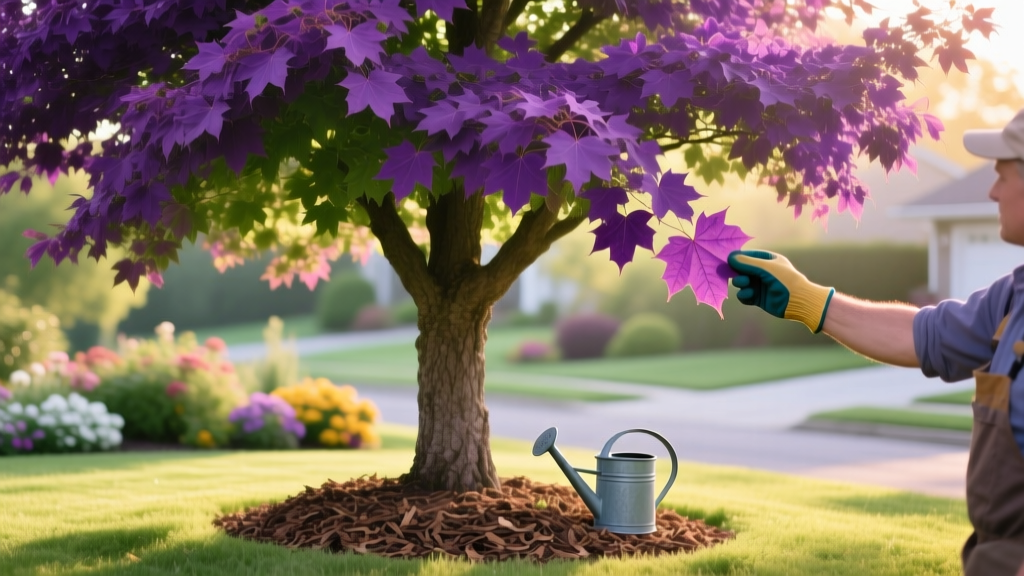
Planting and Caring for a Maple Tree with Purple Leaves
Maples with deep purple foliage serve as striking focal points in residential landscapes, driven by high concentrations of anthocyanin pigments that mask the underlying green chlorophyll. While the term 'purple maple' is common, it generally refers to specific cultivars of either the Norway maple (Acer platanoides) or the Japanese maple (Acer palmatum). Successfully establishing and maintaining the vivid coloration of these trees requires precise attention to sun exposure, soil chemistry, and nitrogen management. This guide provides the exact horticultural protocols required to plant and care for a maple tree with purple leaves.
Selecting the Right Purple-Leaf Cultivar
Not all purple maples perform equally across different climates. Norway maples offer massive shade canopies and extreme cold tolerance, while Japanese maples provide intricate leaf architecture and fit into smaller spaces. Review the specifications below to match the cultivar to your site conditions.
| Cultivar | Species | Mature Height | USDA Zones | Foliage Characteristics |
|---|---|---|---|---|
| Crimson King | Norway Maple | 40-50 ft | 3-7 | Large, deeply lobed maroon leaves; dense shade canopy |
| Royal Red | Norway Maple | 35-45 ft | 4-7 | Brighter red-purple foliage; slightly more compact than Crimson King |
| Bloodgood | Japanese Maple | 15-20 ft | 5-8 | Deep burgundy palmate leaves; excellent crimson fall color |
| Emperor I | Japanese Maple | 15-18 ft | 5-8 | Opens 2 weeks later than Bloodgood to avoid late spring frost damage |
⚠️ Invasive Species Warning: Norway maples (Acer platanoides) are classified as invasive in several northeastern and midwestern US states due to their aggressive seed dispersal and dense shade that suppresses native understory plants. If you live in a restricted area, opt for non-invasive Japanese maple cultivars or purple-leaf alternatives like the Eastern Redbud (Cercis canadensis 'Forest Pansy'). Consult your local university extension for current regional planting bans.
Step-by-Step Planting Protocol
Proper installation is critical for purple-leaf maples, as root girdling and improper depth will stunt growth and diminish foliage vibrancy. Follow the University of Minnesota Extension guidelines adapted for anthocyanin-heavy cultivars.
- Site Selection for Pigment Retention: Anthocyanin production requires direct sunlight. Select a site that receives a minimum of 6 to 8 hours of direct sun. Heavy shade will cause the leaves to revert to a muddy bronze or green as the tree produces more chlorophyll to compensate for low light.
- Soil Testing and Amendment: Purple maples thrive in slightly acidic to neutral soil (pH 5.5 to 7.0). Alkaline soils (pH above 7.5) lock up iron and manganese, leading to chlorosis (yellowing between leaf veins) which severely degrades the purple aesthetic. Apply elemental sulfur at a rate of 1.5 lbs per 100 square feet to lower pH if necessary.
- Excavation: Dig a hole 2 to 3 times the width of the root ball, but no deeper than the root ball itself. The structural root flare must sit 1 to 2 inches above the surrounding grade to prevent trunk rot.
- Backfilling: Use only the native soil you excavated. Do not mix in peat moss or compost directly into the planting hole, as this creates a 'bathtub effect' that traps water and rots the fine feeder roots.
- Mulching: Apply a 2 to 3-inch layer of shredded hardwood mulch in a 4-foot diameter ring. Keep the mulch at least 3 inches away from the trunk bark to prevent vole damage and fungal pathogens.
Watering and Fertilization: The Anthocyanin Balance
The most common mistake homeowners make with purple-leaf maples is over-fertilizing with high-nitrogen synthetic blends.
Fertilizer Formulations
Excessive nitrogen triggers rapid vegetative cell expansion. When the leaf surface area expands faster than the tree can synthesize anthocyanins, the leaves will appear greenish or washed out. Avoid high-nitrogen lawn fertilizers (like 30-0-0) near the drip line. Instead, use a slow-release, low-nitrogen organic fertilizer such as Espoma Tree-tone (6-3-2 NPK). Apply 3 lbs per inch of trunk diameter in early spring just before bud break. According to the Royal Horticultural Society (RHS), established Japanese maples rarely require supplemental feeding if planted in organically rich soil.
Irrigation Volumes
Newly planted purple maples require deep, infrequent watering to establish a drought-tolerant root system. Apply 10 to 15 gallons of water per week for the first two growing seasons. Use a soaker hose coiled around the drip line and run it for 2 hours, rather than using a high-pressure spray nozzle which only wets the top inch of soil. During extreme summer heat waves (above 90°F), increase volume to 20 gallons per week to prevent leaf scorch.
Pruning for Structure and Sap Management
Maples are notorious 'bleeders.' If you prune a maple in late winter or early spring, the heavy upward flow of xylem sap will cause the cuts to drip profusely. While this sap loss does not harm the tree's overall health, it is unsightly and can attract fungal spores to the open wounds.
- Structural Pruning: Perform major structural cuts in mid-summer (July) when the tree is fully leafed out and sap flow has slowed. Remove crossing branches, water sprouts, and any limbs growing inward toward the central leader.
- Deadwood Removal: Dead, diseased, or broken branches can be removed at any time of year.
- Canopy Thinning: For weeping Japanese maples, thin the canopy by removing no more than 15% of the secondary branches. This allows dappled sunlight to reach the inner leaves, maintaining their purple pigmentation rather than letting them fade to green in the deep shade of the outer canopy.
Troubleshooting Fading or Scorching Foliage
When a purple maple loses its signature color, it is usually a physiological response to environmental stress rather than a disease.
| Symptom | Primary Cause | Actionable Fix |
|---|---|---|
| Leaves turning green in mid-summer | Insufficient sunlight or excess nitrogen fertilizer | Thin surrounding canopy to increase sun exposure; switch to low-N organic fertilizer |
| Crispy brown leaf margins (Scorch) | Shallow watering, high wind, or alkaline soil | Increase watering depth to 12 inches; apply soil sulfur to lower pH below 7.0 |
| Sudden wilting of entire branches | Verticillium wilt (soil-borne fungal pathogen) | No chemical cure; prune infected branches 12 inches below the dieback and sterilize tools with 70% isopropyl alcohol between cuts |
Expert FAQ
Can I grow a purple-leaf maple in a container?
Yes, but restrict container growing to Japanese maple cultivars like 'Bloodgood' or 'Emperor I'. Norway maples will quickly become root-bound and top-heavy. Use a minimum 20-gallon pot with a well-draining soil mix consisting of 50% pine bark fines, 30% perlite, and 20% peat moss. Container-grown maples require watering every 2 to 3 days during summer and must be insulated in winter to prevent the root ball from freezing solid.
Why is my Crimson King maple dropping leaves in August?
Premature leaf drop in late summer is typically caused by drought stress or a fungal issue like tar spot or powdery mildew. If the leaves are dropping while still partially green or purple and feel dry, the tree is aborting foliage to conserve water. Implement a deep-watering schedule immediately. If the leaves have black, tar-like spots, rake and destroy all fallen leaves to prevent the spores from overwintering in the soil.
Do purple maples change color in the fall?
Japanese maples like 'Bloodgood' will often shift from deep burgundy to a brilliant, fiery crimson in autumn as temperatures drop and chlorophyll breaks down completely. Norway maples like 'Crimson King' tend to hold their maroon color until the first hard frost, after which the leaves typically turn a dull brown and drop without a vibrant fall color transition.

