
Tree Care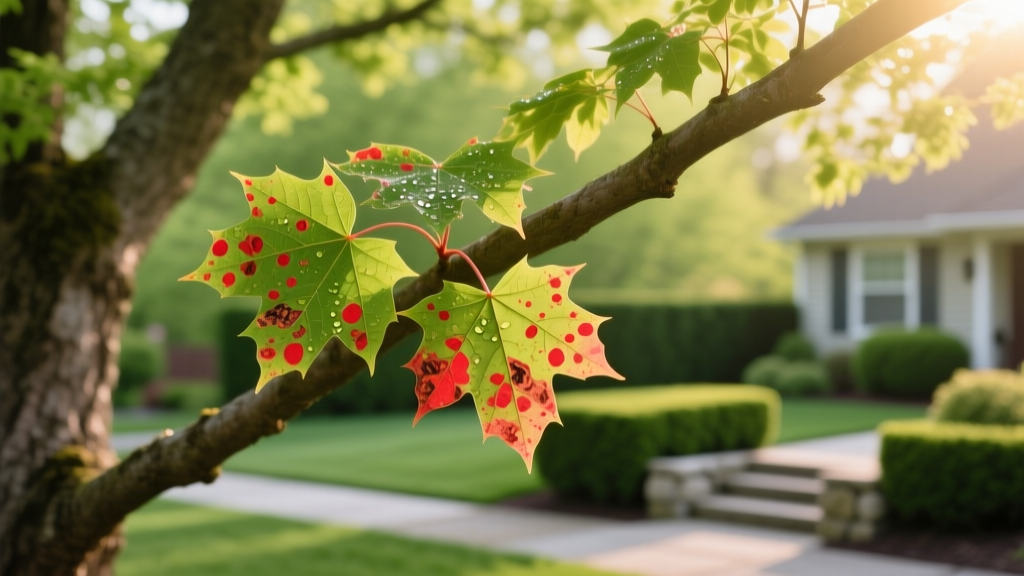
Red Spots on Maple Leaves: Causes, Diagnosis & Fixes
The Pathology of Red and Black Maple Leaf Lesions
When homeowners notice red spots on maple leaves, the immediate assumption is often a fatal vascular disease or severe nutrient deficiency. In reality, the vast majority of these localized red, brown, or black lesions are caused by foliar fungi that are largely cosmetic. However, ignoring recurring infections can lead to premature defoliation by late July, severely depleting the tree's carbohydrate reserves needed for winter survival and spring bud set.
To effectively treat the issue, you must first distinguish between the three primary pathogens responsible for these symptoms: Tar Spot, Anthracnose, and Maple Leaf Blister. Each requires a different phenological timing for fungicide application and cultural management.
Pathogen Comparison Matrix
| Pathogen | Visual Signature | Primary Host Species | Defoliation Risk |
|---|---|---|---|
| Tar Spot (Rhytisma acerinum) | Raised, shiny, tar-like black stromata (0.5 inch) with yellow/red halos | Norway, Silver, Sycamore maples | Low to Moderate (Late season) |
| Tar Spot (Rhytisma punctatum) | Pinpoint, scattered black/red speckles (less than 3mm), no large halos | Silver, Red, Sugar maples | Low |
| Anthracnose (Discula / Apiognomonia) | Irregular brown/red blotches tracking along leaf veins, necrotic margins | Sugar, Red, White Ash | High (Early season drop) |
| Leaf Blister (Taphrina) | Puckered, pale green to red blisters that turn gray/brown and velvety | Silver, Red, Sugar maples | Moderate |
Symptom Decision Tree: Is It Tar Spot or Anthracnose?
Accurate diagnosis dictates your rescue protocol. Use this visual decision framework to identify the specific fungus attacking your canopy.
Check 1: Lesion Texture and Elevation
- Raised and Shiny: If the red/black spots feel raised like a drop of dried roof tar and have a distinct, glossy surface, you are dealing with Rhytisma acerinum (Tar Spot). The fungus forms a hardened stroma to protect its overwintering spores.
- Flat and Papery: If the red/brown areas are flat, dry, and crumble when rubbed between your fingers, suspect Anthracnose or environmental leaf scorch.
Check 2: Lesion Placement and Pattern
- Random Scattering: Tar spots appear randomly across the leaf blade, ignoring the venation structure.
- Vein-Tracking: Anthracnose lesions typically start at the leaf margins or track inward along the primary and secondary veins, creating distinct V-shaped necrotic wedges. According to the University of Minnesota Extension, anthracnose thrives in cool, wet springs where leaf wetness persists for over 12 hours.
Check 3: Timing of Symptom Emergence
- Early Summer (June): Anthracnose and Leaf Blister show symptoms shortly after leaf expansion in spring.
- Mid-to-Late Summer (July/August): Tar spots begin as pale yellow chlorotic flecks in early summer but do not develop their characteristic red/black raised stromata until late July or August.
Expert Diagnostic Tip: Flip the leaf over. Tar spot fungi (Rhytisma) form their fruiting bodies primarily on the upper leaf surface (adaxial). If the severe necrosis is concentrated on the underside (abaxial) with corresponding yellowing on top, investigate for sap-feeding insects like spider mites or lace bugs, which cause stippling that mimics fungal spotting.
Actionable Rescue Fixes & Treatment Protocols
Once you have confirmed the presence of a fungal pathogen, implement these targeted rescue fixes. Note that fungicides are preventative, not curative. They will not erase existing red spots on maple leaves; they protect new, uninfected tissue.
Phase 1: Aggressive Sanitation (Autumn & Early Spring)
Fungi like Rhytisma overwinter in the ascocarps housed within fallen leaf litter. If you leave infected leaves on the lawn, the tree will re-infect itself when spring rains trigger spore release.
- Rake the Drip Line: Remove 100% of fallen maple leaves within a 50-foot radius of the tree's canopy drip line. Use a steel-tined leaf rake to agitate the soil surface slightly, exposing any buried leaves.
- Proper Disposal: Do not compost these leaves in a standard backyard bin. Home compost piles rarely sustain the 140°F+ temperatures for the 3 consecutive days required to denature Rhytisma spores. Bag the leaves for municipal high-heat composting or burn them where local ordinances permit.
- Mulch Management: If you use a mulching mower, ensure the clippings are blown into garden beds far from the maple, or use a bagger attachment during the final fall mow.
Phase 2: Targeted Fungicide Application
If your tree suffered severe defoliation (more than 30% canopy loss) for two consecutive years, chemical intervention is warranted. The Morton Arboretum emphasizes that timing is the single most critical factor for fungicide efficacy.
- Active Ingredients: Look for concentrates containing Chlorothalonil (e.g., Bonide Fung-onil) or Copper Octanoate (e.g., Monterey Liqui-Cop). For organic preferences, Bacillus subtilis (Serenade Garden) offers moderate suppression.
- Phenological Timing: Apply the first spray exactly at bud break—when the leaf tips are 1/2 to 2 inches emerging from the bud scales. In USDA Zones 5-6, this typically falls between late April and early May.
- Follow-up Spray: Apply a second treatment 10 to 14 days later, once the leaves have fully expanded but before they harden off. A third application may be necessary if spring weather remains unusually wet and cool (below 65°F).
- Application Method: For trees under 15 feet, a 2-gallon pump sprayer is sufficient. Ensure complete coverage of the upper leaf surface, as stomatal penetration and direct contact are required for protectant fungicides.
Phase 3: Canopy Microclimate Modification
Fungal spores require prolonged leaf wetness to germinate and penetrate the leaf cuticle. By altering the tree's microclimate, you can reduce infection rates without chemicals.
- Structural Pruning: During winter dormancy (December-February), hire an arborist to remove crossing branches and thin the interior canopy. The goal is to allow morning sunlight to penetrate the inner branches, drying dew off the leaves 2-3 hours faster.
- Irrigation Adjustment: Never use oscillating sprinklers that wet the maple's lower canopy. Switch to drip irrigation or soaker hoses placed at the drip line to deliver water directly to the root zone while keeping the foliage bone-dry.
When to Call a Certified Arborist: Cost & Thresholds
DIY treatments are highly effective for maples under 20 feet tall. However, mature Norway or Silver maples often exceed 50 feet, making adequate spray coverage impossible with consumer-grade pump sprayers.
Professional Treatment Costs (2026 Estimates):
- Canopy Spraying (Hydraulic Rig): $85 to $150 per tree, per application. Requires 2-3 visits in spring.
- Trunk Macro-Infusion: $150 to $350 per tree. An arborist injects systemic fungicides (like Propiconazole) directly into the xylem at the root flare. This provides 12 to 24 months of internal protection and eliminates the need for canopy spraying, though it does cause minor, localized trunk wounding.
If your maple is exhibiting red spots alongside branch dieback, oozing bark cankers, or D-shaped exit holes, the foliar spots are likely a secondary symptom of severe environmental stress or a secondary borer invasion (such as the Asian Longhorned Beetle). In these cases, bypass DIY fungicide treatments and immediately schedule a Level 2 Tree Risk Assessment with an ISA Certified Arborist.

