
Tree Care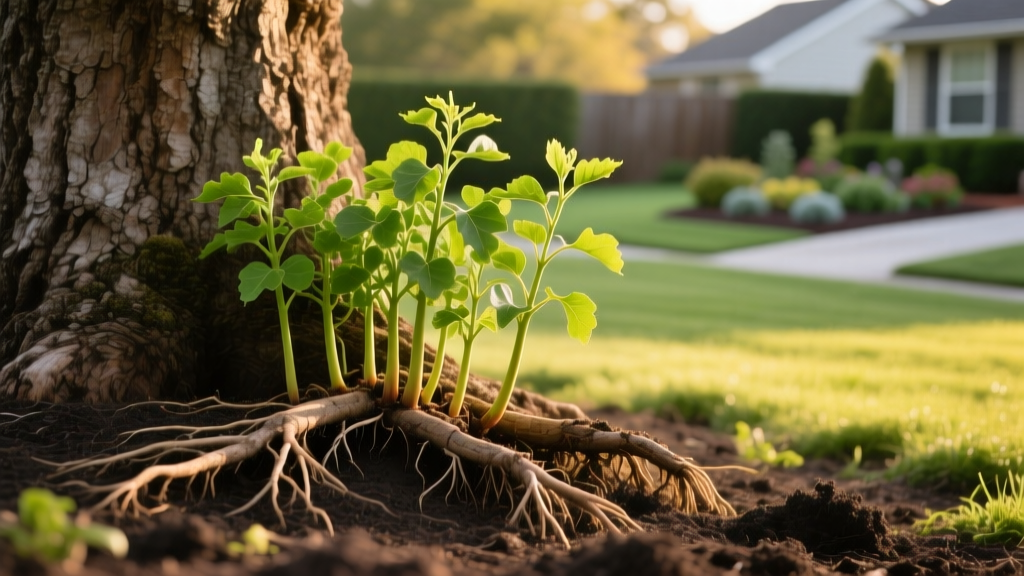
Sucker Trees Explained: How to Remove and Prevent Root Sprouts
What Are 'Sucker Trees' and Why Do They Appear?
When homeowners talk about sucker trees, they are usually referring to aggressive, vertical shoots that erupt from the base of a tree's trunk or directly from the root system. Botanically known as root suckers or basal sprouts, these offshoots are a physiological stress response. While they might look like vigorous new growth, they are actually a distress signal from your tree, indicating that the main canopy is struggling to maintain apical dominance.
As of 2026, prolonged summer droughts and increased soil compaction in urban environments have caused a noticeable spike in suckering across popular ornamental species. To effectively manage them, you must first understand the difference between true root suckers and their canopy-dwelling cousins, water sprouts.
⚠ Critical Warning: Never Use Glyphosate on Root Suckers
A fatal beginner mistake is spraying root suckers with systemic herbicides like Roundup (glyphosate) or Triclopyr. Because the suckers share a vascular system with the mother tree, the poison will translocate through the roots and systematically kill or severely decline the main tree. Never use standard brush killers on attached root sprouts.
Diagnosis Matrix: Root Suckers vs. Water Sprouts
Proper identification dictates your removal strategy. Use the table below to diagnose the type of rogue growth you are dealing with before reaching for your pruning shears.
| Feature | Root Suckers (Basal Sprouts) | Water Sprouts (Epicormic Shoots) |
|---|---|---|
| Origin Point | Root system or base of the trunk (below or just at soil line) | Main branches, trunk, or previous pruning cuts (above ground) |
| Primary Cause | Root damage, graft incompatibility, severe drought, or deep planting | Over-pruning, canopy loss, storm damage, or sudden light exposure |
| Growth Habit | Thick, rigid, often forms a dense thicket around the base | Whip-like, highly vertical, weak branch attachments |
| Removal Method | Manual tearing below soil line + NAA hormone treatment | Flush pruning at the branch collar during winter dormancy |
For authoritative guidance on identifying these growth patterns, the University of Minnesota Extension provides excellent visual diagnostics for homeowners.
The 'Tear, Don't Cut' Protocol for Physical Removal
If you simply snip a root sucker off at the soil line with pruners, you are leaving behind a ring of dormant adventitious buds. Within weeks, the tree will push out three or four new suckers from the exact same node, making the problem exponentially worse. To stop this cycle, you must use the tearing method.
Step-by-Step Sucker Eradication
- Expose the Base: Use a hand trowel to carefully excavate the soil or mulch around the base of the sucker until you can see exactly where it connects to the main root or trunk flare.
- Grip Low and Firm: Wear heavy leather gloves. Grip the sucker as close to the root junction as physically possible. Pliers can provide extra leverage for thick, woody sprouts.
- Tear Downward: Pull the sucker sharply downward and away from the tree, peeling it off the root. You want to tear away the swollen basal tissue (the bud ring) along with the shoot. A clean tear leaves a smooth, flush wound on the root.
- Seal the Wound (Optional but Recommended): If the tear leaves a large, gaping wound on a primary structural root, apply a thin layer of a tree wound dressing or grafting wax to prevent soil-borne pathogens like Phytophthora from entering.
For thicker suckers exceeding 1.5 inches in diameter that cannot be torn, use a sharp, sterilized pruning saw (such as the Silky Gomboy 210) to cut flush against the root, and immediately follow up with a targeted hormone application, detailed below.
Chemical Suppression: Using NAA Safely
When mechanical removal isn't enough, or when dealing with highly aggressive species like the Tree of Heaven (Ailanthus altissima), you need a chemical growth regulator. The only safe, proven compound for this is Naphthaleneacetic acid (NAA).
NAA is a synthetic auxin (plant hormone). When applied to a fresh pruning cut on a sucker, it overloads the localized tissue with hormones, effectively suppressing the dormant buds from sprouting without harming the main tree's vascular system.
- Recommended Product: Monterey Sucker-Stopper RTU or Bonzi Sucker Stopper.
- Cost: Typically $15 to $25 for an 8 oz ready-to-use bottle, which is enough to treat dozens of cuts over multiple seasons.
- Application Timing: Apply immediately after cutting or tearing, ideally in early spring or late fall when the tree's vascular flow is moderate. Do not apply during peak summer heat (above 85°F), as the chemical can volatilize and cause leaf curl on the main canopy.
- Method: Use a small foam brush or sponge dauber to paint the NAA directly onto the cut surface and the surrounding bark ring. Do not spray it.
The Morton Arboretum strongly advises limiting chemical use to severe cases, emphasizing that correcting the underlying environmental stress is the only permanent cure.
Notorious 'Sucker Trees' to Watch For
Some species are genetically predisposed to suckering, especially when grown outside their native ranges or subjected to urban stress. If you are planning a new landscape design in 2026, consider avoiding these high-maintenance species, or be prepared for annual basal maintenance:
- Quaking Aspen (Populus tremuloides): Naturally reproduces via root suckers to form massive clonal colonies. In a manicured lawn, this is a nightmare. Alternative: Serviceberry (Amelanchier).
- Callery/Bradford Pear (Pyrus calleryana): Highly prone to basal suckering, especially after the frequent wind-splitting that damages their weak crotches. Alternative: Eastern Redbud (Cercis canadensis).
- Grafted Japanese Maples (Acer palmatum): Suckers erupting below the graft union are from the hardy understock (usually Acer buergerianum or generic green maple). If left unchecked, the vigorous understock will outcompete and kill the delicate grafted scion. Remove these immediately upon sighting.
- Crape Myrtle (Lagerstroemia): Frequently pushed out from the root crown when subjected to severe 'crape murder' (topping) or prolonged drought stress.
Frequently Asked Questions
Will mulching prevent tree suckers from growing?
Mulch alone will not stop suckers, as they are driven by internal hormonal imbalances and root stress, not light exposure. However, maintaining a 3-inch layer of organic wood mulch out to the drip line keeps roots cool and moist, reducing the drought stress that triggers suckering in the first place. Never pile mulch against the trunk (volcano mulching), as the resulting trunk decay can actually stimulate epicormic sprouting.
Can I dig up a root sucker and plant it as a new tree?
Technically, yes, but it is rarely advisable. If the parent tree is a grafted cultivar (like a weeping cherry or a specific apple variety), the sucker is growing from the generic rootstock. Planting it will yield a completely different, often inferior, wild-type tree. Furthermore, severing a thick structural root to harvest a sucker creates a massive entry wound for fungal rot on the parent tree.
My tree is pushing out hundreds of tiny suckers all over the trunk. Is it dying?
Massive trunk suckering (epicormic sprouting) is a severe red flag. It usually indicates that the upper canopy is dying from vascular disease (like Verticillium wilt), severe girdling roots, or borer infestations, and the tree is desperately trying to push out new foliage to photosynthesize. Consult a certified arborist immediately for a hazard assessment.

