
Tree Care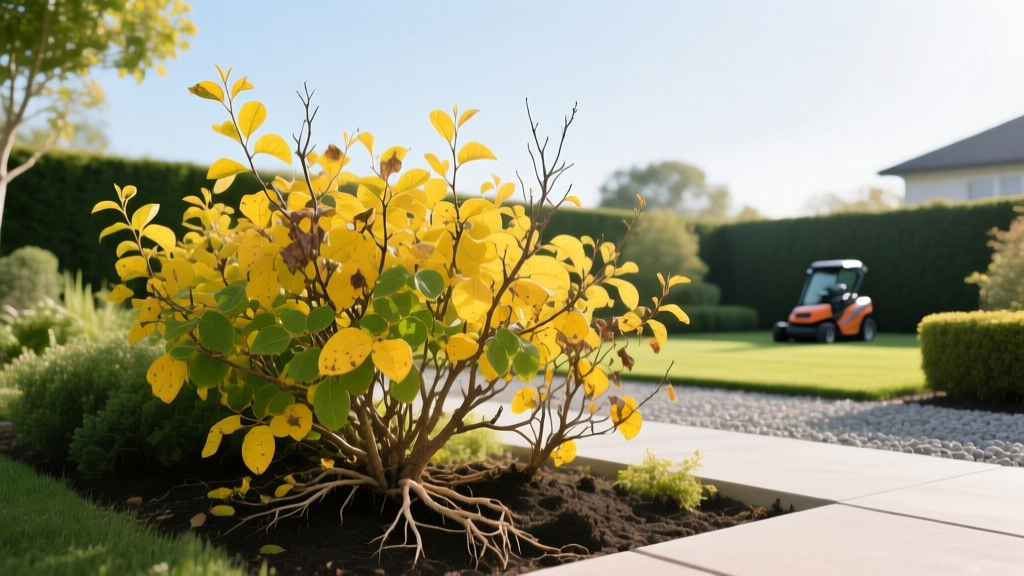
Diagnosing Failing Yellow Shrubs for Landscaping: Rescue Fixes & Care
The Volatility of Golden Foliage in Landscape Design
Homeowners intentionally select yellow shrubs for landscaping—such as Sunshine Ligustrum, Gold Mop Cypress, and Golden Euonymus—to create high-contrast focal points and brighten shaded garden beds. However, golden foliage is notoriously volatile. When these specimens lose their vibrant hue, turn muddy green, or develop crispy brown margins, it signals environmental stress, nutrient lockout, or genetic reversion.
Unlike standard green shrubs, yellow cultivars possess a genetic mutation that suppresses chlorophyll production, allowing carotenoids (yellow and orange pigments) to dominate the leaf tissue. This suppression makes them inherently less efficient at photosynthesis and highly sensitive to environmental shifts. Understanding the exact physiological trigger behind your shrub's color change is the first step in executing a successful rescue.
Symptom Diagnosis: The Golden Shrub Decision Matrix
Before applying fertilizers or pruning, you must accurately identify the failure mode. Use the diagnostic matrix below to match your shrub's visual symptoms to the underlying physiological cause.
| Visual Symptom | Primary Indicator | Underlying Cause | Immediate Rescue Action |
|---|---|---|---|
| Muddy green leaves on inner branches | Reversion to wild-type green | Insufficient UV exposure (less than 4 hours direct sun) or genetic instability | Selective pruning of green shoots; relocate to full sun |
| Pale, washed-out yellow with green veins | Interveinal chlorosis | Iron or manganese lockout due to high soil pH (>7.0) | Apply chelated iron (Fe-EDDHA) and soil acidifier |
| Crispy, brown leaf margins and tips | Desiccation and winter burn | Moisture loss from freezing winds exceeding root uptake capacity | Deep hydration, apply anti-transpirant spray, adjust mulch |
| Uniform yellowing dropping to the ground | Root asphyxiation or rot | Overwatering, heavy clay soil, or mulch piled against the stem (volcano mulching) | Pull back mulch 3 inches from stem; aerate root zone |
Symptom 1: Genetic Reversion and Shade Fading
The most common complaint with yellow shrubs for landscaping is the gradual loss of color, where vibrant gold turns into a dull, muddy green. This occurs via two distinct mechanisms:
Shade-Induced Chlorophyll Upregulation
When a golden cultivar like the Gold Mop Cypress (Chamaecypis pisifera 'Filifera Aurea') receives less than four to six hours of direct sunlight, the plant experiences energy starvation. To survive, it upregulates chlorophyll production to maximize whatever light is available. The surge in green chlorophyll masks the yellow carotenoids. Rescue Fix: You cannot reverse shaded leaves to gold. You must either prune surrounding canopy trees to increase light penetration or transplant the shrub during its dormant season (late fall or early spring) to a location receiving a minimum of six hours of direct sun.
Genetic Reversion (Sporting)
Sometimes, a single branch or cluster of leaves will revert to pure green due to cellular instability in the meristematic tissue. This is highly common in Golden Euonymus (Euonymus japonicus 'Aureomarginatus'). If left unchecked, the vigorous green shoots will outcompete the slower-growing yellow tissue, eventually taking over the entire plant.
Warning: Never shear a reverting yellow shrub with hedge clippers. Shearing stimulates dense outer growth that shades the interior, accelerating further reversion. Always use bypass pruners to trace the green branch back to its origin point on the main stem and remove it entirely.
Symptom 2: Iron Chlorosis and Nutrient Lockout
If your shrub's leaves are turning a pale, sickly yellow while the leaf veins remain distinctly green, you are looking at interveinal chlorosis. This is rarely a true iron deficiency in the soil; rather, it is a pH-induced lockout. Iron becomes chemically unavailable to plant roots when soil pH rises above 7.0, which is common in arid regions or newly constructed homes with alkaline subsoil.
The Chelated Iron Rescue Protocol
Standard iron sulfate will not work in high-pH soils because it oxidizes and locks up before the roots can absorb it. You must use a specific chelated iron formulation.
- Product Selection: Purchase a chelated iron product containing Fe-EDDHA (such as Bonide Liquid Iron or Sequestrene 138). Fe-EDDHA remains stable and bioavailable in soils with a pH up to 9.0. Expect to pay approximately $18 to $25 for a 16 oz concentrate.
- Application Rate: Mix 2 oz of liquid chelated iron per gallon of water. Apply as a soil drench directly over the root zone, using 1 gallon of mixed solution per 10 square feet of shrub canopy.
- Timeline: Foliar and tissue greening should begin within 7 to 14 days. For severe cases, a second application may be required after 21 days.
According to the University of Minnesota Extension, correcting the underlying soil pH is critical for long-term health, as repeated iron applications are only a temporary bandage.
Long-Term pH Correction
To permanently lower soil pH into the optimal 5.5 to 6.5 range for acid-loving golden shrubs, apply elemental sulfur or a commercial soil acidifier. Espoma Soil Acidifier (approx. $14 for a 4 lb bag) contains elemental sulfur and gypsum. Apply 1 cup per 10 square feet of soil surface in early spring and again in late fall. Water it in thoroughly. Note that elemental sulfur relies on soil bacteria to convert it to sulfuric acid, meaning it will take 3 to 6 months to see a measurable shift on your soil test kit.
Symptom 3: Winter Burn and Desiccation
Evergreen yellow shrubs, particularly those exposed to harsh northern or western winter winds, often emerge in spring with scorched, brown, or bleached foliage. Because they retain their leaves year-round, they continue to lose moisture through transpiration even when the ground is frozen solid and roots cannot replace the lost water.
Preventative and Reactive Fixes
If your shrub is already showing winter burn in early spring, do not prune the brown tissue immediately. Wait until the threat of the final frost has passed and new buds begin to swell, then prune back only to live, green wood. To prevent this in future seasons, implement an anti-transpirant protocol:
- Hydrate Deeply: In late autumn, before the ground freezes, provide 1 inch of water per week to ensure the root zone is fully saturated.
- Apply Anti-Transpirant: Spray the foliage with a polymer-based anti-desiccant like Wilt Pruf ($22 for a 32 oz ready-to-use bottle) in late November, and apply a second coat in late January during a thaw when temperatures are above 40°F. This coats the needles and leaves in a breathable resin that reduces moisture loss by up to 50%.
- Install Windbreaks: For highly susceptible specimens like Golden Euonymus, erect a temporary burlap screen on the windward side to block desiccating winter winds without smothering the plant.
Step-by-Step Root Zone Rescue for Failing Shrubs
When a yellow landscaping shrub is declining rapidly with no obvious foliar disease, the problem is almost always subterranean. Follow this exact sequence to rescue a suffocating root system.
Pro Tip: Before digging, use a Luster Leaf Rapitest Soil Test Kit ($12) to check your baseline pH and moisture levels. Guessing your soil chemistry leads to wasted money on the wrong amendments.
Step 1: Correct 'Volcano Mulching'
Pulling mulch away from the trunk is non-negotiable. Mulch piled against the bark keeps the cambium layer perpetually wet, inviting fungal pathogens and rodent girdling. Use a hand cultivator to pull all mulch and soil away from the base, creating a 3-inch to 4-inch dry moat around the main stem. The root flare (where the trunk widens at the base) must be fully exposed to the air.
Step 2: Alleviate Soil Compaction
Landscaping shrubs planted near walkways or driveways suffer from severe soil compaction, which starves roots of oxygen. Use a broadfork or a solid steel rebar to poke 8-inch deep holes in a grid pattern every 12 inches across the entire drip line (the area under the outermost branches). Do not use a rototiller, as this will sever the critical fine feeder roots.
Step 3: Top-Dress with Organic Matter
Fill the aeration holes with a 50/50 mix of coarse horticultural sand and screened compost. This creates permanent vertical channels for oxygen and water penetration. Finally, apply a uniform 2-inch layer of arborist wood chips over the root zone, ensuring it stays 3 inches away from the trunk.
Proactive Maintenance Calendar for Golden Cultivars
Maintaining the vibrant color of yellow shrubs for landscaping requires a strict, seasonally timed maintenance schedule. Print this framework and stick to it to prevent symptom onset.
- Early Spring (Bud Break): Apply a slow-release, acid-forming fertilizer (such as Holly-tone) at a rate of 1 cup per foot of shrub height. Prune out any winter-killed or reverted green branches.
- Late Spring (Post-Bloom): Apply the first dose of elemental sulfur or soil acidifier if your soil pH tests above 6.5. Ensure the shrub is receiving 1 inch of water per week as temperatures rise.
- Mid-Summer: Monitor for spider mites, which thrive in hot, dry conditions and cause yellow foliage to look dusty and stippled. If detected, blast the foliage with a strong jet of water or apply Monterey Horticultural Oil ($15/pint) in the early evening to avoid leaf burn.
- Late Fall (Pre-Dormancy): Deep water the root zone. Apply anti-transpirant sprays to evergreen varieties. Apply the second dose of soil acidifier before the ground freezes.
For comprehensive species-specific care, particularly regarding pruning tolerances for Ligustrum varieties, refer to the guidelines published by the Clemson University Home & Garden Information Center. By combining precise soil chemistry management with strategic pruning, you can maintain the striking, high-contrast gold foliage that makes these shrubs so valuable in landscape design.

