
Tree Care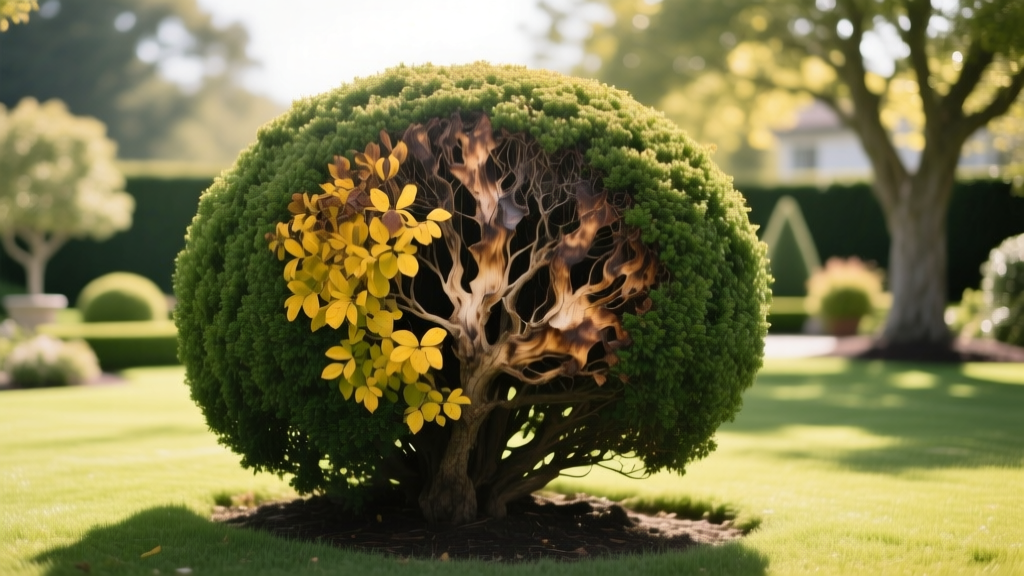
Round Bushes Turning Brown Inside? Diagnosis and Fixes
The Anatomy of a Failing Spherical Shrub
Homeowners frequently plant shrubs like Buxus sempervirens (common boxwood), Thuja occidentalis 'Danica' (globe arborvitae), and spherical junipers to create perfect, manicured foundation anchors. However, a pervasive structural failure plagues these specimens after three to five years of standard maintenance: the exterior remains a vibrant green shell, while the interior turns into a brittle, brown graveyard.
This phenomenon is rarely a sudden disease outbreak; it is almost always a mechanical failure caused by improper shearing. When you shape a bush into a tight sphere using power hedge trimmers, you stimulate dense lateral bud growth on the outer 1 to 2 inches of the canopy. This creates a thick 'canopy shell' that intercepts up to 95% of photosynthetically active radiation (PAR). The interior foliage, receiving less than 5% PAR, undergoes abscission—dropping leaves to conserve carbohydrates for the sunlit exterior. Over time, this hollow center becomes a trap for moisture, dead debris, and fungal pathogens.
Critical Maintenance Error: Using gas-powered or electric hedge shears exclusively on round bushes guarantees interior dieback. Shearing only cuts the tips, forcing outward growth and choking the core. Hand-pruning is mandatory for spherical shrub longevity.
Symptom Checker: Cultural, Fungal, or Pest-Related?
Before applying fungicides or fertilizers, you must accurately diagnose why the center of your round bush is failing. Misdiagnosis leads to wasted chemical applications and further plant decline. Use this diagnostic matrix to identify the primary driver of interior browning.
| Visual Symptom | Primary Cause | Field Test / Confirmation |
|---|---|---|
| Brown, dry leaves strictly in the deep interior; outer shell is bright green and dense. | Light Deprivation (Cultural) | Part the outer canopy. If inner stems are alive (green under the bark) but leafless, it is purely a light/airflow issue. |
| Salmon-pink or orange pustules on inner stems; rapid leaf drop in wet weather. | Volutella Blight (Pseudonectria rousseliana) | Inspect dead inner twigs in high humidity. Look for raised, pinkish fruiting bodies on the dark, sunken bark cankers. |
| Interior browning accompanied by fine, silken webbing and stippled (yellow-speckled) outer leaves. | Spider Mites or Spruce Spider Mites | Hold a white piece of paper under an inner branch and tap sharply. If tiny, moving 'dust specks' fall and streak when smeared, mites are present. |
| Random inner branches turning straw-brown; outer canopy shows scattered yellowing. | Boxwood Leafminer or Nematode Damage | Hold a leaf up to the sun. Leafminers show translucent blotches. Root-knot nematodes require a soil lab assay to confirm. |
Deep Dive: Managing Volutella Blight in Hollow Centers
If your diagnostic test points to a fungal issue, Volutella blight is the most common opportunistic pathogen in the hollow centers of round boxwoods. According to the Boxwood Blight Task Force, Volutella is a weak pathogen that exclusively targets stressed tissue trapped in high-humidity, low-airflow environments—exactly the conditions created by tight spherical shearing.
Once Volutella establishes in the dead interior duff of a round bush, it will eventually girdle the main structural scaffolds, causing entire quadrants of the shrub to collapse. Treatment requires a two-pronged approach: physical removal of the inoculum and targeted chemical protection.
- Sanitation: You must physically rake out the interior 'duff' (the mat of dead leaves and twigs trapped in the crotches of the branches). This removes the overwintering site for fungal spores.
- Chemical Control: Apply a protectant fungicide containing chlorothalonil (e.g., Bonide Fung-onil) or a systemic like propiconazole (e.g., Bayer Advanced Disease Control). Spray must penetrate the outer shell and coat the inner scaffolding. Apply in early spring just before bud break, and again in early summer.
The 'Renovation Pruning' Protocol: Restoring the Sphere
To fix a round bush that is brown inside due to light deprivation, you must perform 'windowing' or 'thinning' cuts. This process opens the canopy to light and air without destroying the overall spherical silhouette. According to NC State Extension, proper thinning allows dappled light to reach the inner scaffolds, waking up dormant adventitious buds.
Step-by-Step Thinning Procedure
- Tool Selection and Sanitization: Discard the hedge shears. Use a high-quality bypass hand pruner (like the Felco 2). Wipe the blades with 70% isopropyl alcohol between every single cut to prevent spreading latent Volutella or Boxwood Blight spores.
- Identify the 'Windows': Visually divide the sphere into six quadrants (like a tennis ball). You will create one 3-to-4-inch wide 'window' in each quadrant.
- Execute Thinning Cuts: Reach deep into the canopy at your marked window points. Remove 15% to 20% of the interior branches by cutting them back to a lateral node or the main trunk. Do not leave stubs; stubs will not back-bud and will rot.
- Clean the Core: Use a specialized shrub rake or your gloved hands to pull out the severed branches and accumulated dead debris from the center of the plant.
- Balance the Exterior: Once the interior is thinned, use your hand shears to lightly shape the outer 1-inch of growth, restoring the round profile. Never cut back into bare, leafless wood on the exterior, as conifers (like globe arborvitae) and some broadleaf evergreens will not regenerate from old, brown wood.
Soil and Root Zone Interventions
Interior browning is often exacerbated by shallow root systems competing for nutrients. Spherical shrubs are frequently planted in compacted foundation beds where soil pH drifts alkaline due to leaching from concrete and mortar.
'Boxwoods and many foundation shrubs require a soil pH between 6.5 and 7.0. When pH exceeds 7.2, iron and manganese become chemically locked in the soil, leading to interior chlorosis that mimics dieback.' — Penn State Extension
Before applying fertilizer, conduct a soil test. If pH is high, apply elemental sulfur at a rate of 1 pound per 100 square feet to lower it gradually. For nutritional support, use a slow-release, acid-forming fertilizer with a 10-6-4 NPK ratio that includes chelated iron (Fe-EDDHA), which remains available to the plant even in slightly alkaline soils. Apply 1.5 pounds per 100 square feet of root zone in early spring.
Decision Framework: When to Rehabilitate vs. Replace
Not every failing round bush is worth saving. Use this economic and biological framework to decide whether to invest time in renovation pruning or to remove the specimen entirely.
| Condition Assessment | Recommended Action | Estimated Cost (2026 Rates) |
|---|---|---|
| < 30% interior dieback; main scaffolds are green and flexible; no active cankers. | Rehabilitate. Perform renovation pruning and interior cleanup. | $40-$60 (DIY tools/chemicals) or $125-$175 (Professional arborist) |
| 30% - 50% dieback; Volutella blight confirmed; main trunks still viable. | Aggressive Rehab. Heavy thinning, duff removal, and 2-year fungicide regimen. | $150-$250 (Professional treatment plan) |
| > 50% canopy dead; Phytophthora root rot suspected; main trunks brittle and snapping. | Replace. Remove shrub, treat soil with phosphite fungicide, replant with resistant cultivar. | $250-$450 (Removal, soil prep, and new 4-ft specimen installation) |
If replacement is necessary, avoid replanting the exact same susceptible species in the same hole. Swap common boxwood (Buxus sempervirens) for blight-resistant cultivars like 'NewGen Independence' or 'Green Beauty', or transition to a different structural species like Ilex crenata (Japanese holly) which naturally maintains a dense, rounded habit with less aggressive shearing requirements.

