Tree Care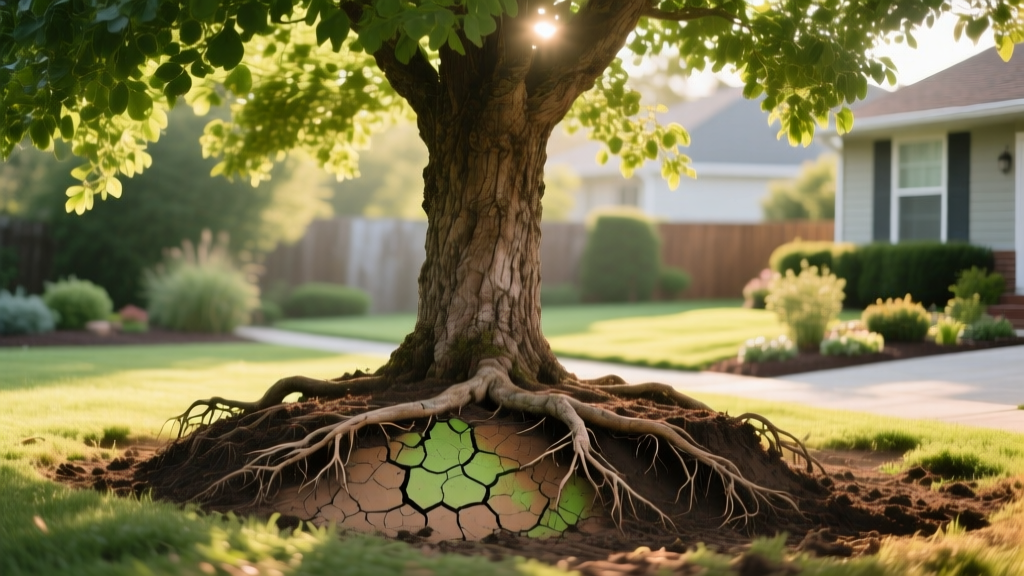
Can Roundup Kill Trees? How Glyphosate Exposure Damages Roots
The Short Answer: Yes, Roundup Can Kill Trees
Homeowners frequently ask, can Roundup kill trees? The direct answer is yes, but rarely through the mechanism most people assume. Glyphosate, the active ingredient in Roundup, is a systemic, non-selective herbicide. While mature tree bark provides a robust physical barrier against foliar contact, the real threat to your trees lies beneath the soil surface and at the root flare. When applied improperly near the base of a tree, glyphosate can be absorbed by shallow feeder roots, root suckers, or green, unhardened bark, eventually translocating through the phloem and destroying the tree's ability to synthesize essential amino acids.
Understanding the exact failure modes of glyphosate exposure is critical for preserving mature landscaping. According to the U.S. Environmental Protection Agency (EPA), glyphosate inhibits the EPSP synthase enzyme, effectively starving the plant of proteins required for growth. While it degrades relatively quickly in the soil via microbial action, direct application within a tree's Critical Root Zone (CRZ) can deliver a lethal dose before breakdown occurs.
⚠️ Critical Warning on 'Extended Control' Formulas: Standard Roundup (glyphosate only) poses a moderate root-uptake risk. However, products labeled 'Roundup Extended Control' or 'Max Control' often contain secondary soil-residual herbicides like imazapic or imazapyr. These soil-active chemicals remain bioavailable for months and will absolutely kill mature trees if applied anywhere within the tree's drip line.
The Hidden Danger: Surfactants and Soil Mobility
Glyphosate alone binds tightly to soil particles, rendering it mostly inactive once it hits the dirt. However, commercial and consumer formulations include surfactants (like POEA or pelargonic acid) to help the chemical penetrate plant cuticles. The National Pesticide Information Center (NPIC) notes that these surfactants can temporarily increase the soil mobility of glyphosate. If you spray weeds at the base of a tree on wet soil or just before a rainstorm, the surfactant can carry the active ingredient down to the shallow, fibrous feeder roots that dominate the top 12 inches of soil, leading to systemic poisoning.
Identifying Glyphosate Toxicity vs. Environmental Stress
Diagnosing herbicide damage requires a trained eye, as symptoms often mimic drought stress, verticillium wilt, or nutrient deficiencies. Glyphosate damage typically appears 10 to 14 days after exposure, though it may take a full season to manifest if absorbed in small quantities via the roots.
Symptom Identification Matrix
| Symptom | Glyphosate Toxicity | Drought / General Stress |
|---|---|---|
| Leaf Chlorosis (Yellowing) | Light, interveinal yellowing starting on new growth and branch tips. | Uniform browning or crispy margins starting on older, lower leaves. |
| Leaf Morphology | Severe cupping, strapping, or extreme narrowing of leaves. | Leaves remain normal shape but wilt or curl inward to conserve water. |
| Growth Patterns | 'Witches broom' effect (dense, stunted clusters of twigs at branch ends). | General stunting, premature leaf drop, or branch dieback. |
| Root Suckers | Prolific, deformed suckering at the trunk base as the tree attempts to replace failing canopy. | Suckering only occurs if the tree has suffered severe physical trauma or root rot. |
Mapping the Danger Zone: The Critical Root Zone (CRZ)
To protect your trees, you must understand where their roots actually live. A common misconception is that roots stop at the 'drip line' (the outer edge of the canopy). In reality, the most vital feeder roots extend 2 to 3 times the width of the canopy. However, the highest concentration of structural and absorbing roots exists within the Critical Root Zone.
Calculate Your Tree's Safe Perimeter
Arborists use a standard formula to establish a no-spray buffer zone around yard trees:
- Measure the Trunk: Measure the trunk diameter at breast height (DBH), which is 4.5 feet above the ground.
- Apply the Multiplier: Multiply the DBH in inches by 1.2 to 1.5.
- The Result: This number is the radius (in feet) of the Critical Root Zone where absolutely no soil-active or surfactant-heavy herbicides should be applied.
Example: A mature red maple with a 20-inch diameter trunk has a CRZ radius of roughly 24 to 30 feet from the trunk center. Spraying weeds directly at the base of this tree is applying poison directly onto its primary feeding network.
Safe Application Protocols Near Landscaping
If you must use glyphosate to manage invasive weeds like poison ivy or deep-rooted dandelions near established trees, strict application protocols are required to prevent accidental root uptake or bark absorption.
- Target Green Tissue Only: Never spray the soil. Use a shielded wand or a sponge applicator to paint the herbicide directly onto the leaves of the target weed.
- Watch the Bark: Glyphosate cannot penetrate thick, corky, mature bark. However, trees under 3 years old, or species with naturally thin bark (like beech, maple, and crape myrtle), have green, photosynthetic tissue near the base. Drift on this tissue will be absorbed directly into the cambium layer.
- Manage Root Suckers: Never spray herbicide on the small shoots (suckers) growing from the base of the tree or surface roots. These are directly connected to the parent tree's vascular system and will act as a superhighway, delivering a concentrated dose of herbicide straight to the main trunk.
- Control Droplet Size: Adjust your sprayer nozzle to a coarse, low-pressure setting (below 20 PSI). Fine mists easily drift in the wind and settle on the lower branches or exposed root flares of adjacent trees.
Alternative Herbicides for the Tree Zone
When managing weeds inside the Critical Root Zone, consider abandoning glyphosate entirely in favor of contact-only or organic alternatives that do not translocate through root systems.
Pro-Tip: Glufosinate-Ammonium
Products containing glufosinate (e.g., Finale) are contact herbicides that do not move systemically through the plant's vascular system like glyphosate. If accidental overspray hits a tree's shallow roots or surface suckers, the damage remains localized to the contacted tissue rather than poisoning the entire tree.
Products containing glufosinate (e.g., Finale) are contact herbicides that do not move systemically through the plant's vascular system like glyphosate. If accidental overspray hits a tree's shallow roots or surface suckers, the damage remains localized to the contacted tissue rather than poisoning the entire tree.
Remediation: What to Do After Accidental Exposure
If you realize you have sprayed glyphosate within a tree's root flare, immediate action can mitigate severe damage:
- Immediate Flushing: Drench the affected soil area with water to push the chemical deeper than the primary feeder root zone and encourage microbial breakdown.
- Activated Charcoal: Apply agricultural-grade activated charcoal (biochar) to the soil surface. Charcoal has a massive surface area and can adsorb unabsorbed glyphosate molecules, neutralizing them before root uptake occurs.
- Pruning Suckers: If you accidentally sprayed root suckers, immediately prune them flush with the root before the herbicide has time to translocate (usually within 1 to 2 hours).
- Foliar Feeding: In the weeks following exposure, apply a kelp-based biostimulant or amino-acid foliar spray directly to the tree's canopy. This bypasses the compromised root system and provides the building blocks the tree is struggling to synthesize.