
Tree Care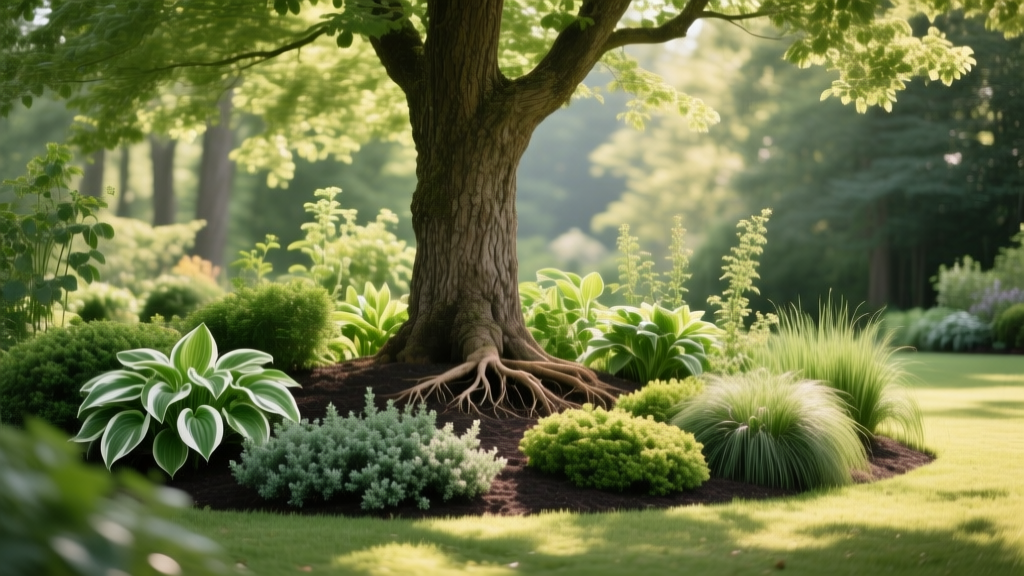
Best Plants Around Trees: Safe Choices for Root Zones
Planting under a mature tree canopy presents a unique horticultural paradox: the area is shaded, yet the soil is often bone-dry and heavily compacted. When beginners search for the best plants around trees, they frequently focus only on shade tolerance, ignoring the fierce underground competition for water and nutrients. Worse, well-intentioned gardeners often inadvertently kill their trees by adding layers of topsoil or rototilling the root zone.
Successfully establishing an under-tree garden requires a shift in strategy. Instead of altering the soil profile to suit the plants, you must select specific shallow-rooted, drought-tolerant species and use a low-impact installation technique. This guide details the exact cultivars, measurements, and "no-dig" protocols required to build a lush understory without suffocating your tree's vital feeder roots.
The Biology of the Tree Root Zone: Why Traditional Planting Fails
To understand how to plant safely, you must understand where tree roots actually live. A common misconception is that tree roots mirror the canopy's depth. In reality, 90% of a tree's fine feeder roots—the ones responsible for absorbing water and oxygen—are located in the top 6 to 12 inches of soil. According to the University of Minnesota Extension, these roots require a constant exchange of gases with the atmosphere.
CRITICAL WARNING: The Topsoil Trap
Never add more than 1 inch of soil or mulch over an existing tree root zone. Adding 3 to 6 inches of topsoil to "create a garden bed" cuts off oxygen to the feeder roots. This triggers a slow decline that often kills the tree 3 to 5 years later, long after the gardener has forgotten they altered the soil grade.
The 3 Golden Rules for Under-Tree Planting
Before selecting your plants, commit to these three non-negotiable rules to protect the tree's health and ensure your new plants survive the first summer.
1. Respect the 18-Inch Trunk Buffer
The area immediately surrounding the trunk is the "root flare" zone, where major structural roots emerge. Keep all planting and mulching at least 18 inches away from the trunk base. Piling soil or mulch against the bark (often called "volcano mulching") invites fungal pathogens and root-girdling, which can strangle the tree.
2. Buy Plugs, Not Gallons
Beginners typically buy 1-gallon or 2-gallon nursery pots, which require digging large, deep holes that sever critical tree roots. Instead, purchase "plugs" or "liners" (typically 2.5-inch deep pots). As of 2026, nursery pricing for high-quality perennial plugs averages $5 to $8 each, compared to $18 to $28 for 1-gallon pots. Plugs require only a 3-inch deep pocket to plant, drastically reducing root damage to the tree.
3. Avoid the "Rototiller" Mistake
Never use a mechanical tiller to prep the soil under a tree canopy. A rototiller will shred the tree's fine feeder roots, causing massive stress and opening the tree up to opportunistic diseases like Armillaria root rot. All soil preparation must be done by hand using a narrow hand trowel or a dibber.
Top 5 Resilient Plants Around Trees (Comparison Matrix)
The following cultivars are specifically selected for their ability to thrive in "dry shade"—the most challenging microclimate in the garden. They feature shallow, fibrous root systems that do not compete aggressively with the tree's deeper structural roots.
| Common Name | Botanical Cultivar | Light Requirement | Mature Height | Root Profile |
|---|---|---|---|---|
| Barrenwort | Epimedium grandiflorum | Deep to Part Shade | 12 - 15 inches | Very shallow, rhizomatous |
| Coral Bells | Heuchera 'Citronelle' | Part Shade | 12 - 18 inches | Fibrous, compact crown |
| Lenten Rose | Helleborus orientalis | Deep Shade Tolerant | 18 - 24 inches | Moderate, fleshy roots |
| Miniature Hosta | Hosta 'Blue Mouse Ears' | Deep Shade | 6 - 8 inches | Shallow, non-invasive |
| Lilyturf | Liriope muscari 'Variegata' | Deep to Part Shade | 12 - 15 inches | Tuberous, drought-hardy |
Step-by-Step: The "Pocket Planting" Technique
Once you have selected your plugs, use this specific installation method recommended by the University of Wisconsin-Madison Extension to minimize root disturbance.
- Map the Safe Zones: Using a hand trowel, gently scrape away the top 1 inch of leaf litter and soil in your planting area. Look for the tree's structural roots. You are looking for "pockets" of empty soil between roots that are at least 4 inches wide and 3 inches deep.
- Assess Root Thickness: If you encounter a tree root thicker than 1/2 inch (the diameter of a standard pencil), do not cut it. Move your planting pocket 3 inches to the left or right. Only fine, hair-like feeder roots can be safely disturbed.
- Dig the Pocket: Dig a hole exactly the depth of the plug's root ball (usually 2.5 inches). Do not dig deeper than necessary, as this loosens the soil beneath the plug and can cause it to sink, burying the plant's crown.
- Amend Only the Pocket: Do not amend the entire bed. Mix a small batch of 50% native soil and 50% high-quality compost (avoid heavy peat moss, which dries out and becomes hydrophobic in dry shade). Place a handful in the bottom of the pocket.
- Plant and Water: Insert the plug, ensuring the crown is level with the surrounding soil grade. Water each plug immediately with 16 ounces of water to settle the soil and eliminate air pockets.
- Apply Micro-Mulch: Apply a maximum of 1.5 inches of fine shredded hardwood mulch or leaf mold around the new plants. Keep the mulch 1 inch away from the stems of the new plants and 18 inches away from the tree trunk.
3 Fatal Beginner Mistakes to Avoid
- Mistake: Building a Raised Bed Around the Tree.
Correction: Enclosing a tree trunk in a wooden or stone raised bed and filling it with soil is a death sentence for the tree. It traps moisture against the bark, causing basal rot, and suffocates the root flare. Always plant directly into the existing grade. - Mistake: Overwatering to Compensate for Dry Soil.
Correction: While new plugs need regular watering for the first 60 days (about 1 inch of water per week), constantly soaking the tree's root zone invites Phytophthora root rot. Use a soil moisture meter to check the top 3 inches of soil before watering. - Mistake: Choosing Aggressive Groundcovers.
Correction: Avoid planting English Ivy (Hedera helix), Vinca Minor, or Wintercreeper. These invasive species will climb the tree trunk, blocking sunlight from the tree's bark and adding immense physical weight to the branches during ice storms.
Frequently Asked Questions
Can I plant spring bulbs around trees?
Yes, early spring bulbs like Narcissus (daffodils) and Galanthus (snowdrops) are excellent choices. Because they bloom and complete their foliage cycle before the tree fully leafs out, they capture the early spring sunlight and go dormant during the dry summer months when the tree's water demand is highest.
How close to the trunk can I plant small ferns?
Maintain the 18-inch buffer rule regardless of the plant size. The area immediately adjacent to the trunk is critical for the tree's structural root flare and bark respiration. If the space inside the 18-inch radius looks bare, cover it lightly with a 1-inch layer of coarse wood chips, not soil or dense plants.
Will the new plants steal water from the tree?
The plants recommended in the matrix above have low transpiration rates and shallow root profiles. A mature tree's root system extends far beyond its drip line, absorbing the vast majority of its water from the outer edges of the canopy. The minor competition from a few understory plugs is biologically insignificant to a healthy, established tree.

