
Tree Care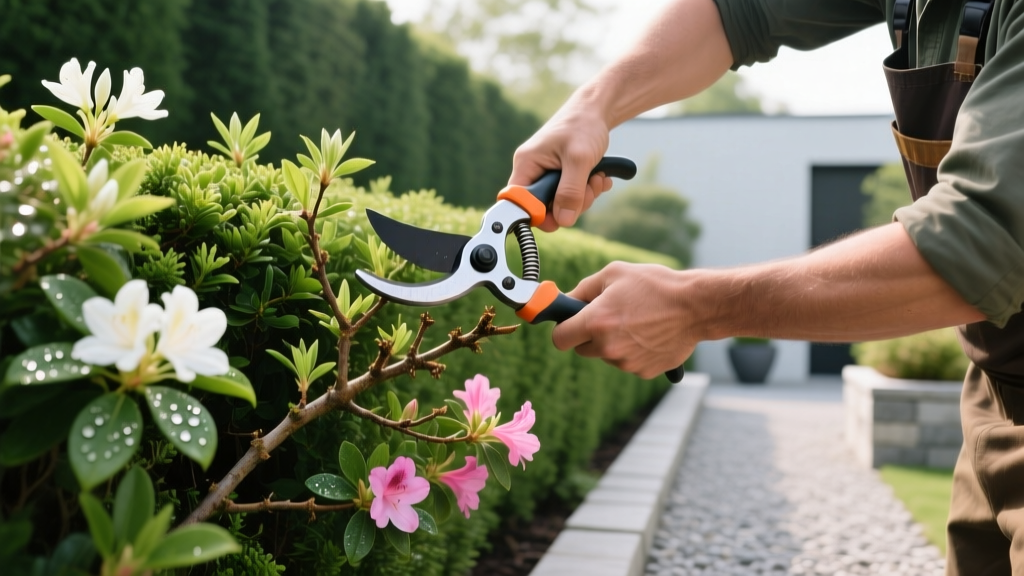
Shrub Trimming Techniques for Flowering and Evergreen Hedges
Improper shrub trimming reduces bloom production by up to 40% and invites fungal pathogens into exposed cambium layers. While shearing a hedge into a geometric shape might look tidy for a few weeks, it ignores the plant's internal biology, leading to hollow centers, dead lower branches, and structural failure. Mastering shrub trimming requires understanding apical dominance, compartmentalization of decay, and the specific flowering habits of your species.
This guide bypasses generic advice to provide exact measurements, tool calibration techniques, and seasonal matrices for maintaining both formal hedges and informal flowering shrubs.
The Biology of the Cut: Where and How to Trim
Every cut you make is a wound. Shrubs do not heal; they compartmentalize. According to the Penn State Extension, proper cutting technique ensures the plant can rapidly seal off the damaged tissue (a process known as CODIT) without dieback spreading to the main stem.
The 1/4-Inch Rule and Angle Geometry
When making heading cuts on individual branches, always cut exactly 1/4 inch above an outward-facing lateral bud. The cut must be made at a 45-degree angle that slopes away from the bud.
- Why 1/4 inch? Cutting closer risks damaging the bud's vascular connection. Cutting further leaves a stub that cannot compartmentalize, eventually rotting and creating an entry point for borers and canker fungi.
- Why the 45-degree slope? A sloped cut acts as a miniature watershed, directing rain and irrigation runoff away from the delicate bud tissue, preventing rot.
- Why outward-facing? This dictates the direction of new growth, pushing the canopy outward to maximize light penetration and air circulation, which is critical for preventing powdery mildew in dense shrubs like lilacs and ninebark.
⚠️ Warning: The Lion-Tailing Mistake
Never strip the inner branches of a shrub and leave foliage only at the extreme tips (lion-tailing). This removes the plant's interior photosynthetic capacity, shifts the center of gravity outward, and creates weak, spindly growth highly susceptible to snapping under heavy snow loads or high winds.
Never strip the inner branches of a shrub and leave foliage only at the extreme tips (lion-tailing). This removes the plant's interior photosynthetic capacity, shifts the center of gravity outward, and creates weak, spindly growth highly susceptible to snapping under heavy snow loads or high winds.
Tool Selection and Calibration
Using the wrong tool crushes plant tissue rather than slicing it, delaying compartmentalization. Invest in high-carbon steel or forged steel blades that hold a sharp edge through 500+ cuts.
| Tool Type | Recommended Model | Est. Cost | Application |
|---|---|---|---|
| Bypass Pruners | Felco F-2 Classic | $62 | Live branches up to 1 inch thick; precision heading cuts. |
| Hedge Shears | ARS HS-K1000 | $78 | Formal hedge shaping; cutting multiple soft, green stems simultaneously. |
| Loppers | Fiskars 32" PowerGear2 | $55 | Thick, dead interior branches up to 2 inches; deep canopy thinning. |
| Cordless Trimmer | EGO 56V 24" Hedge Trimmer | $229 | Large-scale evergreen hedge maintenance (yew, arborvitae, boxwood). |
Calibration Tip: For bypass pruners and hedge shears, adjust the pivot bolt until the blades pass each other with a faint metallic whisper. If the gap is too wide, the blades will fold and tear the cambium layer. If too tight, you will experience rapid hand fatigue and premature pivot wear.
Seasonal Timing Matrix: When to Trim
Timing is dictated by whether the shrub blooms on "old wood" (last year's growth) or "new wood" (current season's growth). Trimming at the wrong time removes the flower buds before they can open. The University of Minnesota Extension emphasizes that aligning your trimming schedule with the plant's biological clock is non-negotiable for flowering species.
| Shrub Category | Common Species | Optimal Trimming Window | Biological Mechanism |
|---|---|---|---|
| Spring Bloomers (Old Wood) | Forsythia, Lilac, Weigela, Azalea | Within 3 weeks after flowering fades (Usually June) | Allows the plant to generate new vegetative growth over the summer, which will set flower buds in late autumn for the following spring. |
| Summer Bloomers (New Wood) | Butterfly Bush, Rose of Sharon, Hydrangea paniculata | Late winter to early spring (March, before bud break) | Stimulates vigorous new spring growth, which directly produces the current year's flower clusters. |
| Evergreens (Non-flowering) | Boxwood, Yew, Arborvitae, Holly | Early summer (June) and late summer (August) | Trims the spring flush to maintain shape, while avoiding late-fall cuts that leave tender tissue vulnerable to winter desiccation. |
Execution: Formal Hedges vs. Informal Shrubs
Formal Hedges: The "Battered" A-Frame Technique
When using hedge shears or a power trimmer on formal hedges (like boxwood or privet), never cut the hedge perfectly vertical or wider at the top. You must employ a "battered" cut, where the base is 10% to 15% wider than the top.
- Calculate the taper: For a 6-foot tall hedge, if you want the top to be 24 inches wide, the base must be at least 30 inches wide.
- Set a guide: Drive wooden stakes at the corners and run a mason's line from the wider base to the narrower top to guide your power trimmer.
- Sweep technique: When using an EGO or STIHL cordless trimmer, use smooth, sweeping upward arcs. Never chop downward, which can catch thick stems and tear the hedge face.
This A-frame geometry ensures that the lower branches receive direct sunlight. Without it, the top canopy shades the bottom, causing the lower branches to die off and leaving you with a "leggy" hedge that is bare at the soil line.
Informal Shrubs: Thinning and Renewal
For informal, naturalistic shrubs, avoid shearing entirely. Shearing forces a dense outer shell of leaves that blocks light from reaching the interior, resulting in a dead, twiggy center.
- Thinning Cuts: Remove 15% to 20% of the oldest, thickest stems completely down to the soil line (or the main trunk). This opens the canopy to light and air, stimulating new basal shoots.
- Heading Cuts: On the remaining branches, make selective heading cuts at varying heights to maintain a natural, staggered profile rather than a flat, artificial top.
💡 Pro Tip: The 1/3 Rejuvenation Rule
If you inherit a severely overgrown, neglected shrub (like an old viburnum or spirea), do not cut it to the ground all at once. Use the three-year rejuvenation method: remove 1/3 of the oldest, thickest canes at ground level in year one, another 1/3 in year two, and the final 1/3 in year three. This maintains the root-to-shoot balance and prevents shock-induced dieback.
If you inherit a severely overgrown, neglected shrub (like an old viburnum or spirea), do not cut it to the ground all at once. Use the three-year rejuvenation method: remove 1/3 of the oldest, thickest canes at ground level in year one, another 1/3 in year two, and the final 1/3 in year three. This maintains the root-to-shoot balance and prevents shock-induced dieback.
Common Failure Modes and Troubleshooting
Even with the right tools, execution errors can compromise the shrub's health. Watch for these specific failure modes:
- Problem: Bark Tearing on Downward Cuts.
Cause: Using dull bypass pruners or cutting branches that are too thick for the tool's capacity.
Fix: Switch to loppers for anything over 3/4 inch. If bark tearing occurs, use a sharp horticultural knife to cleanly trim the ragged bark edges back to healthy tissue to speed up callus formation. - Problem: Interior Dieback and Fungal Growth.
Cause: Over-shearing the exterior, creating a dense "shell" of leaves that traps humidity and blocks UV light from the interior.
Fix: Reach deep into the canopy with hand pruners and make thinning cuts to open up "windows" for light and airflow. Remove all dead interior twigs. - Problem: Winter Burn on Evergreens.
Cause: Trimming arborvitae or yew too late in the fall (October/November). The new growth does not have time to harden off before freezing temperatures hit.
Fix: Cease all trimming of evergreens by mid-August. Apply a 2-inch layer of mulch to retain soil moisture, which prevents winter desiccation.
Precision in shrub trimming is the difference between a landscape that thrives and one that requires constant replacement. By matching your cutting technique to the plant's biological needs and utilizing properly calibrated tools, you ensure vigorous growth, maximal bloom production, and long-term structural integrity.