
Tree Care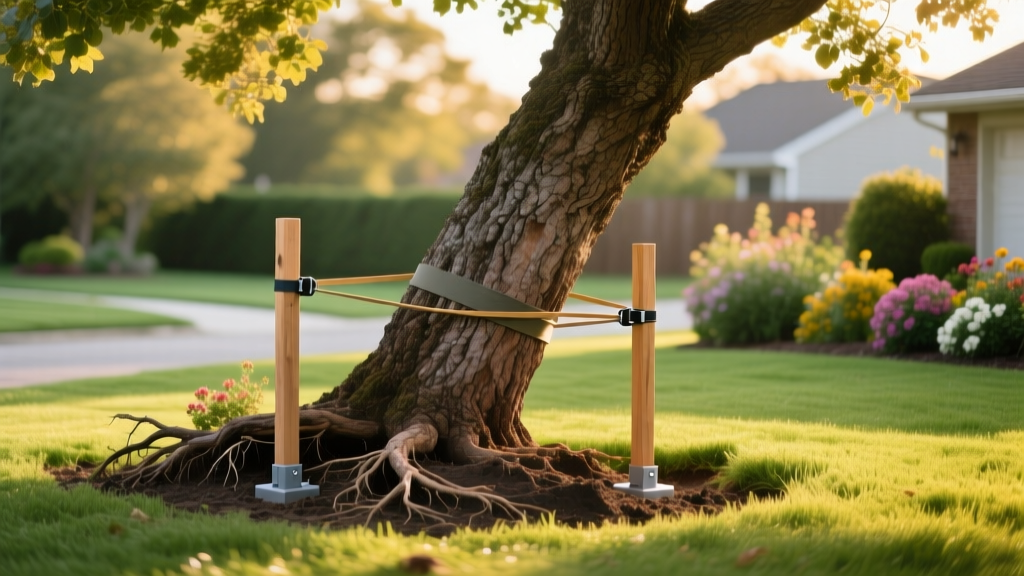
How to Straighten Trees That Lean: Diagnosis and Staking Fixes
A leaning tree is a ticking clock. Whether caused by severe wind events, frost heave, or phototropic growth toward a light source, an off-plumb trunk compromises the root system's structural integrity. Understanding how to straighten trees that lean requires more than just pushing the trunk upright; it demands a precise diagnosis of the root plate and the application of correct mechanical leverage. If executed incorrectly, staking can girdle the cambium layer or snap the taproot, guaranteeing the tree's death.
Diagnose the Lean: Is the Tree Saveable?
Before purchasing stakes and webbing, you must determine why the tree is leaning and whether the root system can support a correction. Not all leans are equal, and applying force to a compromised root plate will only accelerate failure.
| Lean Type | Visual Symptoms | Root Plate Status | Prognosis & Action |
|---|---|---|---|
| Root Ball Tilt (Windthrow) | Soil heaving on the side opposite the lean; visible roots pulling from the earth. | Severed or stretched anchor roots. | Saveable if caliper is under 6 inches and lean is under 30 degrees. |
| Phototropic Lean | Trunk curves gradually toward sunlight; soil at the base is undisturbed. | Intact and well-established. | Highly saveable; requires gradual tensioning over multiple seasons. |
| Improper Planting | Tree was planted off-plumb; trunk is straight but angled from the base. | Intact but adapting to the angle. | Saveable for young trees (under 2 years in ground). Older trees should be left alone. |
| Root Rot / Decay | Mushrooms at the base, oozing sap, soft bark at the root flare. | Structurally failed due to fungal pathogens. | Unsaveable. Immediate removal is required to prevent property damage. |
The 30-Degree Rule of Thumb: If a tree has been uprooted and tilted past a 30-degree angle from vertical, the anchor roots on the tension side are typically snapped beyond repair. For trees exceeding this threshold or with a trunk caliper larger than 8 inches, professional removal is usually the only safe option.
Tools and Materials for Mechanical Correction
Abandon the use of wire, rope, or chain directly against the bark. These materials will cut into the phloem and xylem within a single growing season, effectively strangling the tree. According to the University of Minnesota Extension, proper staking requires materials that distribute pressure evenly across the trunk.
- Strapping: 1.5-inch to 2-inch UV-resistant nylon webbing (e.g., ArborTie). Never use materials narrower than 1 inch.
- Stakes (for young trees): 6-foot galvanized steel T-posts or 2x2 pressure-treated wooden stakes.
- Anchors (for mature trees): 18-inch galvanized rebar or screw-in earth anchors (deadman anchors).
- Tensioners: Heavy-duty ratchet straps or a come-along winch for initial pulling, replaced by webbing for long-term holding.
- Protection: 12-inch sections of old garden hose or specialized rubber chafing guards to protect the bark.
Method 1: Single-Stake Staking (Trees Under 4-Inch Caliper)
This method is appropriate for saplings and young ornamental trees that have recently shifted due to soft soil or minor wind events.
- Position the Stake: Drive a 6-foot T-post into the ground on the side of the tree opposite the direction of the lean. Place it roughly 18 inches from the trunk. Drive it at least 18 inches deep to ensure it won't pull out under tension.
- Attach the Webbing: Loop the 2-inch nylon webbing around the trunk at the lowest point necessary to hold the tree upright—usually about two-thirds of the way up the canopy. Thread the webbing through the rubber hose sleeve to prevent bark abrasion.
- Apply Tension: Pull the tree gently back to plumb. Do not yank it; use steady pressure. Secure the webbing to the T-post using a tension knot or a specialized tree-tie buckle. Leave exactly 1 inch of slack to allow for natural trunk swaying, which stimulates caliper growth and root development.
- Monitor: Check the tie every 30 days. As the trunk expands, loosen the webbing to prevent girdling.
Method 2: The Deadman Anchor System (Trees 4 to 8-Inch Caliper)
For larger shade trees or evergreens with substantial wind resistance, a single stake will fail. You must use a multi-point guying system with subterranean deadman anchors.
Step-by-Step Execution
Begin by wrapping a protective collar of burlap or heavy rubber around the trunk at the attachment point (roughly 5 to 6 feet high). Attach three nylon guy wires spaced exactly 120 degrees apart around the trunk. This geometric distribution ensures equalized load-bearing regardless of wind direction.
Instead of driving stakes straight down, you will install 'deadman' anchors. Dig a trench 12 inches deep and 24 inches long on the side opposite the lean. Place a heavy object (like a treated 4x4 timber or a bundle of rebar) in the trench. Attach your tensioning cable or heavy webbing to this buried mass, then backfill and tamp the soil firmly. Use a turnbuckle or a ratchet mechanism on the webbing to apply gradual tension over a period of two weeks, pulling the tree back to vertical incrementally. This slow correction prevents the snapping of lateral feeder roots.
'The most common mistake homeowners make is pulling the tree perfectly plumb on day one and locking it in tight. Trees need micro-movements to build reaction wood. If a tree is completely immobilized, it will never develop the trunk taper required to support itself once the stakes are removed.' — International Society of Arboriculture (ISA) Best Management Practices
Post-Straightening Care and Root Recovery
Mechanically straightening the tree is only 20% of the battle; the remaining 80% involves rehabilitating the torn root system.
- Hydration Protocol: The severed roots on the tension side can no longer uptake water efficiently. Apply 10 gallons of water per inch of trunk caliper every 3 days for the first month, tapering to once a week for the remainder of the first growing season.
- Mycorrhizal Inoculation: Apply a granular mycorrhizal fungi treatment (such as Myke or Bio-Tone) to the soil surface over the root zone. This accelerates the symbiotic relationship needed to rebuild the fine root hairs that were destroyed during the lean.
- Avoid Nitrogen Spikes: Do not apply high-nitrogen synthetic fertilizers in the first year. Nitrogen pushes rapid, weak canopy growth that the compromised root system cannot support. Focus on phosphorus-heavy root stimulators instead.
Cost Breakdown: DIY vs. Professional Arborist
Determining whether to tackle the project yourself or hire a certified arborist depends heavily on the tree's size and the proximity to structures.
| Service Level | Tree Size / Scenario | Estimated Cost (2026) | When to Choose |
|---|---|---|---|
| DIY Staking | Saplings under 4-inch caliper, away from structures. | $40 - $85 (Materials) | You have the physical strength to pull the trunk and basic hand tools. |
| DIY Deadman Anchor | Trees 4 to 8-inch caliper, requiring trenching and winching. | $120 - $250 (Materials + Winch rental) | You are comfortable using a come-along winch and digging anchor trenches. |
| Professional Staking/Guying | Trees up to 12-inch caliper, or trees near power lines/roofs. | $350 - $850 | The tree is heavy, the lean is severe, or failure would cause property damage. |
| Professional Removal | Trees over 30 degrees of lean, or showing signs of root rot. | $800 - $2,500+ | The root plate is shattered or fungal decay is present at the root flare. |
Frequently Asked Questions
Can I straighten a tree that has been leaning for several years?
If a tree has grown in a leaned position for more than two full growing seasons, it has likely developed 'reaction wood' (tension wood in hardwoods, compression wood in conifers) to structurally support the angle. Forcing an older, adapted tree back to plumb will cause immense internal stress and often leads to trunk splitting. In these cases, it is safer to leave the tree as-is and consult an arborist for a risk assessment, or prune the canopy to balance the weight distribution over the compromised root zone.
How long should the stakes and webbing remain on the tree?
Stakes are a temporary crutch, not a permanent fixture. The general rule is to leave the support system in place for exactly one full growing season (typically 12 to 18 months). After this period, remove the ties and observe the tree during a mild wind event. If the root ball shifts in the soil, re-stake for one more season. If the trunk sways but the root ball remains firmly planted, the tree has successfully regenerated its anchor roots and the hardware should be removed immediately to prevent girdling.

