Tree Care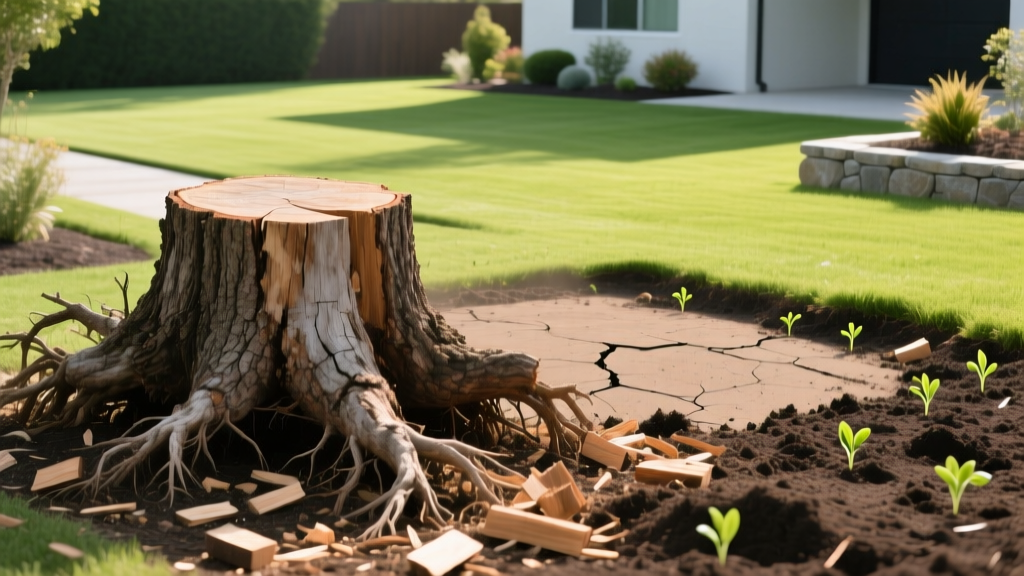
Stump Grinding Before and After: Costs, Process, and Lawn Recovery
The Stump Grinding Before and After Transformation
Removing a hazardous or dead tree is only half the battle. The remaining stump poses tripping hazards, attracts carpenter ants and termites, and prevents new landscaping. Understanding the stump grinding before and after reality helps homeowners set accurate expectations for their yard's recovery. Before the grinder arrives, you are looking at a solid mass of heartwood and root flare extending 10 to 30 inches above grade, with lateral roots spreading up to 15 feet outward. After the process, that same footprint is reduced to a cavity 4 to 12 inches below grade, filled with a mound of loose woodchips.
Expert Specification: The International Society of Arboriculture (ISA) recommends grinding a minimum of 4 to 6 inches below grade for standard lawn recovery, and 8 to 12 inches deep if you plan to replant a new tree or install deep-rooted shrubs in the exact same location. (Source: International Society of Arboriculture)
The physical volume change is often shocking to homeowners. A 24-inch diameter stump ground to a depth of 8 inches does not simply disappear. The solid wood is converted into aerated woodchips, expanding its volume by roughly 200%. You will be left with approximately 3 to 4 cubic feet of chips per 10 inches of stump diameter, which must be managed properly to avoid lawn damage.
2026 Cost Breakdown: What You Will Actually Pay
Pricing for stump grinding has stabilized after the equipment and fuel surges of the early 2020s, but it remains highly dependent on stump diameter, species hardness, and site accessibility. Most professional tree services charge a minimum trip fee, followed by a per-inch rate based on the stump's diameter measured at ground level.
| Stump Diameter | Average Cost (Standard Access) | Root Flare Grinding Add-On | Estimated Woodchip Yield |
|---|---|---|---|
| 10 - 15 inches | $150 - $225 | $50 | 3 - 5 cubic feet |
| 16 - 24 inches | $250 - $400 | $85 | 6 - 10 cubic feet |
| 25 - 36 inches | $450 - $650 | $120 | 12 - 18 cubic feet |
| 37+ inches (Multi-stem) | $700 - $1,200+ | $150+ | 20+ cubic feet |
Hidden Cost Factors: If your stump is located in a fenced backyard with gates narrower than 36 inches, contractors cannot use standard tracked grinders. They must use manual push-grinders or mini-skid steers, which can increase labor time and add $100 to $250 to the final invoice. Furthermore, grinding surface roots (the root flare) is almost always billed as an extra service, but it is critical for preventing future tripping hazards and fungal fruiting bodies.
The Grinding Process: Equipment and Execution
A professional stump grinding operation is a highly mechanical process that relies on high-torque hydraulic systems and specialized cutting teeth. Here is what happens on the day of service:
- Utility Clearance (811): Before any cutting begins, the operator must verify that underground utilities (gas, water, fiber optics) are marked. Grinding deeper than 4 inches without utility marks risks severing shallow-buried irrigation or communication lines.
- Debris Clearing: The operator will clear rocks, bricks, and heavy soil from the base of the stump. Hitting a single piece of limestone or concrete can shatter the $15-$30 carbide-tipped cutting teeth, halting the job for replacements.
- The Sweeping Cut: Using a machine like the Vermeer SC252 or Bandit 990XP, the operator engages the cutting wheel (spinning at roughly 1,000 to 1,500 RPM). They use a side-to-side sweeping motion, removing the wood in 1-to-2-inch horizontal layers rather than plunging straight down. This prevents the wheel from binding in the green wood.
- Track vs. Wheel Impact: If your lawn is wet or prone to rutting, insist on a tracked stump grinder. Tracked units distribute weight at roughly 4 to 6 PSI, gliding over turf. Wheeled units can exert 15+ PSI, leaving deep, muddy ruts that require extensive topsoil leveling afterward.
Post-Grind Lawn Recovery: Beating the Nitrogen Robbery
The most common mistake homeowners make after seeing the stump grinding before and after results is leaving the woodchips in the hole and throwing grass seed directly on top. This guarantees a dead, yellow patch of grass.
Warning: The Nitrogen Tie-Up Effect
Woodchips have a carbon-to-nitrogen (C:N) ratio of roughly 400:1. As soil microbes break down this massive carbon load, they consume all available nitrogen in the surrounding soil, starving your new grass. According to the University of Minnesota Extension, uncomposted wood mixed into soil can cause severe nitrogen deficiency for up to two years.
Woodchips have a carbon-to-nitrogen (C:N) ratio of roughly 400:1. As soil microbes break down this massive carbon load, they consume all available nitrogen in the surrounding soil, starving your new grass. According to the University of Minnesota Extension, uncomposted wood mixed into soil can cause severe nitrogen deficiency for up to two years.
The 4-Step Recovery Protocol
To achieve a seamless lawn patch, follow this exact soil remediation sequence:
- Step 1: Extract the Chips. Shovel out 90% of the fresh woodchips. Use them as mulch for distant garden beds, but do not leave them in the stump cavity.
- Step 2: Build the Base. Fill the cavity with a 50/50 mix of screened topsoil and finished compost. Mound the soil mixture 2 to 3 inches above the surrounding grade. The organic matter in the stump hole will rapidly decompose and settle over the next 6 months; mounding prevents a sunken depression from forming later.
- Step 3: Apply a Starter Fertilizer. Because residual wood dust will still tie up some nitrogen, apply a high-nitrogen starter fertilizer (such as a 24-4-12 NPK ratio) at a rate of 1 pound of actual nitrogen per 1,000 square feet before seeding.
- Step 4: Seed and Tamp. Broadcast a grass seed blend that matches your existing lawn (e.g., Kentucky Bluegrass for northern zones, Bermudagrass for southern zones). Lightly rake the seed into the top 1/4 inch of soil and tamp it down with a hand tamper to ensure seed-to-soil contact.
Decision Matrix: Replanting Trees in the Same Spot
Many homeowners want to replace a removed tree with a new one in the exact same location. Use this framework to decide if the site is ready:
| Scenario | Action Required | Timeline |
|---|---|---|
| Planting a sapling (under 2-inch caliper) | Offset the new planting hole 3 to 4 feet from the old center to avoid decaying root mass and soil settling. | Can plant immediately after backfilling. |
| Planting a mature tree (3-inch+ caliper) | Wait for the old root system to decay, or hire a contractor to use a hydraulic spade to physically extract the remaining root ball. | Wait 1 to 2 years, or extract immediately. |
| Old tree died of Armillaria or Verticillium wilt | Do not plant the same species. The soil pathogens remain active in the residual roots. Select a resistant species. | Wait 1 year; plant resistant species. |
Frequently Asked Questions
Can I use the stump grindings as mulch around my other trees?
Yes, but with a major caveat. Fresh woodchips should only be applied as a surface mulch (no deeper than 2-3 inches) and kept at least 4 inches away from the trunks of your living trees to prevent collar rot and rodent damage. Never till fresh stump grindings into your garden beds or vegetable patches, as the nitrogen tie-up will stunt plant growth for an entire season.
Will grinding the stump kill the remaining roots?
Stump grinding severs the central taproot and the primary lateral roots near the trunk, which effectively kills the root system for most non-suckering species like Oaks, Pines, and Maples. However, if you removed a species prone to root suckering—such as a Bradford Pear, Tree of Heaven, or certain Poplars—the residual lateral roots may push up new shoots for a year or two. In these cases, you must monitor the area and apply a targeted glyphosate or triclopyr herbicide to the suckers as they emerge to exhaust the remaining root energy.
How long does it take for the ground to stop settling?
The soil and residual wood dust in a ground stump cavity will continue to settle for 6 to 12 months, particularly after heavy rains or winter freeze-thaw cycles. This is why mounding your topsoil mix 2 inches above grade during the initial backfill is non-negotiable. If a depression forms after the first year, simply top-dress the area with a 50/50 sand-and-compost mix and overseed.