
Tree Care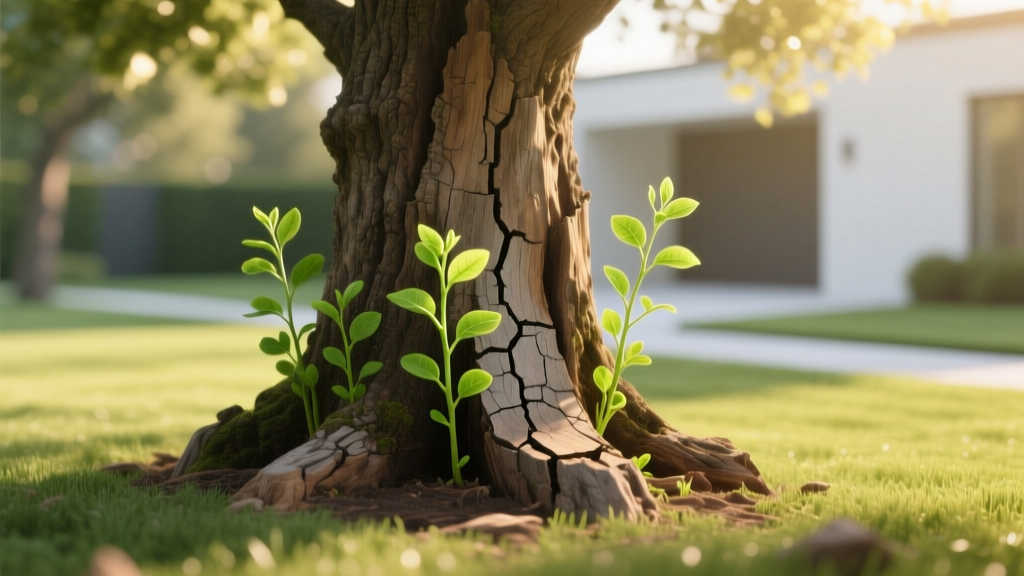
Can a Tree Regrow From a Stump? Species & Prevention Guide
The Biology of Stump Regrowth: Epicormic Sprouts vs. Root Suckers
When a homeowner asks, "can a tree regrow from a stump?" the answer depends entirely on the tree's biological classification and its hormonal response to trauma. Deciduous hardwoods possess dormant buds beneath their bark and extensive lateral root networks that act as survival mechanisms. When the main trunk is severed, the tree experiences a sudden drop in auxin—a plant hormone produced in the apical meristem (the top of the tree) that suppresses lower growth. Without this apical dominance, the tree aggressively redirects stored carbohydrates to push out new growth.
This regrowth manifests in two distinct ways:
- Epicormic Shoots: These emerge directly from the stump's vascular cambium (the thin layer of living tissue just inside the bark). They are the tree's attempt to rebuild a photosynthesizing canopy from the remaining base.
- Root Suckers: These sprout from the lateral roots, sometimes appearing 10 to 30 feet away from the main stump. Species like the Tree of Heaven (Ailanthus altissima) and trembling aspen (Populus tremuloides) are notorious for sending up root suckers that can damage sidewalks and foundations.
Warning: The 'Zombie Tree' Foundation Risk
Allowing root suckers to mature near structural foundations is a critical error. As these suckers thicken, their root systems expand radially, exerting up to 2,000 PSI of lateral pressure on concrete footings and underground plumbing. Eradicating the parent stump is mandatory to halt this subterranean expansion.
Allowing root suckers to mature near structural foundations is a critical error. As these suckers thicken, their root systems expand radially, exerting up to 2,000 PSI of lateral pressure on concrete footings and underground plumbing. Eradicating the parent stump is mandatory to halt this subterranean expansion.
Which Trees Regrow? A Species-Specific Breakdown
Not all trees possess the ability to resprout from a cut base. Conifers (evergreens) generally lack the dormant epicormic buds required for stump regeneration. If you cut down a pine or spruce, the stump will simply rot. However, many common landscape hardwoods are highly resilient. According to research on epicormic shoot development, the vigor of regrowth is directly tied to the tree's carbohydrate reserves at the time of felling.
| Tree Species | Regrowth Method | Risk Level | Time to First Sprout |
|---|---|---|---|
| Willow (Salix) | Stump & Root | Extreme | 7-14 Days |
| Poplar / Aspen (Populus) | Root Suckers | Extreme | 14-21 Days |
| Tree of Heaven (Ailanthus) | Root Suckers | Extreme | 10-14 Days |
| Silver Maple (Acer saccharinum) | Epicormic | High | 21-30 Days |
| Oak (Quercus - Live/Water) | Epicormic | Moderate | 30-45 Days |
| Pine (Pinus) | None | Zero | N/A |
| Spruce (Picea) | None | Zero | N/A |
How to Permanently Kill a Tree Stump (Step-by-Step Eradication)
If you are dealing with a high-risk deciduous species, simply cutting the tree down is only half the battle. To prevent regrowth, you must systematically destroy the cambium layer and the root system's ability to transport nutrients. While internet forums often suggest pouring Epsom salt or boiling water onto a stump, these methods are largely ineffective on vigorous species and can alter soil pH to the detriment of surrounding turfgrass.
For reliable eradication, arborists rely on targeted systemic herbicides. The Penn State Extension outlines the cut-stump method as the most effective protocol for preventing epicormic sprouting without harming adjacent desirable plants via soil contamination.
Step 1: The Fresh Cut and the 15-Minute Window
The single most critical factor in chemical stump treatment is timing. When a tree is cut, its vascular system immediately begins to seal the wound to prevent pathogen entry and moisture loss. It does this by forming tyloses (balloon-like outgrowths in the xylem) and pushing resin to the surface. You must apply herbicide within 15 minutes of making the final chainsaw cut. If you wait longer, the vascular pathways will be blocked, and the chemical will not translocate down to the root tips.
Step 2: Chemical Selection and Application
Do not use ready-to-use consumer weed killers; they lack the concentration required to penetrate mature woody tissue. You need a professional-grade or concentrated formulation.
- Triclopyr (Ester formulation, e.g., Garlon 4 Ultra): This is the industry standard for woody plants. Mix at a 20% to 30% concentration with a basal oil or penetrating surfactant. Triclopyr mimics plant growth hormones, causing the root system to grow itself to death.
- Glyphosate (41% Active Ingredient, e.g., Roundup Pro): Effective on less aggressive species like maples and elms. Use undiluted or mixed at a 50/50 ratio with water. Glyphosate inhibits the EPSP synthase enzyme, halting amino acid production.
Step 3: Targeting the Cambium Ring
A common mistake is painting the entire top surface of the stump. The center of the stump (the heartwood) is dead tissue and cannot transport chemicals. You only need to apply the herbicide to the outer 2 inches of the stump—the living vascular cambium and phloem. Use a small foam brush or a specialized squeeze bottle to apply a generous bead around the perimeter edge.
Mechanical vs. Chemical Stump Management: Cost & Effort Analysis
Deciding between chemical eradication and mechanical removal depends on your budget, timeline, and the physical location of the stump. Below is a decision framework to help you choose the right approach.
Chemical Treatment
- Cost: $25 - $60 (for concentrated herbicide and surfactant)
- Timeline: 4 to 8 weeks for total root death
- Effort: Low (15 minutes of application)
- Best For: Stumps near fence lines, retaining walls, or desirable plant root zones where grinding equipment cannot reach.
Mechanical Stump Grinding
- Cost: $3 to $6 per inch of diameter (Average 24-inch stump = $72 - $144)
- Timeline: Immediate removal of the base
- Effort: High (Requires renting a 400lb+ walk-behind grinder or hiring a pro)
- Best For: Open lawns where you intend to lay new sod or plant a new tree in the exact same location.
Note on Stump Grinding: While grinding removes the visible stump and the upper root flare, it does not remove the deep lateral roots. If you grind a Willow or Tree of Heaven without applying a granular root killer to the remaining root mass, those buried roots may still push up suckers through your new sod. Always treat high-risk species chemically before grinding, or apply a root-zone herbicide immediately after grinding.
"The biggest mistake homeowners make is treating a stump in late spring. During the spring flush, a tree's sap flow is moving strictly upward to push out leaves. If you apply herbicide then, it won't pull down into the roots. The optimal window for cut-stump treatment is late summer through mid-autumn, when the tree is actively pulling carbohydrates down into the root system for winter storage."
— Certified Master Arborist, Regional Forestry Board
Frequently Asked Questions
Will drilling holes and filling them with salt kill a stump?
While rock salt or Epsom salt will dehydrate the immediate wood tissue, it rarely translocates to the far-reaching root tips of vigorous species. Furthermore, the massive influx of sodium or magnesium will sterilize the surrounding soil, making it impossible to grow grass or ornamental plants in that spot for several years. Systemic herbicides are vastly superior and soil-safe when applied correctly to the cambium.
How long does it take for an untreated stump to rot naturally?
According to University of Minnesota Extension data, an untreated hardwood stump can take 7 to 15 years to fully decompose, depending on soil moisture and fungal presence. Conifer stumps, rich in decay-resistant resins, can persist for 20 to 50 years. During this time, the stump will serve as a breeding ground for carpenter ants, termites, and fungal pathogens like Armillaria root rot, which can spread to your living landscape trees.
Can I plant a new tree directly over a ground-out stump?
It is not recommended to plant directly in the exact center of a recently ground stump. The decaying wood chips left behind will tie up soil nitrogen as they break down, starving your new tree. Additionally, residual allelopathic chemicals or herbicides may linger. Offset your new planting hole by at least 3 to 4 feet from the center of the old stump to ensure the new root system has access to mineral-rich, undisturbed soil.

