Tree Care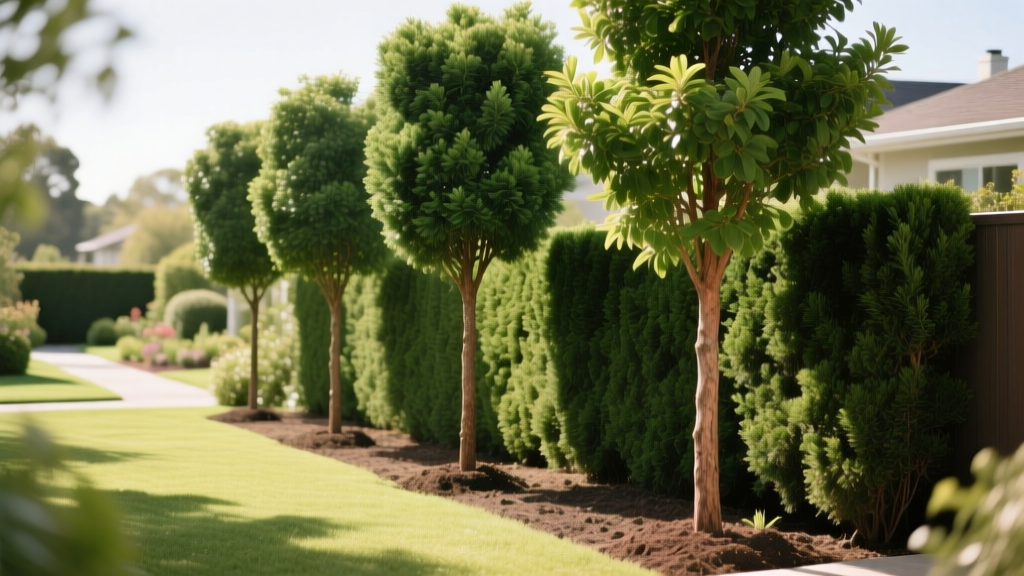
How to Plant Tall Trees for Privacy: Spacing & Care Guide
Installing a living fence requires precise horticultural execution. When homeowners plant tall trees for privacy, the most common failures—gapping, disease outbreaks, and stunted growth—stem from incorrect spacing and improper root-flare placement rather than poor species selection. A mature privacy screen acts as a windbreak, noise barrier, and visual shield, but achieving a seamless wall of foliage demands a calculated approach to trenching, soil mechanics, and establishment watering.
This guide provides the exact measurements, species data, and arborist-approved planting protocols required to establish a dense, healthy privacy screen that will thrive for decades.
Selecting the Right Species for Your Hardiness Zone
Not all evergreens are suited for dense screening. Fast-growing species often sacrifice structural integrity and disease resistance for vertical speed. When evaluating tall trees for privacy, prioritize cultivars with strong central leaders, dense lateral branching, and proven resistance to regional fungal pathogens.
| Species / Cultivar | Mature Height & Width | Avg. Growth Rate | 2026 Avg. Cost (15-Gallon) | Best Use Case |
|---|---|---|---|---|
| Thuja 'Green Giant' | 50-60' H x 12-20' W | 3-5 ft/year | $120 - $160 | Large properties, Zone 5-8 |
| Thuja 'Emerald Green' | 12-15' H x 3-4' W | 1-2 ft/year | $60 - $85 | Narrow property lines, Zone 3-7 |
| Spartan Juniper | 15-20' H x 4-5' W | 1-2 ft/year | $75 - $110 | Drought-prone areas, Zone 4-9 |
| Leyland Cypress | 50-70' H x 10-15' W | 3-4 ft/year | $90 - $130 | Zone 6-9 (High disease risk) |
Arborist Warning: Avoid planting Leyland Cypress (x Cuprocyparis leylandii) in humid climates (Zones 7 and above). According to NC State Extension, this hybrid is highly susceptible to Seiridium canker and Cercospora needle blight, which can decimate an entire privacy screen within 5 to 7 years. Opt for 'Green Giant' or disease-resistant junipers instead.
Calculating Exact Spacing for a Seamless Screen
The most expensive mistake in privacy tree installation is planting them too close together. Overcrowding leads to intense root competition, lower-branch dieback (creating a "leggy" screen with gaps at the bottom), and restricted airflow that invites fungal diseases.
The 50-75% Spacing Formula:
To achieve a solid visual barrier without suffocating the trees, plant your trees at a distance equal to 50% to 75% of their mature spread.
Example: If a 'Green Giant' Arborvitae has a mature spread of 15 feet, plant them 7.5 to 11 feet apart, measured from the center of one trunk to the center of the next. For a faster-fill screen, use the 50% metric (7.5 feet). For long-term tree health and lower maintenance, use the 75% metric (11 feet).
To achieve a solid visual barrier without suffocating the trees, plant your trees at a distance equal to 50% to 75% of their mature spread.
Example: If a 'Green Giant' Arborvitae has a mature spread of 15 feet, plant them 7.5 to 11 feet apart, measured from the center of one trunk to the center of the next. For a faster-fill screen, use the 50% metric (7.5 feet). For long-term tree health and lower maintenance, use the 75% metric (11 feet).
Step-by-Step Trenching and Planting Protocol
Proper planting mechanics dictate the survival rate of your investment. The Morton Arboretum emphasizes that planting depth is the number one cause of premature tree mortality. Follow this exact sequence:
- Locate Utilities: Call 811 at least three business days before digging to have underground gas, water, and fiber-optic lines marked.
- Dig the Trench or Holes: Dig individual holes or a continuous trench that is 2 to 3 times wider than the root ball, but no deeper than the root ball itself. Wide holes encourage lateral root expansion.
- Excavate the Root Flare: Nursery-grown trees are often buried too deep in their pots. Brush away the top 2 inches of soil from the root ball until you find the root flare (the trunk flare where the first structural roots emerge). This flare must sit 1 to 2 inches above the final soil grade.
- Score the Roots: If the tree is pot-bound, use a sterilized pruning saw to make three vertical cuts (1 inch deep) down the sides of the root ball, and shave off the bottom inch of circling roots. This prevents girdling roots from strangling the trunk years later.
- Backfill with Native Soil: Do not amend the backfill with compost or potting mix. Amending the planting hole creates a "bathtub effect" in heavy clay soils, where water pools in the loose amended soil and drowns the roots. Use the native soil you dug out to backfill, tamping it gently to remove large air pockets.
Irrigation and First-Year Establishment Care
Privacy trees have dense canopies that intercept rainfall, meaning the soil directly beneath them often remains dry even during heavy storms. Hand-watering with a hose is rarely sufficient for deep root establishment.
The Caliper-Based Watering Metric
Measure the trunk caliper (diameter) 6 inches above the soil line. Newly planted evergreens require approximately 1.5 gallons of water per inch of caliper per week during their first two growing seasons. A tree with a 2-inch caliper needs 3 gallons of water applied slowly to the root zone every week, increasing to 6 gallons during peak summer heat.
"Install a drip irrigation line with 2-gallon-per-hour emitters placed 12 inches from the trunk on alternating sides. Run the system for 90 minutes twice a week. This slow, deep application forces roots to grow downward rather than surfacing for shallow moisture." — Certified Arborist Field Notes, 2025
For winter protection in Zones 4 through 6, apply an anti-desiccant spray (such as Wilt-Pruf) to the foliage in late November and again in late January. This polymer coating reduces winter transpiration and prevents "winter burn," a common cause of browning on the sun-facing side of privacy screens.
Pruning and Maintenance to Prevent Snow Splaying
Conifers and broadleaf evergreens used for privacy screens require specific pruning techniques to maintain their density and structural integrity.
Never "Top" a Privacy Tree: Cutting the central leader (the top vertical shoot) of an arborvitae or cypress destroys its apical dominance. The tree will respond by sending out multiple, weak lateral shoots at the cut site, creating a flat, misshapen top that is highly vulnerable to splitting under heavy snow or ice loads.
Corrective Pruning Protocol:
- Timing: Prune in early spring just before the flush of new growth, or in late summer after the current year's growth has hardened off.
- Technique: Use sharp bypass pruners to selectively thin out crossing branches and open the canopy to sunlight. This prevents the interior foliage from dying due to shade.
- Snow Management: For multi-leader arborvitae, wrap the trees with heavy-duty jute twine in a spiral pattern from bottom to top before the first snowfall. This prevents the weight of wet snow from splaying the branches outward and tearing them from the trunk.
Common Privacy Tree Failure Modes and Fixes
Even with perfect planting, environmental stressors can compromise your screen. Monitor for these specific issues:
- Interior Browning: If the inner needles turn brown and drop while the outer foliage remains green, this is normal "seasonal needle drop." Evergreens shed their oldest needles every 2-3 years. No action required.
- Tip Dieback and Canker: If branch tips turn brown and you see sunken, resin-oozing lesions on the bark, your trees likely have Seiridium or Botryosphaeria canker. Prune infected branches 4 inches below the visible margin of infection, sterilizing your saw with 70% isopropyl alcohol between every single cut. There is no effective chemical cure for canker; sanitation is your only defense.
- Spider Mite Damage: If the foliage looks dusty, stippled with yellow dots, and drops prematurely, shake a branch over a piece of white paper. If you see tiny, moving specks, you have spider mites. Treat with a horticultural oil spray applied in the early morning when temperatures are below 85°F.
Establishing tall trees for privacy is a multi-year investment. By adhering to the 50-75% spacing rule, respecting the root flare during planting, and implementing caliper-based irrigation, your living fence will close the gaps and provide total seclusion within three to four growing seasons.