
Tree Care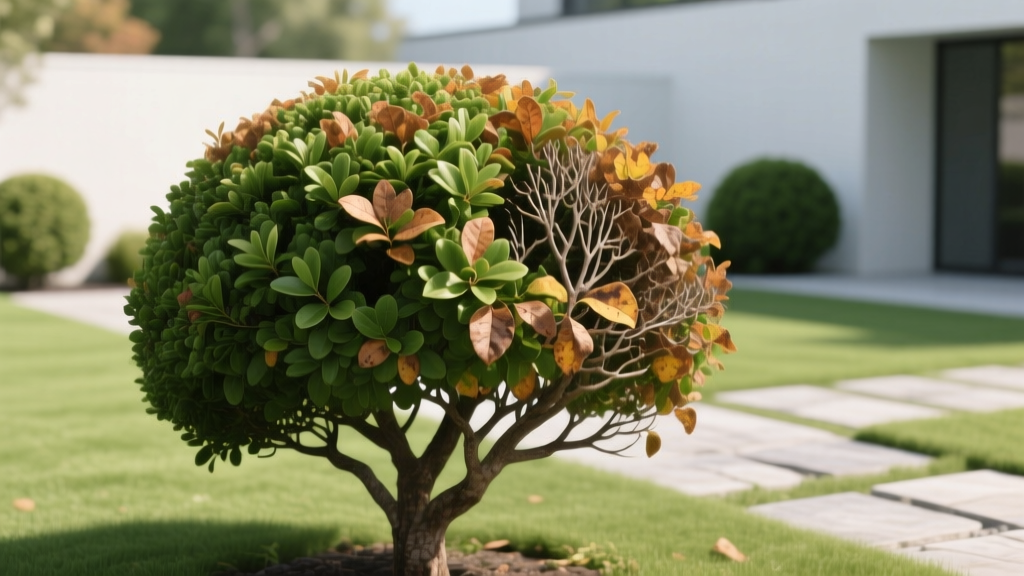
Topiary Bushes Turning Brown? Diagnosis and Expert Solutions
The Diagnostic Framework for Failing Topiaries
Topiary bushes—whether sculpted from Buxus sempervirens (English Boxwood), Taxus baccata (Yew), or Ligustrum (Privet)—require precise environmental conditions and maintenance routines. When these living sculptures begin to brown, thin, or lose their geometric integrity, the cause is rarely singular. Misdiagnosis leads to wasted money on ineffective fungicides or catastrophic pruning errors. Replacing a mature, 4-foot boxed topiary costs between $120 and $350, making accurate diagnosis a financial necessity.
Rapid Symptom Triage
- Crisp, bronze foliage on windward sides: Winter desiccation (Winter Burn).
- Dark brown leaf spots with black stem streaks: Boxwood Blight (Calonectria pseudonaviculata).
- Dead, hollow interior with a thin green outer shell: Improper shearing techniques blocking light penetration.
- Dull green foliage turning bronze with peeling basal bark: Phytophthora root rot due to soil compaction.
Symptom 1: The 'Dead Center' Syndrome
The most common non-pathological failure in topiary bushes is the 'dead center' syndrome. This occurs when homeowners or landscapers rely exclusively on mechanical or manual hedge shears to maintain the outer geometric shape. Shearing cuts leaves in half and stimulates dense, lateral bud break on the exterior. Over 2 to 3 growing seasons, this creates an impenetrable outer 'shell' of foliage that blocks sunlight and air circulation from reaching the interior branches.
The Solution: Selective Hand-Thinning
To reverse this, you must transition from shearing to thinning. Using bypass pruners (such as the Felco 2 or ARS VS-8R), reach past the outer canopy and selectively remove 15% to 20% of the interior stems back to a lateral branch or the main trunk. This creates 'light windows' that allow photosynthesis to reach the inner scaffolding. Perform this thinning in early spring before the primary growth flush. Never remove more than 25% of the live canopy in a single season, as this triggers shock-induced epicormic water sprouts that ruin the topiary's silhouette.
Symptom 2: Fungal Pathogens and Cankers
When browning is accompanied by leaf drop, stem dieback, or distinct lesions, a fungal pathogen is likely at work. Differentiating between Boxwood Blight and Volutella Canker is critical, as their management protocols differ drastically. According to the USDA APHIS, Boxwood Blight spores can survive in soil and plant debris for up to five years, making sanitation paramount.
| Pathogen | Primary Symptoms | Leaf Drop Pattern | Treatment Strategy |
|---|---|---|---|
| Calonectria pseudonaviculata (Boxwood Blight) | Dark brown spots, black stem cankers, white fungal tufts under high humidity | Rapid, severe defoliation starting from the bottom up | Preventative chlorothalonil applications; immediate removal and burning of infected plants |
| Volutella buxi (Volutella Canker) | Salmon-pink fruiting bodies on stems, sunken bark lesions | Gradual, localized dieback on individual branches | Prune 12 inches below visible canker; apply copper octanoate during dry weather |
| Macrophoma (Boxwood Leaf Spot) | Straw-colored leaves with tiny black pycnidia (fruiting bodies) | Minimal drop; leaves remain attached but discolored | Improve air circulation; apply mancozeb if severe |
For comprehensive regional guidance on identifying these specific fungal strains, the Royal Horticultural Society (RHS) maintains an updated visual database of boxwood diseases that is invaluable for home gardeners.
Symptom 3: Winter Desiccation and Root Failure
Evergreen topiary bushes continue to transpire (lose water through leaves) during winter, especially on bright, windy days. If the soil is frozen, the roots cannot replace this lost moisture, resulting in winter desiccation. The foliage turns a uniform bronze or crisp brown, typically on the south or west-facing sides exposed to prevailing winds.
The Anti-Desiccant Protocol
To prevent this, apply an anti-desiccant spray like Wilt Pruf (pine oil-based emulsion) in late November and again in late January during a thaw. The spray must be applied when temperatures are between 40°F and 50°F and no freezing rain is expected for 24 hours. Coat the foliage until it drips, ensuring the undersides of the leaves are covered, as this is where the majority of stomata (pores) are located.
Diagnosing Hidden Root Rot
If browning persists despite anti-desiccant application and fungal treatments, suspect Phytophthora root rot. This soil-borne water mold thrives in poorly drained soils. Perform a percolation test: dig a 12x12 inch hole near the topiary's drip line, fill it with water, and let it drain. Refill it and time the drainage. If it takes longer than 4 hours to drain the second filling, your soil is heavily compacted or clay-dominant. The solution is not more water, but less. Reduce irrigation frequency, carefully aerate the soil outside the root ball using a 2-inch auger bit, and top-dress with 2 inches of composted pine bark to improve microbial activity and drainage.
The 3-Year Rejuvenation Protocol for Neglected Topiaries
If your topiary bushes have suffered years of neglect, severe winter burn, or localized dieback, a hard rejuvenation is required. Do not attempt to fix a severely damaged topiary in one season. Use this phased approach to restore health without killing the plant:
- Year 1 (Spring): Remove all dead, diseased, and crossing branches. Thin the outer canopy by 20% to allow light penetration. Apply a balanced, slow-release fertilizer (such as a 10-6-4 formula with added magnesium) at a rate of 1 lb per 100 square feet of root zone.
- Year 2 (Spring): Begin selective heading cuts on the remaining leggy branches. Cut back to a lateral branch that is at least one-third the diameter of the branch being removed. This maintains sap flow and prevents dieback.
- Year 3 (Spring): Re-establish the formal geometric shape using hand shears, but maintain the 'batter' rule: the base of the topiary must be 10% to 15% wider than the top. This ensures the lower branches receive adequate sunlight, preventing basal shading and future dieback.
Expert Insight: When pruning Yew (Taxus) topiaries, you can cut back into old, bare wood, and it will sprout new epicormic buds. However, never cut Boxwood or Arborvitae back into bare, needle-less wood; these species lack dormant buds on old wood, and the cut branch will remain permanently dead.
For ongoing soil health and cultivar selection, consult resources like the University of Minnesota Extension, which provides excellent data on cold-hardy boxwood alternatives like Buxus x 'Green Velvet' and Buxus 'North Star' that resist both winter burn and blight.

