
Tree Care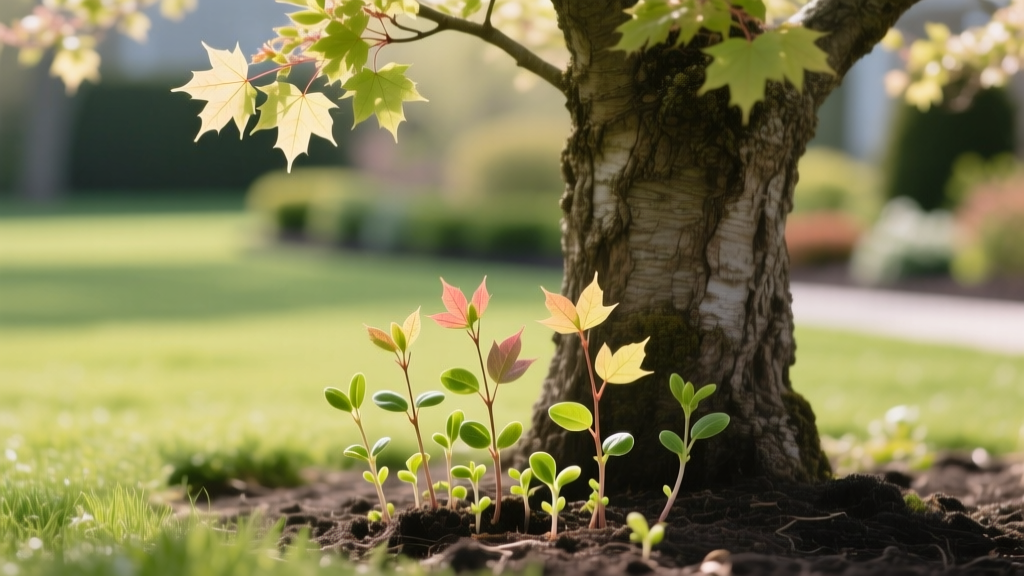
Identifying and Treating Maple Tree Weeds and Volunteer Seedlings
The Two Faces of 'Maple Tree Weeds'
When homeowners search for solutions to maple tree weeds, they are typically battling one of two distinct problems. The first is the proliferation of volunteer maple seedlings—often referred to colloquially as maple weeds—that sprout from thousands of dropped samaras (helicopter seeds). The second involves standard broadleaf and grassy weeds growing beneath the dense canopy of an established maple tree. Treating these two issues requires entirely different chemical and mechanical strategies, primarily because maples possess notoriously shallow, sensitive root systems that are easily damaged by improper herbicide use or aggressive soil cultivation.
Quick ID Guide: Is it a Weed or a Seedling?
• Volunteer Maples: Emerge with two distinct, smooth-edged cotyledon leaves, followed by true leaves with deep lobes and serrated edges. Stems quickly turn woody and reddish-brown.
• Broadleaf Weeds (e.g., Dandelion, Plantain):strong> Feature fleshy, non-woody stems, distinct taproots, and lack the opposite leaf arrangement characteristic of Acer species.
• Volunteer Maples: Emerge with two distinct, smooth-edged cotyledon leaves, followed by true leaves with deep lobes and serrated edges. Stems quickly turn woody and reddish-brown.
• Broadleaf Weeds (e.g., Dandelion, Plantain):strong> Feature fleshy, non-woody stems, distinct taproots, and lack the opposite leaf arrangement characteristic of Acer species.
Eradicating Volunteer Maple Seedlings
Silver maples (Acer saccharinum) and Norway maples (Acer platanoides) are prolific seeders. A single mature silver maple can drop over 100,000 samaras in a single spring. If left unchecked, these seedlings develop deep taproots within 60 days, making manual extraction nearly impossible without breaking the root and guaranteeing regrowth. According to the Morton Arboretum, early intervention before the stem lignifies (turns woody) is critical for effective control.
Lawn Spot-Treatment Protocol
If volunteer maples are invading your turfgrass, do not use non-selective herbicides like glyphosate, as they will kill the surrounding grass. Instead, utilize a selective broadleaf herbicide containing a three-way mixture of 2,4-D, dicamba, and MCPP (commonly sold as Trimec Classic or Ortho WeedClear).
- Timing: Apply when seedlings are in the 2-to-4 leaf stage, typically 3 to 4 weeks after samara drop.
- Mixing Rate: Combine 1.5 fluid ounces of Trimec concentrate per 1 gallon of water. This covers approximately 1,000 square feet.
- Application: Use a pump sprayer with a fan nozzle. Spray until the leaves are uniformly wet but not dripping. Add a non-ionic surfactant (0.25% v/v) to break the waxy cuticle of the maple leaves.
- Follow-up: Expect chlorosis (yellowing) within 5 days and complete necrosis in 14 days. A second application may be required for seedlings that were larger than 4 inches at the time of spraying.
Garden Bed and Hardscape Protocol
In mulched beds or near the parent tree's trunk, spraying herbicides is highly risky. Maples can share nutrients and chemicals through root grafts, meaning poisoning a volunteer seedling can inadvertently damage the parent tree. For bed-grown maple tree weeds, use the cut-and-paint method.
- Cut the volunteer seedling as close to the soil line as possible using bypass pruners.
- Within 60 seconds, paint the fresh cut stump with an 8% Triclopyr solution (e.g., Ortho Poison Ivy & Tough Brush Killer concentrate mixed at 4 fl oz per gallon) or a 41% Glyphosate solution.
- The chemical will translocate down into the root system, killing it without risking foliar drift onto desirable landscape plants.
Managing Standard Weeds Under the Maple Canopy
Treating standard weeds (like creeping charlie, crabgrass, or spurge) beneath a mature maple requires extreme caution. Maples are shallow-rooted; the vast majority of their feeder roots reside in the top 12 to 18 inches of soil, often extending well beyond the drip line. Tilling the soil to remove weeds will sever these critical roots, leading to canopy dieback and increased susceptibility to verticillium wilt.
Warning: Soil Sterilants and Root Damage
Never use soil sterilants (like imazaquin or prometon) or heavy pre-emergent overlaps under a maple canopy. These chemicals can be absorbed by the shallow feeder roots, causing severe phytotoxicity, leaf scorch, and long-term decline. Stick to targeted post-emergent spot treatments and safe pre-emergents.
Never use soil sterilants (like imazaquin or prometon) or heavy pre-emergent overlaps under a maple canopy. These chemicals can be absorbed by the shallow feeder roots, causing severe phytotoxicity, leaf scorch, and long-term decline. Stick to targeted post-emergent spot treatments and safe pre-emergents.
Pre-Emergent vs. Post-Emergent Strategy Matrix
| Weed Type | Recommended Active Ingredient | Application Timing & Safety Notes |
|---|---|---|
| Crabgrass / Grassy Weeds | Dithiopyr (Dimension) | Apply in early spring before soil reaches 55°F. Safe for maple roots when used at labeled rates (0.125% AI). |
| Broadleaf Weeds (Dandelion) | 2,4-D + Dicamba (Trimec) | Spot-treat only. Avoid spraying within 2 feet of the maple trunk to prevent bark absorption. |
| Creeping Charlie / Ground Ivy | Triclopyr | Apply in fall when temperatures are between 60-70°F. Highly effective on tough broadleaves without harming surface roots. |
Preventative Mulching and Root Zone Care
The most effective long-term defense against both volunteer maple seedlings and standard weeds is a properly installed mulch ring. The University of Minnesota Extension emphasizes that organic mulch suppresses weed germination by blocking sunlight while regulating soil moisture for the maple's feeder roots.
- Material: Use coarse arborist wood chips or shredded hardwood bark. Avoid fine mulches like pine straw, which allow maple samaras to penetrate and reach the soil.
- Depth: Apply exactly 2 to 3 inches of mulch. Exceeding 4 inches suffocates the shallow maple roots and promotes secondary root growth into the mulch layer.
- The Donut Rule: Keep mulch at least 3 to 4 inches away from the actual trunk of the tree. Piling mulch against the bark (a 'mulch volcano') traps moisture, inviting Phytophthora root rot and providing a haven for trunk-boring insects.
- Cost Expectation: Bulk hardwood mulch costs between $35 and $45 per cubic yard in 2026. A 10-foot diameter ring requires roughly 1 cubic yard to achieve a 3-inch depth.
Frequently Asked Questions
Why did my pre-emergent fail to stop maple seedlings?
Pre-emergent herbicides like Dimension or Prodiamine are designed to stop seed germination by creating a chemical barrier in the top inch of soil. However, maple samaras are large and contain significant energy reserves. If the samaras land on top of a thick mulch layer or if the pre-emergent barrier is broken by foot traffic or raking, the seedlings will easily bypass the chemical barrier. Pre-emergents are highly effective against crabgrass, but less reliable against heavy maple seed drops.
Can I just pull the maple weeds by hand?
You can pull them by hand only if they are less than 4 inches tall and the soil is heavily saturated from recent rain. Once the stem turns from green to reddish-brown (lignification), the taproot anchors deeply. Pulling mature seedlings will snap the stem at the soil line, leaving the root intact to resprout multiple lateral shoots, effectively turning one weed into three.
Will vinegar kill maple tree weeds?
Horticultural vinegar (20% to 30% acetic acid) is a contact burn-down herbicide. It will scorch the leaves of young maple seedlings but will not translocate to the root system. The seedling will almost certainly resprout within two weeks. Furthermore, repeated application of high-concentration vinegar drastically lowers soil pH, which can lock out essential nutrients like phosphorus and calcium for your desirable landscape plants.

