
Tree Care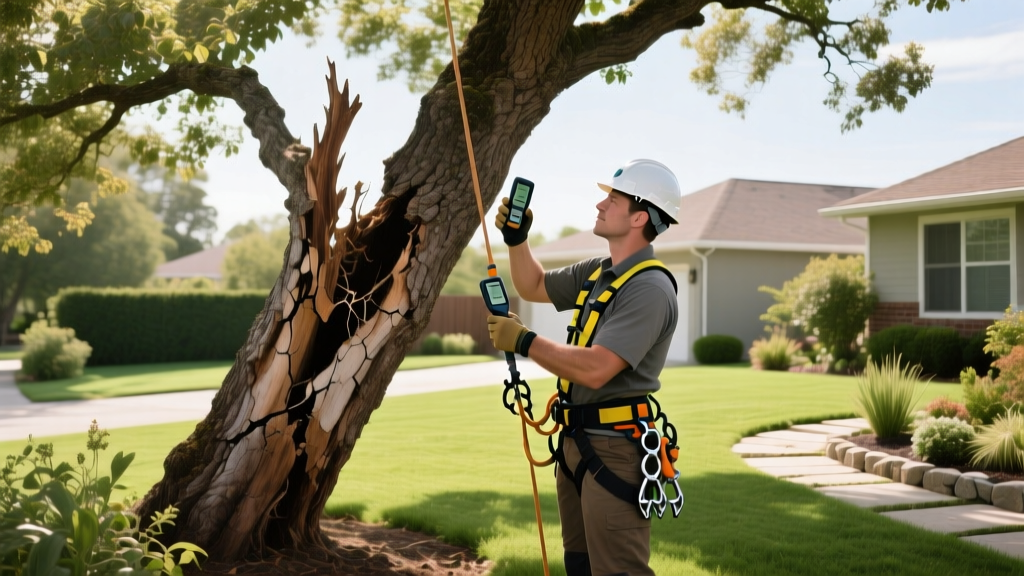
Tree House Construction: Diagnosing Tree Health & Structural Risks
The Intersection of Arboriculture and Structural Engineering
Tree house construction is often treated as a basic carpentry project, but it is fundamentally an exercise in applied arboriculture. A standard 10x10 foot platform with a roof and live loads (occupants, furniture, snow accumulation) can easily exceed 4,000 pounds. When you bolt this static weight to a living, growing, and swaying organism, you create a complex biomechanical system. Misdiagnosing the host tree's health or using improper attachment hardware leads to catastrophic structural failure and severe, often fatal, damage to the tree. This guide provides a clinical framework for diagnosing tree suitability, identifying hidden structural defects, and implementing engineered solutions for safe tree house construction.
Phase 1: Diagnosing Tree Species and Wood Density
Not all trees can support the shear and compressive forces of a treehouse. The primary metric for evaluating wood suitability is Janka hardness (measured in pounds-force, lbf) and the tree's natural compartmentalization capabilities. Hardwoods with tight grain structures are mandatory for primary load-bearing trunks.
| Species | Janka Hardness (lbf) | Compartmentalization Rating | Suitability Verdict |
|---|---|---|---|
| Hickory (Shagbark) | 1,820 | Excellent (Walls off decay rapidly) | Ideal for heavy multi-level structures |
| White Oak | 1,360 | Excellent (Highly rot-resistant heartwood) | Ideal for large platforms and high wind zones |
| Sugar Maple | 1,450 | Good | Suitable, but requires monitoring for borers |
| Eastern White Pine | 380 | Poor (Prone to internal heart rot) | Reject for primary supports; use only for framing |
| Silver Maple | 700 | Poor (Brittle wood, included bark common) | Reject entirely; high risk of limb failure |
According to University of Minnesota Extension guidelines on tree evaluation, fast-growing species like Silver Maple and Willow sacrifice wood density for rapid vertical growth, resulting in brittle branch unions that snap under dynamic wind loads. Always target slow-growing, dense hardwoods for your primary anchor points.
Phase 2: Identifying Structural Defects and Internal Decay
A tree with a 24-inch diameter trunk may appear robust from the outside while being entirely hollow inside. Before any tree house construction begins, you must conduct a Level 2 Tree Risk Assessment. Look for these specific biological red flags:
- Conks and Fungal Fruiting Bodies: The presence of Ganoderma or Armillaria conks at the base or on the trunk indicates advanced internal heart rot. If a conk is present, the tree has lost at least 30% of its structural integrity in that zone.
- V-Crotches and Included Bark: When two main trunks grow at a narrow V-angle, bark gets trapped inside the union (included bark). This prevents the wood fibers from interlocking, creating a natural split line that will fail under the asymmetric load of a treehouse.
- Epicormic Shoots: Clusters of small, spindly branches sprouting directly from the trunk indicate severe stress, often from root damage or canopy dieback. These trees lack the energy reserves to heal construction wounds.
- Seams and Ribs: Vertical bulges or seams on the bark are the tree's attempt to reinforce a cracked or decaying internal column. Do not drill into these stress points.
Phase 3: The Attachment Problem and Biological Solutions
The most common failure in amateur tree house construction is the use of standard galvanized lag screws. This approach fundamentally misunderstands tree biology, specifically the process of Compartmentalization of Decay in Trees (CODIT).
WARNING: The Lag Screw Failure Mode
Driving a 1-inch lag screw into a tree crushes the cambium layer and creates a massive wound. As the tree grows outward, it engulfs the screw head, causing girdling. More critically, lag screws rely on thread friction in the sapwood, which is the weakest part of the tree. Under heavy sheer loads, the threads strip out, leading to sudden platform collapse.
The Solution: Treehouse Attachment Bolts (TABs)
Professional tree house construction relies on Treehouse Attachment Bolts (TABs), specifically forged steel models like the Garnier Limb (GL) TAB. A standard 1.25-inch diameter GL TAB is drilled through the heartwood of the tree. It features a 3-inch cylindrical 'boss' that rests flush against the cambium layer.
Why TABs work biomechanically:
- Shear Strength: A 1.25-inch forged steel TAB has a shear strength exceeding 8,000 pounds, compared to roughly 1,500 pounds for a standard lag screw.
- Cambium Preservation: The boss prevents the tree from growing over the bracket. The tree simply grows around the cylinder, maintaining uninterrupted vascular flow and avoiding girdling.
- Heartwood Anchoring: The bolt penetrates the dense, dead heartwood, which provides superior compressive strength compared to the living sapwood.
Phase 4: Managing Dynamic Loads and Wind Sway
Trees are not static pillars; they are dynamic structures that sway in the wind. A mature oak can move several inches in a moderate breeze. If you rigidly bolt a beam between two separate trees, the differential movement will act as a lever, tearing the hardware out of the wood or snapping the tree trunks.
Diagnostic Solution: For any span crossing between two or more trees, you must install a sliding beam bracket on one end of the primary support beam. This bracket allows the beam to slide back and forth along a steel track as the trees sway independently, while still supporting the vertical dead load. A heavy-duty 4x12 sliding bracket typically costs between $220 and $280, a necessary investment to prevent catastrophic structural tearing during high-wind events.
Cost Breakdown: Professional Assessment vs. DIY Hardware
Budgeting for tree house construction must prioritize the health assessment and structural hardware over aesthetic finishes. Below is a realistic cost matrix for ensuring structural integrity.
| Service / Hardware | Estimated Cost (2026) | Frequency / Quantity | ROI / Risk Mitigation |
|---|---|---|---|
| ISA Certified Arborist TRAQ Assessment | $350 - $600 | Once per tree (pre-construction) | Prevents building in a dying/hazardous tree |
| Sonic Tomography (Internal Decay Scan) | $400 - $800 | Per tree (if external defects noted) | Maps exact internal hollows to avoid drilling |
| 1.25' Forged Steel TAB (e.g., GL TAB) | $135 - $160 | 4 to 8 per platform | Eliminates shear failure and tree girdling |
| Dynamic Sliding Beam Bracket | $240 - $290 | 1 per multi-tree span | Prevents trunk tearing from wind sway |
| Standard 3/4' Galvanized Lag Screw | $8 - $12 | N/A | High risk of failure; not recommended |
Frequently Asked Questions
Can I build a treehouse in a tree that has a large hollow cavity?
It depends on the cavity's location and size. According to the Arbor Day Foundation, a tree can remain structurally sound with significant heartwood decay as long as the outer shell (sapwood and bark) is thick enough. The general rule of thumb is that the solid wood shell must be at least 1 inch thick for every 6 inches of trunk diameter. If the cavity breaches this ratio, or if it is located at a primary branch union, the tree is unsuitable for construction.
How many TABs do I need for a standard 10x10 treehouse?
A standard single-tree 10x10 platform typically requires four primary TABs to support the main perpendicular beams. However, the exact number and diameter depend on the tree's species, the height of the platform, and the anticipated live load. Always consult a structural engineer or a specialized treehouse builder to calculate the exact shear load distribution for your specific design.
Will drilling holes for TABs kill my tree?
No, if done correctly. Trees are highly adapted to surviving physical wounds from broken branches and lightning strikes. When you drill a clean, precise hole for a TAB, the tree initiates its CODIT response, walling off the immediate area to prevent decay from spreading. The critical factor is using sharp, specialized ship auger bits designed for deep wood boring, and never stacking multiple bolts vertically within 18 inches of each other, which compromises the tree's structural column.

