
Tree Care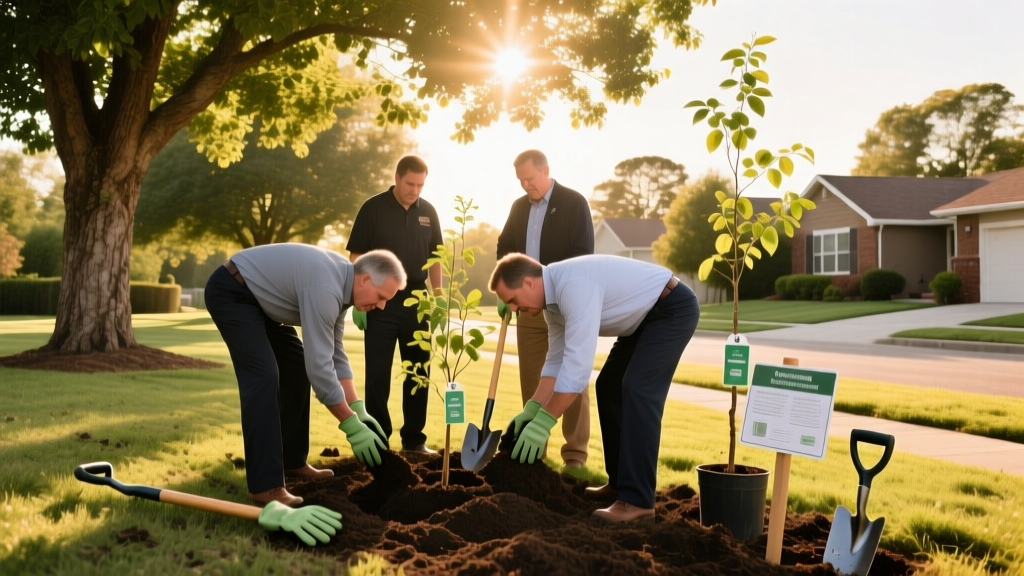
Tree Planting Partnerships: A Guide for Homeowners and HOAs
The Strategic Value of Collaborative Tree Establishment
Planting a single shade tree in a private suburban yard is a straightforward weekend project. However, scaling that effort to reforest an HOA common area, establish a neighborhood canopy, or secure municipal grant funding requires a fundamentally different approach: tree planting partnerships. These collaborative agreements between homeowners, community associations, local governments, and non-profit organizations transform isolated landscaping projects into funded, ecologically sound initiatives.
According to the USDA Forest Service, urban tree canopies significantly reduce stormwater runoff and lower ambient temperatures. Yet, the primary barrier to expanding this canopy is not land availability, but the compounding costs of sourcing mature stock, professional installation, and the critical two-year establishment phase. By structuring a formal partnership, HOAs and community groups can leverage cost-sharing models, access wholesale nursery pricing, and secure technical oversight that drastically reduces mortality rates in newly planted landscapes.
The Economics of Collaborative Tree Sourcing
To understand why partnerships are essential, we must first look at the unit economics of residential tree planting. When an individual homeowner purchases a tree from a retail garden center, they pay a premium for convenience and low-volume logistics.
Cost Comparison: Solo vs. Partnership Planting (30-Gallon Shade Tree)
- Retail Solo Purchase: $450 - $800 per tree (includes retail markup, delivery fee, and standard contractor planting rate).
- Municipal 50/50 Cost-Share Grant: $225 - $400 out-of-pocket (municipality matches funds up to a $5,000 neighborhood cap).
- Non-Profit / Arborist Partnership: $120 - $180 per tree (leverages wholesale nursery direct-purchasing and volunteer planting days supervised by a certified arborist).
For an HOA looking to plant 40 street trees along a subdivision entrance, the difference between retail pricing ($24,000) and a partnership wholesale model ($6,400) is substantial. The savings can be reallocated to post-planting irrigation infrastructure, which is the leading factor in tree survival.
Types of Tree Planting Partnerships Available
Not all partnerships are structured identically. The right model depends on your land ownership status, available volunteer labor, and long-term maintenance capabilities.
| Partnership Model | Primary Partners | Best For | Funding & Resource Flow |
|---|---|---|---|
| Municipal Right-of-Way | City Forestry Dept. + HOA | Street trees, sidewalk verges | City provides free trees and planting; HOA assumes watering and pruning after year one. |
| Non-Profit Grant | NGOs (e.g., Arbor Day Foundation) + Community | Large common areas, park reforestation | NGO provides grant funds and saplings; community provides volunteer labor and site prep. |
| Commercial Arborist Co-Op | Local Tree Care Company + Neighborhood Block | Private yard bulk planting | Homeowners pool orders for wholesale nursery pricing; arborist provides group-rate installation. |
| Utility Company Canopy | Local Power Utility + Homeowners | Away from power lines, energy reduction | Utility offers rebates ($50-$100 per tree) for planting shade trees on the south/west sides of homes. |
Step-by-Step Framework to Establish a Partnership
Securing a partnership requires more than a simple request; it requires a data-driven proposal that aligns your community's goals with the partner's mandate.
Step 1: Conduct a Baseline Canopy Assessment
Before approaching a municipal forestry department or a non-profit, quantify your need. Use free tools like i-Tree Canopy to analyze satellite imagery of your neighborhood. Document the percentage of impervious surfaces versus current tree cover. The EPA notes that increasing canopy cover by just 10% in heavily paved areas can reduce localized summer temperatures by up to 2°F, a metric that strongly appeals to municipal grant committees focused on urban heat island mitigation.
Step 2: Identify and Align with Partner Mandates
Review the specific goals of your target partner. If approaching a local water authority, focus your proposal on stormwater interception (a mature oak can intercept over 40,000 gallons of rainfall annually). If approaching the Arbor Day Foundation or similar NGOs, emphasize community engagement, volunteer hours, and educational outreach.
Step 3: Draft the Memorandum of Understanding (MOU)
This is where most informal partnerships fail. A formal MOU must explicitly define the 'Establishment Period' (typically 24 to 36 months) and outline mortality responsibilities. Your MOU should include:
- Stock Specifications: Mandate that nursery stock must be root-pruned, free of girdling roots, and possess a visible, undamaged root flare.
- Planting Depth Clause: Specify that the root flare must be planted 1 to 2 inches above the surrounding grade to prevent stem girdling and root rot.
- Mortality Replacement: Define who bears the cost if a tree dies. A standard partnership clause dictates that the planting contractor replaces stock if mortality exceeds 10% due to planting defects, while the community assumes loss due to documented drought or vandalism.
The Establishment Phase: Defining Maintenance Responsibilities
The establishment phase is the critical 24-month window where a tree develops a sufficient root system to sustain itself without supplemental irrigation. In a partnership model, ambiguity regarding who waters, mulches, and prunes the trees leads to catastrophic failure rates.
Watering Protocols and Metrics
Do not rely on vague instructions like 'keep the soil moist.' The MOU must assign specific watering metrics to the responsible party (usually the HOA or adjacent homeowner). During the first 24 months, apply 1.5 to 2 gallons of water per inch of trunk caliper, twice weekly. For a 3-inch caliper shade tree, this means 4.5 to 6 gallons per watering session. Utilize slow-release watering bags (e.g., Treegator bags) which hold 15 to 20 gallons and release moisture over 5 to 7 hours, ensuring deep soil penetration without runoff.
Mulching and Staking Standards
Partnerships often fail when well-meaning volunteers apply 'volcano mulch'—piling mulch against the trunk. The agreed-upon standard must mandate a 3-inch layer of double-shredded hardwood mulch, spread in a 3-foot radius around the tree, shaped like a donut to keep mulch at least 3 inches away from the trunk bark. Furthermore, staking should only be used in high-wind areas or for top-heavy species, and must be removed after 12 months to allow the trunk to develop reaction wood and structural taper.
Species Selection for Partnership Success
When leveraging grant funds or municipal partnerships, you are often restricted to a pre-approved species list designed to promote biodiversity and resist local pests. Avoid the temptation to request overplanted species like the Bradford Pear or Green Ash, which are highly susceptible to structural failure and Emerald Ash Borer, respectively.
Expert Insight: A successful partnership planting list follows the '10-20-30 Rule' of urban forestry: no more than 10% of any single species, 20% of any single genus, and 30% of any single family. This prevents a single pathogen from decimating the entire neighborhood canopy.
For HOAs in USDA Hardiness Zones 5 through 7, excellent partnership-approved alternatives include the Quercus bicolor (Swamp White Oak) for heavy clay soils, Gymnocladus dioicus (Kentucky Coffeetree) for urban pollution tolerance, and Zelkova serrata (Japanese Zelkova) as a disease-resistant substitute for the American Elm.
Common Pitfalls in Partnership Agreements
Warning: The 'Plant and Walk Away' Syndrome
Many non-profit partnerships excel at the 'planting day' event but lack mechanisms for post-planting care. If your MOU does not include a funded maintenance escrow or a legally binding assignment of watering duties to adjacent property owners, your 60% survival rate will drop to 20% by year two. Always secure funding for the establishment phase, not just the installation day.
Warning: Ignoring Nursery Root Defects
Even if a partner provides 'free' trees, accepting poor-quality stock is a false economy. Trees grown in deep containers often develop circling roots that eventually girdle the trunk, causing the tree to topple 10 years later. Your partnership agreement must grant the community's designated arborist the right to reject and return any nursery stock that exhibits severe root binding upon delivery.
Summary: Building for Long-Term Canopy Health
Tree planting partnerships are powerful tools for transforming residential landscapes, provided they are built on clear data, rigorous species selection, and unambiguous maintenance contracts. By shifting the focus from the single act of digging a hole to the multi-year process of root establishment, HOAs and homeowners can secure the funding and expertise necessary to cultivate a resilient, multi-generational urban forest. Whether you are tapping into municipal right-of-way programs or organizing a neighborhood wholesale co-op, the success of your canopy depends entirely on the strength of the agreements you sign before the first shovel hits the dirt.

