
Tree Care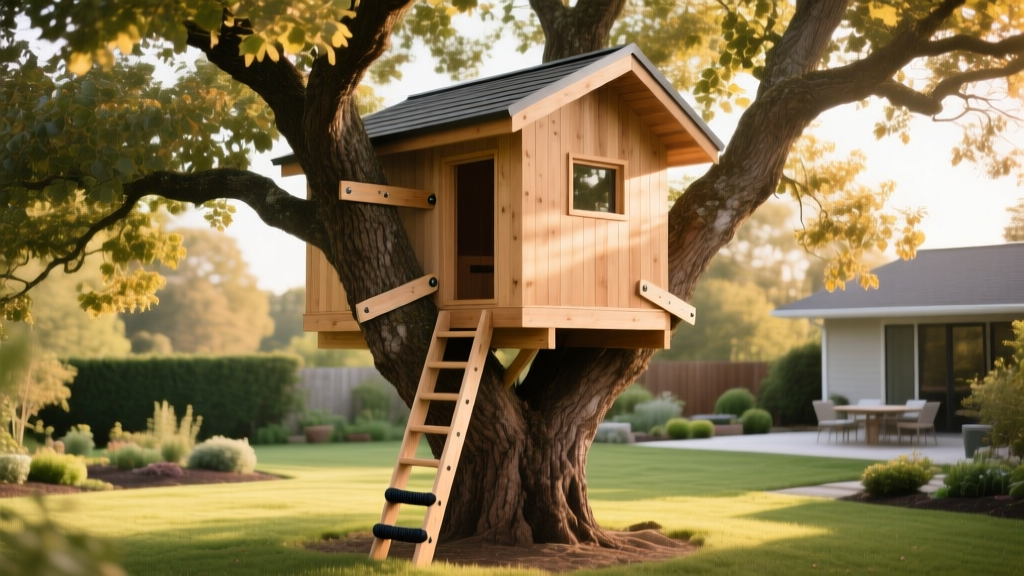
Building a Simple Tree House: A Tree-Safe Attachment Guide
The Biology of Treehouse Attachment: Why Most DIY Builds Fail
Building a simple tree house is a rewarding backyard project, but prioritizing the host tree's biology is where most amateur builders fail. Piercing the bark and cambium layer incorrectly introduces decay fungi and restricts nutrient flow. Trees do not heal like human skin; they seal. According to the widely accepted Compartmentalization of Decay in Trees (CODIT) model developed by the USDA Forest Service, trees wall off wounded areas to prevent the spread of pathogens. When you drive dozens of standard nails or lag screws into a trunk, you create overlapping wound zones that the tree cannot effectively compartmentalize, leading to structural rot and eventual failure.
To build a simple tree house that lasts decades without killing your yard's centerpiece, you must minimize puncture points, use specialized arboricultural hardware, and select the right host species.
Assessing Tree Health and Species Suitability
Not every tree in your yard is a candidate for a treehouse. You need a species with dense, closed-grain wood and a high Janka hardness rating to support dynamic loads (the shifting weight of children and wind). The trunk must also have a minimum Diameter at Breast Height (DBH) of 12 inches for a basic 8x8 foot platform.
| Tree Species | Janka Hardness (lbf) | Suitability | Arborist Notes |
|---|---|---|---|
| White Oak | 1,360 | Excellent | Highly rot-resistant heartwood; compartmentalizes wounds exceptionally well. |
| Shagbark Hickory | 1,880 | Excellent | Extremely dense; requires pre-drilling with high-torque augers. |
| Hard Maple | 1,450 | Good | Strong wood, but susceptible to heart rot if the root flare is damaged. |
| White Pine | 380 | Poor | Softwood; fast growth rings mean hardware will loosen over time. |
| Poplar / Birch | 410 / 1,260 | Poor | Prone to internal decay and brittle branch unions; high risk of limb failure. |
Warning: Never build a treehouse in a tree that shows signs of fungal fruiting bodies (conks) on the trunk, deep vertical cracks, or significant root heaving at the soil line. Consult an ISA-certified arborist for a risk assessment before loading a compromised tree with thousands of pounds of lumber.
The Hardware: Treehouse Attachment Bolts (TABs) vs. Lag Screws
The most critical mistake in building a simple tree house is using galvanized lag screws. As a tree grows radially (outward), it will swallow a lag screw. Because lag screws have a uniform shank, the tree's growth creates immense friction, eventually girdling the vascular cambium and cutting off the phloem (nutrient transport). Furthermore, lag screws rely on the shear strength of the wood threads, which degrades as the tree naturally moves in the wind.
Instead, professional treehouse builders use Treehouse Attachment Bolts (TABs). A TAB features a thick, unthreaded boss (usually 1.25 to 2 inches in diameter) that rests against the inner wood, and a forged shoulder that sits just outside the bark. This design allows the tree to grow over the shoulder without friction-girdling, while the heavy-duty bolt supports up to 8,000 lbs of shear force.
Step-by-Step: Installing TABs Without Girdling
Proper installation of TABs requires precision to avoid damaging the xylem (water-conducting tissue). Follow these exact measurements for a standard 1.25-inch TAB:
- Mark the Height: Determine your platform height. Mark two drill points on opposite sides of the trunk, ensuring they are perfectly level using a laser level or water level.
- Drill the Pilot Hole: Use a heavy-duty 1/2-inch ship auger bit. Drill straight through the trunk. Keep the drill perfectly perpendicular to the bark to prevent the bolt from binding.
- Counterbore for the Boss: Switch to a 1.25-inch Forstner or spade bit. Drill into the entry side of the trunk to a depth of exactly 1.5 inches. This creates a recess for the TAB's thick boss to sit flush inside the heartwood, bypassing the delicate cambium layer.
- Install the Bolt: Thread the TAB into the pilot hole using a high-torque impact wrench or a heavy ratchet. Stop driving when the forged shoulder is exactly 2 inches away from the bark.
- Seal the Wound: While the University of Florida IFAS Extension notes that trees naturally compartmentalize clean cuts, applying a thin layer of breathable tree wound dressing over the counterbore margin can deter carpenter ants during the first year of healing.
Framing the Platform: Accommodating Tree Movement
Trees are not static pillars; they sway in the wind and expand in diameter. If you bolt a rigid wooden frame directly to two different trees, or even rigidly to a single trunk with multiple anchor points, the tree's natural movement will tear your platform apart.
Dynamic Load Solutions
- Sliding Beam Brackets: On one side of your main support beams, use a fixed TAB bracket. On the opposite side, use a sliding bracket that allows the beam to move horizontally up to 4 inches as the tree sways.
- Knee Braces with Flex Joints: If using diagonal knee braces for extra support, attach them to the trunk using heavy-duty lag screws (acceptable here, as they are lower on the trunk and bear compression, not shear), but use a pivot joint where the brace meets the main beam.
Material Costs and Selection (2026 Estimates)
When building a simple tree house, material selection dictates both longevity and weight. Keep the structure as light as possible to reduce static load on the host tree.
| Material Component | Recommended Choice | Estimated Cost (per unit/board) | Why It Matters |
|---|---|---|---|
| Main Support Beams | 2x10 Pressure-Treated Southern Pine | $28 - $35 per 12ft board | High structural strength; resists ground-level moisture if braces touch soil. |
| Decking Boards | 5/4x6 Western Red Cedar | $6.50 - $8.00 per 8ft board | Lighter than PT lumber, naturally rot-resistant, and won't leach copper into the tree canopy. |
| Hardware (TABs) | 1.25" Galvanized TABs (Set of 2) | $130 - $170 per set | |
| Fasteners | Stainless Steel Structural Screws (e.g., GRK RSS) | $45 per box of 50 | Prevents rust stains on the tree bark and resists snapping under dynamic wind loads. |
Ongoing Canopy Care and Pruning
Once your simple tree house is built, the tree's environment changes. The roof blocks rainfall and sunlight from reaching the lower branches, and the structure alters the tree's wind profile. Proper ongoing maintenance is required to keep the tree healthy.
The Rule of Thirds: Never remove more than 25% of a tree's live canopy in a single season to accommodate a treehouse. Over-pruning starves the root system and triggers a stress response known as epicormic sprouting, where the tree rapidly pushes out weak, poorly attached water sprouts to replace lost foliage.
Maintain a minimum clearance of 18 inches between the treehouse roof and any overhanging branches. This prevents branches from abrading the roofing material during wind events and allows sufficient airflow to prevent moisture buildup and fungal growth on the treehouse shingles. When pruning branches that interfere with the structure, always make cuts just outside the branch collar—the swollen area where the branch meets the trunk—to ensure the tree can effectively seal the wound.
Frequently Asked Questions
Can I build a simple tree house in a tree with a slight lean?
Yes, but you must account for the altered center of gravity. If the tree leans, position the main support beams so that the heaviest load is centered over the trunk's base, not the canopy's center. Use a plumb bob dropped from the highest anchor point to the ground to find the true vertical load path, and align your knee braces to support that specific vector.
Will the tree eventually swallow the treehouse platform?
If you use proper TABs and leave the required 2-inch gap between the bolt shoulder and the bark, the tree will grow over the bolt shoulder and encapsulate it, but it will not swallow the wooden beams. The beams rest on the hardware, not the bark. However, you must inspect the gap annually; if the tree's radial growth closes the gap, you must loosen the bracket, slide it outward, and re-tighten it to prevent the wood from compressing against the expanding trunk.
Do I need a permit to build a treehouse?
Most municipalities classify simple, un-plumbed treehouses under 200 square feet as temporary play structures, exempting them from building permits. However, if your property is governed by a Homeowners Association (HOA) or if the tree is designated as a protected heritage species by your local urban forestry department, you may need written approval before driving any hardware into the trunk.

