
Tree Care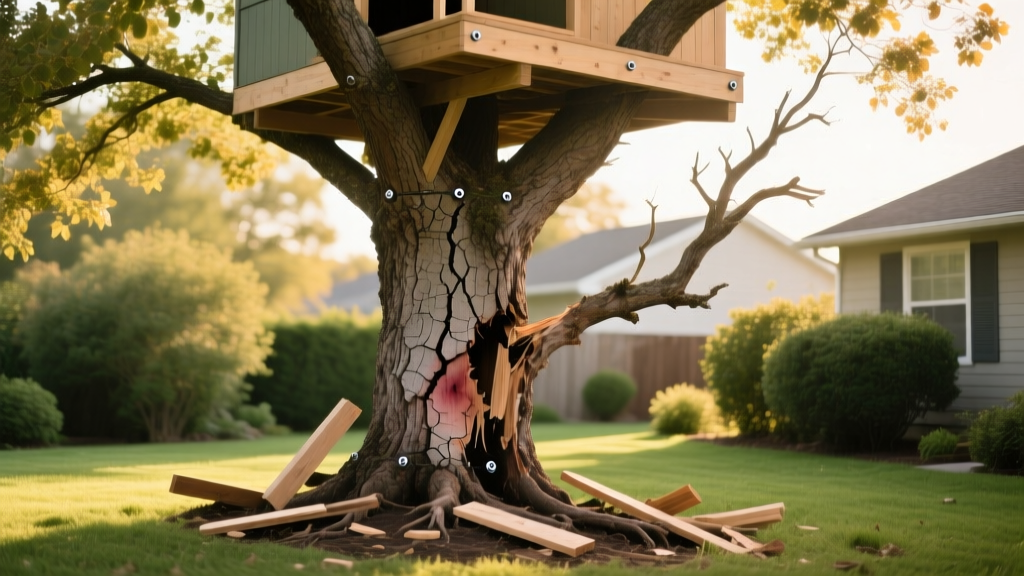
Diagnosing Tree Damage From Building Tree Houses: Expert Solutions
The intersection of recreational construction and arboriculture presents severe biological conflicts. When building tree houses, homeowners and contractors frequently prioritize structural load-bearing over the physiological needs of the host tree. Trees are not static wooden poles; they are living organisms that react to wounding, compaction, and weight loads through complex biochemical processes. Poor construction techniques lead to vascular girdling, heartwood decay, and catastrophic structural failure. This guide provides a diagnostic framework for identifying construction-induced tree stress and details the precise arboricultural solutions required to mitigate long-term damage.
The Biology of Tree Wounds: Why Traditional Fasteners Fail
To diagnose damage, you must first understand how a tree defends itself. Unlike humans, trees do not heal wounds by replacing damaged tissue; they isolate them. This process, known as the Compartmentalization of Decay in Trees (CODIT), was mapped by Dr. Alex Shigo. When a nail, lag screw, or wire is driven into a trunk, it breaches the tree's four chemical walls of defense.
WARNING: The Girdling Effect
Trees grow outward via the vascular cambium layer, located just beneath the bark. If you wrap a cable, chain, or wire around a trunk to support a treehouse platform, the tree will eventually grow over it. This chokes off the phloem, halting the transport of sugars from the canopy to the roots. Girdled trees typically exhibit sudden canopy dieback and will die within 2 to 5 years, often becoming brittle and dangerous before they are removed.
Standard galvanized lag screws (e.g., 3/4-inch diameter) lack the shear strength for dynamic treehouse loads and, more importantly, lack a specialized shoulder design. When the tree swells and grows, the wood crushes against the flat head of a lag screw, killing the surrounding cambium and inviting fungal pathogens like Armillaria (honey fungus) into the heartwood.
Diagnosing Construction-Induced Tree Stress
Diagnosing problems early prevents irreversible decline. The following matrix outlines the primary symptoms of treehouse-induced stress, their underlying biological causes, and severity levels.
| Visual Symptom | Underlying Biological Cause | Severity |
|---|---|---|
| Epicormic sprouting (water sprouts on trunk) | Severe canopy loss, root shock, or vascular disruption triggering survival reproduction. | High |
| Premature autumn coloration (August/September) | Hydraulic failure; roots cannot pull sufficient water due to soil compaction in the Critical Root Zone (CRZ). | Critical |
| Resin, sap, or gum exudation at fastener sites | Cambium layer breach; tree is attempting to chemically wall off the physical intrusion (common in pines and cherries). | Medium |
| Fungal fruiting bodies (conks/mushrooms) at base | Advanced heartwood decay caused by root severing during material staging or heavy equipment compaction. | Critical |
| Cracks radiating from bolt holes | Exceeding the wood's modulus of rupture; improper load distribution or using undersized fasteners. | High |
Real-World Edge Case: Contractors often park scissor lifts or dump piles of lumber inside the tree's Critical Root Zone (CRZ) during construction. The CRZ extends 1.5 feet radially for every 1 inch of trunk diameter at breast height (DBH). Compacting the soil reduces macroporosity below 10%, suffocating the fine feeder roots. If you observe premature leaf drop after building tree houses, soil compaction is the most likely culprit.
The TAB Solution: Engineering for Tree Health
The industry standard for mitigating fastener damage is the Treehouse Attachment Bolt (TAB). Unlike lag screws, a TAB is a heavy-duty, hot-dipped galvanized or 304-grade stainless steel bolt featuring a distinct, oversized shoulder (the "boss"). This boss rests against the outer bark, maintaining a precise gap between the treehouse beam and the trunk, allowing the tree to grow outward without crushing its own vascular tissue.
Step-by-Step TAB Installation Protocol
- Calculate Load and Spacing: A standard 10x10 foot treehouse can weigh 2,500 lbs, plus a live load of 40 lbs per square foot. Use a minimum of four 1.25-inch or 1.5-inch diameter TABs. Space them vertically no closer than 24 inches apart to avoid compromising the same vertical column of wood fibers.
- Drill the Pilot Hole: Use a sharp, high-torque auger bit matching the exact core diameter of the TAB (excluding the threads). Drill perfectly perpendicular to the trunk. Angled holes create uneven shear stress and will cause the bolt to bend under load.
- Drive the TAB: Use a 3/4-inch drive socket or heavy-duty impact wrench. Torque the bolt until the shoulder seats firmly against the bark, but do not overtighten to the point of crushing the outer bark layers. Target torque is typically 250 to 300 ft-lbs depending on wood density.
- Attach the Sliding Bracket: The main support beam must rest on a sliding bracket or a friction-fit cradle atop the TAB. This allows the beam to slide laterally as the tree sways in high winds (up to 3-5 inches of deflection in mature oaks).
Species Selection Matrix: Load and Healing Capacity
Not all trees are biologically equipped to handle the immense static and dynamic loads of a treehouse. According to the Arbor Day Foundation, selecting a species with high wood density and strong compartmentalization is non-negotiable. The host tree should have a minimum trunk diameter of 18 inches at the attachment height.
| Tree Species | Wood Density & Shear Strength | Compartmentalization (CODIT) | Verdict for Treehouses |
|---|---|---|---|
| White Oak (Quercus alba) | Very High (770 kg/m³) | Excellent; rapidly seals wounds. | Ideal. Can support massive multi-tree platforms. |
| Sugar Maple (Acer saccharum) | High (710 kg/m³) | Good, but susceptible to heart rot if deep wounds occur. | Very Good. Requires precise drilling to avoid heartwood. |
| Eastern White Pine (Pinus strobus) | Low/Medium (400 kg/m³) | Poor; resin bleeds heavily, decay spreads fast. | Avoid. Wood is too soft to hold heavy shear loads safely. |
| Paper Birch (Betula papyrifera) | Low (510 kg/m³) | Very Poor; highly susceptible to borers and rot. | Strictly Avoid. Short lifespan and brittle limbs. |
Accommodating Growth: The 3-Inch Rule and Dynamic Cabling
Trees grow via apical meristems (upward) and the vascular cambium (outward). A mature oak can add 0.25 to 0.5 inches of radial girth annually. When building tree houses, you must engineer for this biological reality.
The 3-Inch Rule: Whenever a beam or platform passes near a branch or trunk, leave a minimum 3-inch clearance gap. If a branch grows into a rigid wooden beam, the friction will strip the bark, creating a massive entry point for decay fungi. Use flexible rubber spacers or leave open gaps in the decking around the trunk.
Multi-Tree Suspensions: If your design spans two or more trees, never use rigid, bolted beams connecting them. Trees sway at different frequencies based on their height, mass, and wind exposure. A rigid beam will eventually tear the fasteners out of the weaker tree. Instead, use dynamic suspension systems (such as the Cobra tree cabling system) or sliding beam joints that allow each tree to move independently without transferring destructive torsional stress to the host trunks.
Post-Construction Tree Care Protocol
The completion of the treehouse is not the end of the tree care process. The construction phase induces severe environmental shock. Implement the following recovery protocol:
- Air-Spading for Compaction: If heavy materials were stored in the CRZ, hire a certified arborist to perform air-spading. This uses compressed air at 90 PSI to fracture compacted soil without severing roots. Expect to pay $150 to $300 per hour for this service.
- Vertical Mulching: Drill 2-inch wide holes, 18 inches deep, in a grid pattern throughout the drip line. Fill these holes with a mix of calcined clay and organic compost to restore soil macroporosity and oxygen exchange.
- Canopy Hydration: Trees under construction stress have impaired hydraulic systems. Install a slow-release drip irrigation ring at the drip line, delivering 10 gallons of water per inch of trunk DBH once a week during dry spells for the first two growing seasons.
By shifting the focus from purely structural engineering to biological integration, you ensure that the tree remains a living, thriving anchor for your structure rather than a slowly dying wooden post.

