
Tree Care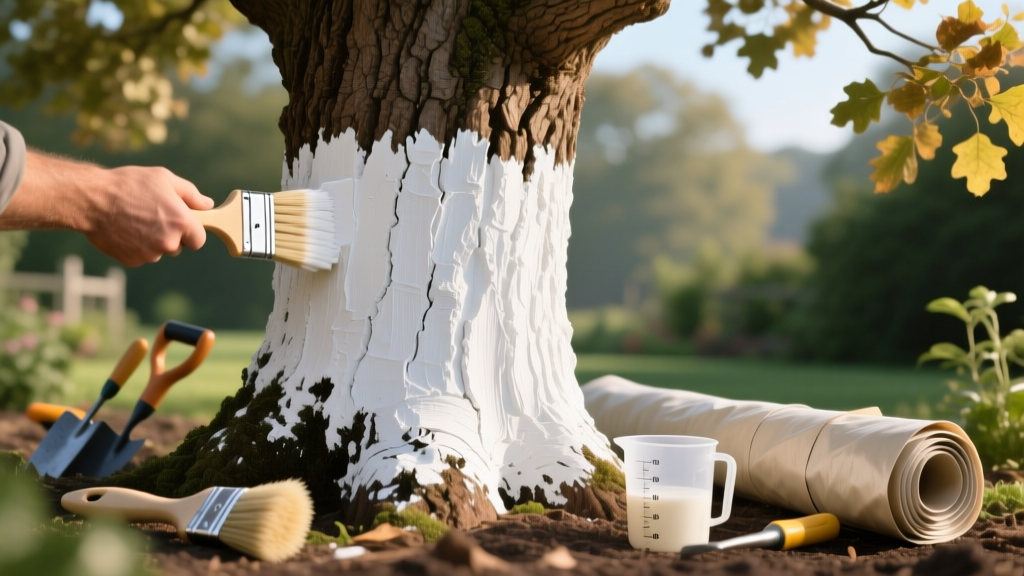
How to Decorate a Tree Trunk Safely: Whitewash Dosage & Wrap Costs
The Arborist’s Approach to Trunk Decoration
When homeowners research how to decorate a tree trunk, they often envision wrapping them in string lights, attaching hanging planters with screws, or painting decorative moss patterns. However, from an arboricultural perspective, the trunk is a tree’s primary vascular highway. Puncturing the bark with nails or girdling it with tight wire introduces decay pathogens and disrupts the phloem and xylem. True tree care "decoration" focuses on aesthetic enhancements that simultaneously protect the cambium layer from environmental stress.
This guide breaks down the exact dosage, coverage rates, and material costs for three professional-grade trunk treatments that beautify your landscape while preserving tree health: protective whitewashing, decorative winter wraps, and non-invasive architectural uplighting.
Whitewashing: Dosage, Coverage, and Material Costs
Whitewashing is the practice of painting the lower trunk white. While it provides a striking, uniform aesthetic that complements modern landscape designs, its primary function is reflecting winter sunlight to prevent sunscald (southwest winter injury) and deterring wood-boring insects.
Calculating Bark Surface Area and Paint Dosage
To determine the exact dosage of whitewash needed, you must calculate the bark surface area of the trunk. Do not guess; over-applying thick coats can suffocate the lenticels (pores) the tree uses to breathe.
- Step 1: Measure the Diameter at Breast Height (DBH) in inches (measured 4.5 feet above the ground).
- Step 2: Calculate circumference: Circumference = DBH × 3.14.
- Step 3: Determine the paint height (standard is 3 feet to 5 feet from the soil line).
- Step 4: Calculate square footage: (Circumference in feet) × (Height in feet) = Total Sq. Ft.
Coverage Rate: A standard 50/50 mixture of white interior latex paint and water covers approximately 400 to 450 square feet of porous bark per gallon. A mature tree with a 20-inch DBH and a 4-foot paint height requires roughly 21 square feet of coverage. Therefore, a single gallon of mixed solution will adequately coat up to 18 mature trees for a single-season application.
⚠️ CRITICAL WARNING: Never use oil-based paints, exterior elastomeric coatings, or spray-on sealants. These trap moisture against the cambium, accelerating fungal rot. Always use a flat-finish, water-based interior latex paint (e.g., Sherwin-Williams ProMar 200 Flat) diluted with water to allow the bark to transpire.
Whitewash Cost Breakdown (2026 Estimates)
| Material | Unit Cost | Cost Per Tree (20" DBH) |
|---|---|---|
| 1 Gallon Flat Interior Latex | $38.00 | $2.11 |
| Water (1:1 ratio) | $0.05 | $0.01 |
| 3" Masonry Brush | $12.00 (one-time) | N/A |
For a comprehensive overview of sunscald prevention and the physiological mechanics of winter bark splitting, refer to the Colorado State University Extension guide on sunscald and bark cracks.
Decorative Winter Wraps: Material Yards and Pricing
If your goal is to add texture and color to the winter landscape while protecting thin-barked species (like Japanese Maples, Honeylocusts, and young Ash trees) from frost cracks and deer rubbing, commercial tree wraps are the safest decorative option.
Wrap Coverage and Application Rules
Unlike whitewash, wraps must be removed in early spring to prevent trapping moisture and harboring pests. Coverage depends heavily on the overlap technique. You must overlap the wrap by 30% to 50% on each upward spiral to ensure water sheds off the material rather than soaking into the bark.
Material Comparison Matrix
| Wrap Material | Standard Roll Dimensions | Coverage per Roll | Avg. Cost (2026) | Breathability |
|---|---|---|---|---|
| Crepe Paper (Green/Brown) | 4" wide × 150' long | ~35 sq. ft. (with 50% overlap) | $14 - $18 | High |
| Polypropylene Fabric | 6" wide × 100' long | ~40 sq. ft. (with 30% overlap) | $22 - $28 | Medium |
| Burlap (Decorative/Rustic) | 40" wide × 3 yards | Custom cut (approx. 60 sq. ft.) | $15 - $25 | Very High |
Pro-Tip for Fastening: Never use duct tape, zip-ties, or wire to secure the wrap, as these will girdle the tree as the trunk expands in spring. Use biodegradable jute twine or specialized tree-tack tape applied only to the wrap itself, not the bark. For detailed seasonal wrapping protocols, consult the University of Minnesota Extension's winter tree care guidelines.
Non-Invasive Landscape Lighting (Uplighting)
Hanging string lights or wrapping trunks in wire-heavy holiday lighting is a common way homeowners attempt to decorate a tree trunk. However, the micro-abrasions caused by wind-blown wires rubbing against the bark create entry points for Hypoxylon canker and other fungal pathogens. The professional alternative is low-voltage architectural uplighting.
Lighting Dosage and Beam Spread
Lighting "dosage" in arboriculture refers to wattage and beam angle to prevent light pollution and thermal stress to the bark.
- Wattage Limit: Use 3W to 5W LED fixtures. Higher wattages generate excess heat at the fixture lens, which can scorch the lower bark of young trees if placed too close.
- Placement Distance: Mount the fixture 18 to 24 inches away from the trunk base. This allows the beam to widen, washing the bark in light rather than creating a harsh, localized hot spot.
- Beam Angle: Choose a 35-degree or 60-degree beam spread for trunks. A 15-degree spot beam is too narrow and will only illuminate a vertical sliver of the trunk, missing the textured bark entirely.
Cost Analysis: A professional-grade, solid brass LED uplight (such as the VOLT® Fat Boy or WAC Lighting brass series) costs between $85 and $130 per fixture. While the upfront cost is higher than a $20 spool of holiday lights, brass fixtures carry a lifetime warranty against corrosion and eliminate the annual labor and bark-damage costs associated with stapling or tying temporary lights.
The Hidden Costs of "Pinterest" Tree Decorations
Aesthetic trends often conflict with tree biology. Understanding the financial and biological cost of common mistakes is crucial for long-term landscape management.
🚫 The Girdling Penalty: Wrapping copper wire or heavy rope around a trunk to hang decorations will eventually girdle the tree. As the trunk grows outward, the wire cuts off the phloem. The cost to remove a mature, girdled tree that has become a hazard ranges from $800 to $2,500, vastly outweighing the cost of safe, non-invasive decorations.
"A tree's bark is not a corkboard. Every nail, screw, or tight wire introduced to the trunk initiates a compartmentalization response (CODIT). The tree spends vital energy walling off the wound instead of growing, and repeated 'decorations' will inevitably lead to structural failure."
Moss and Lichen "Painting"
Another trending search involves painting moss onto tree trunks using buttermilk and food coloring blends. While moss itself is harmless to trees, applying thick, acidic organic slurries directly to the bark of species prone to fungal issues (like Dogwoods or Magnolias) can trap excess moisture and alter the bark's pH. If you desire the look of a mossy trunk, it is safer to cultivate a humid microclimate via ground-level shade planting and drip irrigation rather than painting the trunk directly.
Quick-Reference Cost & Coverage Matrix
Use this summary matrix to budget your trunk enhancement project based on your specific landscape goals.
| Treatment Method | Primary Benefit | Coverage / Dosage | Estimated Cost Per Tree |
|---|---|---|---|
| Latex Whitewash | Sunscald & Borer Prevention | 400 sq ft / gallon (50/50 mix) | $2.50 - $4.00 |
| Crepe Paper Wrap | Frost Crack & Deer Protection | 1 roll per 2-3 young trees | $6.00 - $12.00 |
| Brass LED Uplight | Nighttime Aesthetics (No Bark Contact) | 1 fixture (5W, 35° beam) per trunk | $90.00 - $140.00 |
By prioritizing treatments that respect the tree's vascular system, you can achieve a beautifully decorated landscape that remains structurally sound and biologically healthy for decades.

