
Tree Care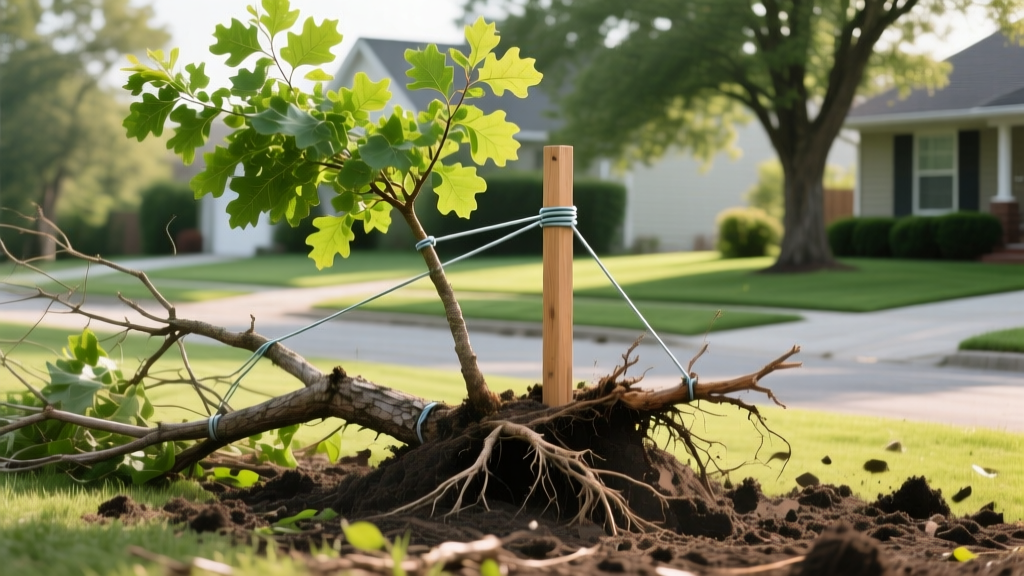
Tree Wind Damage: How to Protect and Stake Young Yard Trees
The Physics of Tree Wind Damage
When severe weather hits, young yard trees face immense mechanical stress. Tree wind damage typically occurs in two distinct failure modes: trunk snap and windthrow. Trunk snap happens when the leverage of the canopy exceeds the bending strength of the wood, usually at a weak branch union or a point of decay. Windthrow, however, is the complete uprooting of the tree, where the root ball acts as a lever, peeling the roots out of the soil.
Soil composition heavily dictates windthrow risk. According to forestry mechanics, saturated sandy loam loses up to 40% of its shear strength compared to dry clay, making newly planted trees in sandy soils highly susceptible to leaning or uprooting during spring storms. Understanding these forces is the first step in effective tree wind protection.
The 1/3 Trunk Rule: Never stake a tree higher than 1/3 of its total trunk height. Staking too high prevents the lower trunk from developing reaction wood (tension and compression wood), which is essential for the tree to build its own natural taper and structural strength against future tree wind events.
Step-by-Step: Staking Trees for Tree Wind Resistance
Improper staking is a leading cause of long-term tree failure. Wire, zip ties, and rigid ropes will cut into the cambium layer, strangling the tree. For beginner gardeners, a flexible two-stake system is the most reliable and cost-effective method for trees with a trunk caliper under 3 inches.
Materials Needed (Approximate Cost: $18 - $28 per tree)
- Two 36-inch steel T-posts or 2x2 pressure-treated wooden stakes
- One roll of 1.5-inch wide canvas arbor tie tape (approx. $8)
- A sledgehammer or post pounder
- Heavy-duty scissors or pruning shears
Installation Steps
- Position the Stakes: Place the two stakes exactly 2 feet away from the trunk on opposite sides. Align them parallel to the prevailing wind direction in your region (e.g., if storms roll in from the west, place stakes on the east and west sides).
- Drive the Stakes: Hammer the stakes at least 18 inches into the ground. If you are working in loose, sandy soil, drive them 24 inches deep to ensure the anchor point remains stable during soil liquefaction.
- Attach the Ties: Wrap the 1.5-inch canvas arbor tie around the trunk in a figure-eight pattern between the stake and the trunk. This prevents the bark from rubbing against the stake.
- Allow Trunk Movement: Tie the canvas loosely enough that you can slide two fingers between the tape and the bark. The tree must be able to sway slightly in the breeze; this micro-movement triggers the release of ethylene gas, which stimulates the roots to anchor deeper and the trunk to thicken.
Advanced Anchoring: Guy-Wiring for Larger Caliper Trees
If you are planting a mature specimen with a trunk caliper exceeding 3 inches, standard stakes will not provide enough leverage to prevent tree wind throw. Instead, use a 3-point guy-wiring system.
Drive three 30-inch Duckbill earth anchors into the soil at a 45-degree angle, positioned 120 degrees apart from each other and roughly 6 to 8 feet away from the trunk. Run galvanized steel aircraft cable through the anchors and attach them to the trunk using wide, padded tree straps. The University of Minnesota Extension emphasizes that guy-wires must be checked monthly and loosened as the trunk expands to prevent fatal girdling.
DIY Windbreaks vs. Natural Windbreaks
For yards in exposed, high-wind corridors, shielding the tree is just as important as staking it. A common beginner mistake is building a solid wooden privacy fence to block the wind. Solid barriers force air up and over the fence, creating a violent, turbulent downdraft on the leeward side that can easily snap young branches.
Effective windbreaks must have a density of 50% to 60%. This allows a portion of the wind to pass through, filtering the air and reducing velocity without creating destructive vacuum eddies. The University of Missouri Extension notes that a properly designed 60% dense windbreak can reduce wind velocity for a distance up to 10 times the height of the barrier.
| Windbreak Type | Density | Estimated Cost | Pros & Cons |
|---|---|---|---|
| Solid Wood Fence | 100% | $45 - $85 / linear ft | High privacy, but creates severe turbulent downdrafts that damage trees. |
| Lattice / Trellis Panel | 50% - 60% | $15 - $30 / linear ft | Filters wind effectively; excellent for supporting climbing vines. |
| Burlap Wind Screen | 70% - 80% | $10 - $15 / tree | Cheap temporary winter protection, but blocks too much airflow for year-round use. |
| Evergreen Shrub Row | 60% (Natural) | $25 - $60 / shrub | Best long-term ecological filter; requires 3-5 years to reach effective height. |
Species Selection: Wind-Resistant Trees for Beginners
If you live in a hurricane-prone or high-wind region, the best defense against tree wind damage is selecting a species with flexible wood, deep taproots, and aerodynamic canopy structures. Avoid brittle, fast-growing species like Bradford Pear, Silver Maple, or Leyland Cypress, which are notorious for catastrophic limb failure.
Top 3 Wind-Resistant Trees for Residential Yards
- Live Oak (Quercus virginiana): Hardiness Zones 7-10. Features incredibly dense wood and a sprawling, low-center-of-gravity canopy that allows wind to pass over it. Highly resistant to salt spray and hurricane-force gusts.
- Bald Cypress (Taxodium distichum): Hardiness Zones 4-10. Known for its buttressed trunk and deep root system. While it naturally grows in swamps, it adapts beautifully to dry yard soils and bends remarkably well under heavy wind loads.
- Ginkgo Biloba (Ginkgo): Hardiness Zones 3-8. A prehistoric species with uniquely flexible branches that sway and fold in high winds rather than snapping. Ensure you purchase a male cultivar (like 'Autumn Gold') to avoid the foul-smelling fruit produced by female trees.
Warning: The Girdling Trap
The most common mistake beginners make is leaving staking materials on the tree for too long. As the trunk expands in diameter, rigid ties will cut off the phloem (the inner bark responsible for transporting nutrients). If you cannot slide two fingers under the tie, it is too tight. Remove all staking materials completely after 12 to 18 months to force the tree to develop its own structural taper.
The most common mistake beginners make is leaving staking materials on the tree for too long. As the trunk expands in diameter, rigid ties will cut off the phloem (the inner bark responsible for transporting nutrients). If you cannot slide two fingers under the tie, it is too tight. Remove all staking materials completely after 12 to 18 months to force the tree to develop its own structural taper.
Frequently Asked Questions
Should I stake a newly planted tree immediately?
Not always. If the tree has a caliper under 2 inches, a strong root ball, and is planted in a sheltered yard, staking may be unnecessary. Staking is only strictly required for top-heavy trees, bare-root plantings, or yards exposed to severe, unblocked wind corridors.
My tree is already leaning after a storm. Can I pull it straight?
If the tree has been in the ground for less than a year and the root ball has shifted, you can carefully excavate the soil on the side it is leaning toward, gently winch the trunk back to plumb using a padded strap and a vehicle, and re-stake it. However, if the tree has been established for more than two years, the roots have likely anchored in the leaning position, and pulling it straight will snap the structural roots. In that case, consult a certified arborist.
How do I prune a tree to make it more wind-resistant?
Focus on structural pruning during the first five years. Remove co-dominant leaders (two main trunks competing for dominance) by subordination pruning, which involves shortening one leader to encourage the other. Additionally, thin the canopy by removing no more than 15-20% of live foliage to allow wind to pass through the branches, reducing the overall sail effect during storms.

