
Tree Care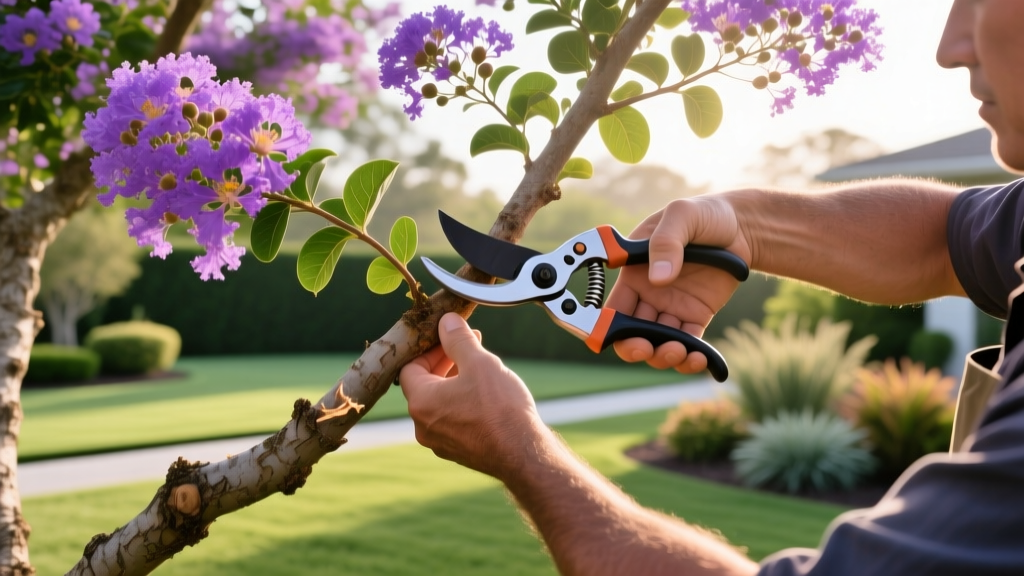
How to Trim Crepe Myrtle Trees: Avoid Crape Murder Mistakes
The 'Crape Murder' Epidemic: Why Topping Destroys Your Trees
Crepe myrtles (Lagerstroemia indica and its hybrids) are the undisputed workhorses of southern landscapes, offering months of vibrant blooms and striking winter bark. Yet, every winter, millions of these trees fall victim to 'crape murder'—the severe, indiscriminate topping of main trunks and primary branches. This practice is not pruning; it is amputation.
When you sever the apical meristem (the dominant growing tip) of a crepe myrtle, the tree responds with epicormic sprouting. It pushes out dozens of weak, spindly whips from the cut site to replace the lost canopy. Because these new shoots originate from the outer edges of the severed trunk rather than from a natural branch collar, they lack structural integrity. By mid-summer, these whippy shoots cannot support the weight of heavy bloom clusters, leading to drooping, breakage, and a permanent, knuckled deformity on the trunk.
Expert Insight: Topping also destroys the tree's natural defense mechanisms. The large, flat cuts left by topping shears cannot be compartmentalized by the tree's wood tissue. This exposes the heartwood to fungal pathogens and wood-boring insects, significantly shortening the lifespan of the tree.
Exact Timing: When to Prune Based on Your USDA Zone
Knowing how to trim crepe myrtle trees correctly starts with knowing when. Pruning must occur during full dormancy, but before bud swell. Pruning too early in the fall can trigger new growth that will be killed by the first hard freeze, causing severe dieback. Pruning too late in the spring removes the wood that has already set flower buds, sacrificing your summer bloom cycle.
| USDA Hardiness Zone | Ideal Pruning Window | Bud Swell Risk Period |
|---|---|---|
| Zone 7a - 7b | Late February to Mid-March | Early April |
| Zone 8a - 8b | Mid-February to Early March | Mid-March |
| Zone 9a - 9b | Late January to Mid-February | Early March |
| Zone 10a - 10b | Early January to Late January | Mid-February |
According to the Clemson University Home & Garden Information Center, waiting until the tree is completely leafless makes it significantly easier to see the branching structure and identify crossing or rubbing limbs that need removal.
The Professional Tool Kit: What You Actually Need
Do not use anvil pruners or hedge trimmers on crepe myrtles. Anvil blades crush the cambium layer, and hedge trimmers create hundreds of jagged, tearing wounds. You need sharp bypass blades that slice cleanly. Budget for high-carbon steel tools that hold an edge through dense, mature wood.
- Bypass Hand Pruners (Under 3/4-inch cuts): The Felco F-2 Classic (approx. $65 in 2026) is the industry standard. Its sap groove prevents the blades from sticking to the sticky crepe myrtle resin.
- Bypass Loppers (3/4-inch to 1.5-inch cuts): The Corona FL 3440 Compound Action Loppers (approx. $48) provide the leverage needed for older, thicker secondary branches without crushing the bark.
- Folding Pruning Saw (Over 1.5-inch cuts): The Silky Gomboy 240mm with medium teeth (approx. $55) cuts on the pull stroke, leaving a glass-smooth finish that heals rapidly without the need for sealants.
Step-by-Step Structural Pruning Framework
Proper pruning enhances the tree's natural, multi-trunk vase shape. Follow this sequential framework to maintain structural integrity and maximize airflow, which is critical for preventing powdery mildew.
Step 1: Basal Sucker Eradication
Crepe myrtles aggressively push suckers from the root flare and lower trunk. Do not just shear them off with hedge trimmers, which leaves stubs that will sprout three new suckers each. Use your hand pruners to cut suckers completely flush against the trunk or root collar. Removing the apical dominance of the sucker prevents immediate regrowth.
Step 2: The 'Three Ds' and Crossing Limbs
Remove all Dead, Damaged, and Diseased wood. Next, look for branches that cross or rub against one another. The friction creates open wounds that invite fungal cankers. Remove the weaker of the two crossing branches, cutting back to the main trunk or a larger lateral branch. Never leave stubs; always cut just outside the branch collar (the swollen area where the branch meets the trunk).
Step 3: Canopy Thinning and Directional Cuts
To open the canopy for sunlight and airflow, thin out inward-growing branches. When making reduction cuts on lateral branches, locate an outward-facing bud. Make your cut exactly 1/4-inch above this bud at a 45-degree angle, sloping away from the bud. This directs the new spring growth outward, expanding the vase shape rather than tangling the center.
Step 4: Elevating the Canopy (Optional)
If pedestrian clearance is needed, remove lower limbs up to a height of 3 to 4 feet. However, avoid stripping the trunk entirely. Leaving some lower, smaller branches maintains the tree's natural shrub-like form and prevents the 'lollipop' look that weakens the trunk's taper and wind resistance.
WARNING: The Pruning Sealer Myth
Never apply wound dressings, pruning paints, or sealants to crepe myrtle cuts. Research from the University of Florida IFAS Gardening Solutions confirms that these products trap moisture against the wood, accelerating fungal decay and preventing the tree's natural compartmentalization process (CODIT) from sealing the wound.
Never apply wound dressings, pruning paints, or sealants to crepe myrtle cuts. Research from the University of Florida IFAS Gardening Solutions confirms that these products trap moisture against the wood, accelerating fungal decay and preventing the tree's natural compartmentalization process (CODIT) from sealing the wound.
Rehabilitating a Previously 'Murdered' Crepe Myrtle
If you have inherited a severely topped crepe myrtle with large, knuckled knobs at the cut sites, do not attempt to fix it in a single year. A three-year restoration plan is required to rebuild the branch structure.
- Year 1 (Selection): In late winter, examine the whippy sprouts emerging from the knobs. Select the 3 or 4 strongest, most outward-growing sprouts on each knob. Cut all other sprouts flush to the knob. Do not head back the selected sprouts; let them grow their full length to build caliper (thickness).
- Year 2 (Establishment): The selected sprouts will now be thicker. Identify a lateral side-branch on each sprout and make a reduction cut just above it. This forces the tree to build a natural branch union and stops the 'whip' effect.
- Year 3 (Refinement): The tree will now have a secondary branch structure. Thin out any remaining dense, inward-growing twigs. Over time, the original knuckled knobs will slowly be swallowed by the expanding caliper of the new, properly attached branches.
Frequently Asked Questions
Will cutting back my crepe myrtle make it bloom more?
No. Crepe myrtles bloom on new wood produced in the current growing season. While severe topping does force a massive flush of new growth, the resulting blooms are smaller, fewer in number per cluster, and often so heavy they break the weak branches. Proper, light thinning actually produces larger, sturdier bloom panicles.
Can I cut my crepe myrtle completely to the ground?
Yes, a technique known as coppicing. If you want to use a crepe myrtle as a dense, flowering privacy hedge or shrub rather than a tree, you can cut all trunks down to 6 inches above the soil line in late winter. The tree will push vigorous new shoots from the base, growing 4 to 6 feet in a single season and blooming heavily in late summer. This must be repeated annually to maintain the shrub form.
How do I deal with powdery mildew on the pruning cuts?
Powdery mildew (Erysiphe lagerstroemiae) thrives in dense, unpruned canopies with poor air circulation. By following the canopy thinning steps outlined above, you naturally reduce the humidity that mildew requires. If you are planting a new tree, bypass this issue entirely by selecting modern, mildew-resistant hybrids like 'Natchez', 'Tuscarora', or 'Dynamite'.

