
Tree Care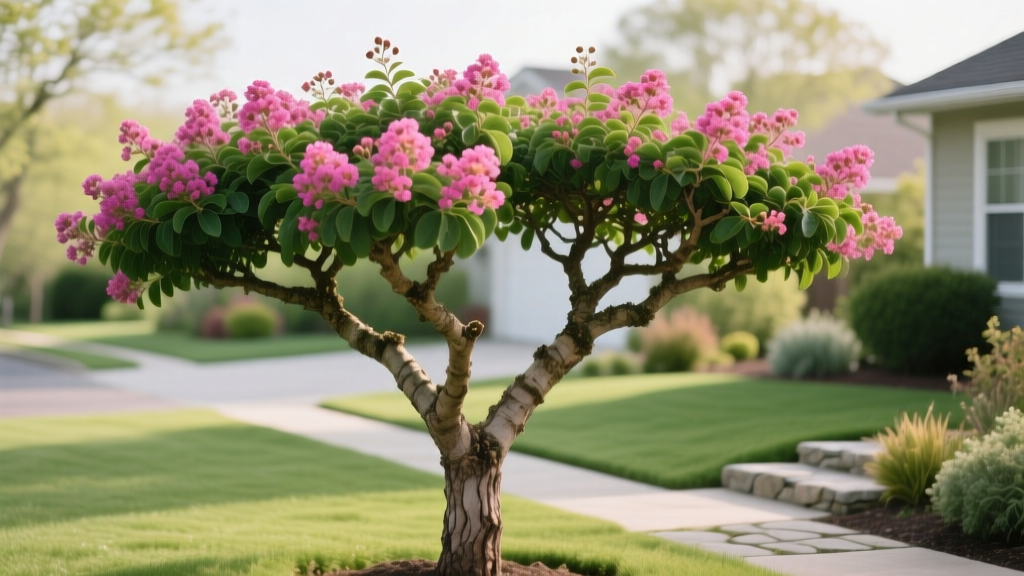
How to Trim a Crepe Myrtle Tree Without Crape Murder
The Lagerstroemia indica, commonly known as the crepe myrtle, is a staple of southern landscapes, prized for its vibrant summer blooms and striking winter bark. Yet, it is also the victim of one of the most widespread arboricultural abuses in North America: 'crape murder.' Topping these trees by blindly chopping off the tops of their branches does not promote better blooming; it destroys the tree's natural architecture, invites disease, and creates structurally unsound growth. Understanding how to trim a crepe myrtle tree properly requires shifting from a mindset of size reduction to one of canopy thinning and structural integrity.
The Physiology of Crape Murder: Why Topping Destroys Your Tree
When you sever a mature crepe myrtle branch mid-stem, you bypass the tree's natural defense mechanisms. Unlike proper pruning cuts made at the branch collar, topping cuts leave large, flat stubs that cannot compartmentalize decay. The tree responds to this severe trauma by pushing out dozens of adventitious shoots (water sprouts) just below the cut site.
⚠️ Warning: The Knuckle Effect and Windthrow Risk
Over successive years of topping, the cut site swells into a gnarled, burl-like mass known as a 'knuckle.' The adventitious shoots emerging from these knuckles lack a strong branch collar attachment. Because they are anchored only to the outer bark layers rather than the structural wood, these top-heavy, weakly attached branches are highly susceptible to windthrow—snapping off during summer thunderstorms and causing significant property damage.
Furthermore, the dense cluster of water sprouts created by topping blocks sunlight and airflow from reaching the inner canopy. This microenvironment is a breeding ground for Erysiphe lagerstroemia (powdery mildew) and cercospora leaf spot, two fungal pathogens that thrive in stagnant, humid conditions.
Essential Tools for Precision Pruning
Executing clean, precise cuts requires sharp, high-quality bypass blades. Anvil pruners crush the vascular tissue of the crepe myrtle, leading to dieback. Invest in the following professional-grade tools to ensure surgical precision.
| Tool Category | Recommended Model (2026) | Price Range | Specific Use Case |
|---|---|---|---|
| Hand Pruners | Felco 2 Classic Bypass | $60 - $68 | Branches up to 1 inch thick; precise tip pruning. |
| Bypass Loppers | Corona SL 4264EZ (32-inch) | $45 - $55 | Structural branches from 1 inch to 2.5 inches. |
| Pole Saw | Silky Hayauchi 3-Extension | $180 - $210 | High canopy thinning without climbing or ladders. |
| Pruning Saw | Silky Gomboy 210 (Fine Teeth) | $50 - $60 | Flush cuts on trunks and branches over 3 inches. |
When to Prune: The Dormancy Window
Timing is critical for wound compartmentalization and bloom production. Crepe myrtles bloom on new wood (the current season's growth). According to Clemson University's Home & Garden Information Center, the optimal window for pruning is late winter, just before the tree breaks dormancy. In USDA Hardiness Zones 7 through 9, this typically falls between late January and early March. Pruning too early in the winter (November or December) can stimulate premature sap flow, making the tree vulnerable to late-season hard freezes. Waiting until you see the tiny green buds swelling on the branches ensures the tree has the immediate energy reserves required to seal pruning wounds and push vigorous new flowering shoots.
Step-by-Step Guide: How to Trim a Crepe Myrtle Tree
Follow this systematic approach to thin and shape your tree while preserving its natural, vase-like architecture. The University of Florida IFAS Extension emphasizes that a properly pruned crepe myrtle should look elegant and open, not like a chopped-off stump.
Step 1: Eradicate Base Suckers
Crepe myrtles naturally push root suckers from the base flare. Do not just snap these off with your hands, as this leaves tissue that will resprout. Use your Silky Gomboy saw or Felco pruners to cut the suckers as flush to the main trunk or root crown as possible. Removing these prevents the tree from wasting energy on non-structural, brushy growth.
Step 2: Remove the 'Three Ds'
Identify and remove all Dead, Damaged, and Diseased wood. Cut dead branches back to the nearest healthy lateral branch or the main trunk collar. If you find branches damaged by wind or ice storms, make a clean cut just below the splintered or torn bark to allow the cambium layer to heal properly.
Step 3: Eliminate Crossing and Inward-Growing Branches
Branches that rub against each other create open wounds that serve as entry points for wood-decaying fungi. When two branches cross, keep the one that grows outward at a wider, more structurally sound angle (ideally 45 to 60 degrees from the trunk) and remove the other. Similarly, prune any branches growing inward toward the center of the canopy to maximize solar penetration and airflow.
Step 4: Canopy Thinning and Lateral Reduction
If the tree is too wide for its space, do not top the branches. Instead, use 'drop-crotch' pruning. Trace the overly long branch back to a lateral side branch that is at least one-third the diameter of the branch being removed. Make your cut just outside the branch bark ridge and branch collar. This reduces the canopy's footprint while maintaining the tree's natural structural hierarchy.
Arborist Insight: Never apply pruning sealants, tar, or paint to your cuts. Research by the International Society of Arboriculture (ISA) confirms that wound dressings trap moisture against the exposed wood, accelerating fungal decay rather than preventing it. Let the tree's natural CODIT (Compartmentalization of Decay in Trees) process do the work.
Restoring a Previously 'Murdered' Crepe Myrtle
If you have inherited a property with a severely topped crepe myrtle exhibiting large knuckles, restoration is a multi-year process. You have two primary decision pathways:
- Option A: Severe Rejuvenation (The Hard Reset). Cut the entire tree down to 6 inches above the soil line in late winter. The root system will push up dozens of new shoots. In the first summer, select the 3 to 5 strongest, most widely spaced shoots and prune away all others. Over the next three years, train these into new main trunks. This yields a beautiful, multi-trunk tree but sacrifices 2 to 3 years of blooms.
- Option B: Gradual Knuckle Reduction. If you prefer to keep the existing height, select the two strongest adventitious shoots growing outward from each knuckle. Prune away all other water sprouts flush to the knuckle. Over the next three to four years, allow these selected shoots to thicken and fuse to the knuckle, eventually cutting the old, dead knuckle stub back to the new branch union once the new wood is structurally sufficient to bear the load.
Cost Analysis: DIY vs. Professional Arborist
While routine thinning of a young crepe myrtle is easily managed by a homeowner with $150 worth of quality tools, mature, multi-trunk specimens over 20 feet tall require professional intervention. In 2026, hiring an ISA Certified Arborist to perform a structural thinning and canopy elevation on a mature crepe myrtle typically costs between $250 and $600 per tree, depending on canopy density and site access. Beware of 'mow-and-blow' landscaping crews offering to prune your trees for $50; they are almost guaranteed to use hedge trimmers or anvil loppers to top the tree, resulting in long-term structural damage that will cost thousands to remediate or remove later.
By committing to proper thinning techniques and respecting the tree's natural growth habits, your crepe myrtle will reward you with larger, heavier flower panicles, exfoliating cinnamon-and-silver bark, and a robust structure capable of withstanding severe weather for decades.

