
Tree Care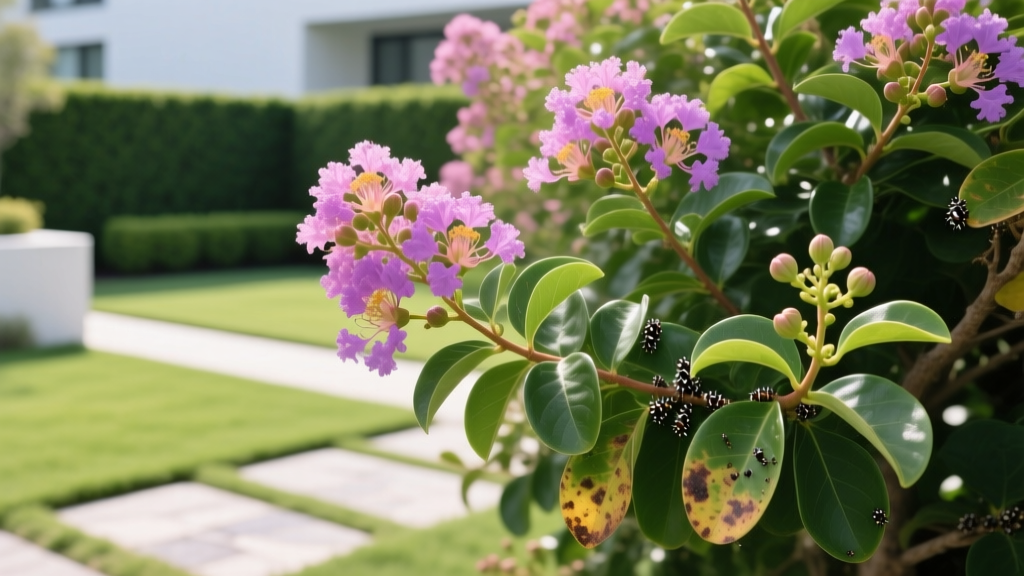
Troubleshooting Crepe Myrtle Shrubs: Disease and Pest Solutions
The Unique Challenges of Shrub-Form Crepe Myrtles
While standard crepe myrtles (Lagerstroemia indica and L. fauriei hybrids) are often trained into small, single-trunk trees, dwarf and semi-dwarf shrub forms—such as 'Pocomoke', 'Chickasaw', 'Acoma', and 'Hopi'—present a distinct set of horticultural challenges. Growing typically between 2 and 6 feet tall, these shrub forms are heavily utilized in foundation plantings, low hedges, and mass landscape beds. However, their multi-stemmed architecture and proximity to the ground make them uniquely vulnerable to specific fungal pathogens, soil-borne issues, and insect infestations that do not always affect their taller, tree-form cousins. Diagnosing issues early is critical to saving the plant's summer bloom cycle and overall vigor.
The 'No Bloom' Mystery: Nutritional and Pruning Failures
The most frequent complaint from homeowners is a crepe myrtle shrub that produces lush green foliage but fails to produce flowers. This is rarely a disease issue and almost always stems from improper pruning or nutritional imbalances.
The Danger of 'Crepe Murder' on Shrub Forms
Topping or severely cutting back the main stems of a crepe myrtle—colloquially known as 'crepe murder'—destroys the natural, graceful architecture of shrub forms. More importantly, it forces the plant to push out weak, spindly vegetative shoots from the cut nodes. These secondary shoots lack the structural integrity to hold heavy flower panicles and often fail to mature enough to set buds before the end of the growing season. The Fix: Shrub forms should only be pruned to remove dead, diseased, or crossing branches, and to thin out weak basal suckers. Prune strictly in late winter (February to early March) before bud break, making cuts just above outward-facing buds.
Nitrogen Overload and Phosphorus Deficiency
Crepe myrtle shrubs planted near turfgrass are often victims of lawn fertilization runoff. High-nitrogen lawn fertilizers (e.g., 30-0-10 formulations) force the shrub into a vegetative growth state, suppressing flower bud initiation. Conversely, a lack of phosphorus limits bloom production. The Fix: Conduct a soil test before applying any fertilizer. If blooming is poor but foliage is dark green, switch to a low-nitrogen, high-phosphorus fertilizer (such as a 5-10-10 or 0-10-10 bloom-booster formulation) applied in early spring at a rate of 1 pound per 100 square feet of canopy drip line.
Fungal Pathogens: Powdery Mildew vs. Cercospora Leaf Spot
Fungal diseases thrive in the humid microclimates often found in dense shrub plantings. The two primary culprits are powdery mildew (Erysiphe lagerstroemiae) and Cercospora leaf spot (Cercospora lythracearum). Differentiating between them is vital for selecting the correct fungicide.
| Feature | Powdery Mildew | Cercospora Leaf Spot |
|---|---|---|
| Visual Symptoms | White to grayish powdery coating on new leaves, shoots, and flower buds. Leaves may curl and stunt. | Dark brown to black circular spots on older leaves, leading to premature yellowing and severe defoliation. |
| Peak Infection Time | Spring and early summer (high humidity, moderate temps of 60-80°F). | Late summer to early fall (prolonged leaf wetness and high heat). |
| Primary Chemical Control | Myclobutanil or Propiconazole (systemic); Potassium bicarbonate (contact). | Chlorothalonil or Mancozeb (contact protectants); applied preventatively. |
| Cultural Prevention | Improve air circulation; avoid overhead irrigation; plant resistant cultivars like 'Chickasaw'. | Rake and destroy fallen leaves in autumn; thin interior branches to improve canopy drying. |
Expert Note: According to the Clemson University Home & Garden Information Center, selecting National Arboretum introductions with documented resistance is the most cost-effective long-term strategy, reducing fungicide dependency by up to 90%.
Insect Pests: Tackling Crepe Myrtle Bark Scale (CMBS)
Crepe Myrtle Bark Scale (Eriococcus lagerstroemiae) has become the most devastating insect pest for this species over the last decade. Unlike aphids that feed on leaves, CMBS feeds directly on the phloem of the bark, appearing as crusty, white or gray waxy spots on the stems. As they feed, they excrete copious amounts of honeydew, which rapidly cultivates black sooty mold, severely inhibiting photosynthesis and eventually killing the shrub.
⚠️ Critical Dosing Warning for Multi-Stem Shrubs:
Most systemic insecticide labels (like Imidacloprid soil drenches) calculate dosage based on the diameter of a single tree trunk. Because shrub-form crepe myrtles have multiple thin stems emerging from the soil, using the standard tree calculation will result in a massive under-dose. The Fix: Measure the diameter of the three largest stems at ground level, add them together, and use that cumulative number to calculate your soil drench volume. Alternatively, use a granular systemic applied uniformly across the entire shrub bed area based on square footage.
Most systemic insecticide labels (like Imidacloprid soil drenches) calculate dosage based on the diameter of a single tree trunk. Because shrub-form crepe myrtles have multiple thin stems emerging from the soil, using the standard tree calculation will result in a massive under-dose. The Fix: Measure the diameter of the three largest stems at ground level, add them together, and use that cumulative number to calculate your soil drench volume. Alternatively, use a granular systemic applied uniformly across the entire shrub bed area based on square footage.
The CMBS Treatment Protocol
- Dormant Season (Late Winter): Apply a 2% to 4% horticultural oil spray (such as Bonide All Seasons Horticultural Oil) to smother overwintering nymphs. Ensure thorough coverage of all bark crevices.
- Early Spring (Post Bud-Break): Apply a systemic soil drench containing Dinotefuran (e.g., Safari 20SG) or Imidacloprid (e.g., Bayer Advanced 12 Month Tree and Shrub). Dinotefuran is highly mobile in the plant's xylem and provides faster knockdown of existing scale populations than Imidacloprid.
- Summer Monitoring: Inspect the lower stems monthly. If white crust reappears, supplement with a contact insecticidal soap or Bifenthrin spray targeting the crawler stage (usually active in late May and August).
Environmental Stress: Root Asphyxiation and Alkaline Lockout
Crepe myrtle shrubs demand well-draining soil. When planted in heavy, compacted clay or in landscape beds where irrigation systems run daily, the shallow root system suffers from hypoxia (oxygen deprivation), leading to root rot caused by Phytophthora species. Symptoms include wilting during the heat of the day despite wet soil, followed by marginal leaf necrosis (browning edges).
Additionally, soil pH plays a massive role in shrub health. Crepe myrtles prefer a slightly acidic pH between 5.0 and 6.5. In alkaline soils (pH above 7.0), essential micronutrients like iron and manganese become chemically locked up, resulting in severe interveinal chlorosis (yellowing leaves with green veins). To correct alkaline lockout, apply pelletized elemental sulfur at a rate of 1.5 pounds per 100 square feet to lower the pH by approximately 0.5 units, followed by a chelated iron foliar spray for immediate symptom relief. The NC State Extension Plant Toolbox emphasizes that amending the soil profile prior to planting is vastly superior to attempting chemical corrections post-establishment.
Diagnostic Decision Tree: What is Ailing Your Shrub?
Use this rapid diagnostic framework to identify the primary stressor affecting your crepe myrtle shrubs:
- Symptom: Leaves are yellowing, but veins remain green.
- Diagnosis: Iron chlorosis due to high soil pH.
- Action: Test soil pH; apply elemental sulfur and chelated iron.
- Symptom: Bark is covered in white, waxy bumps and black mold.
- Diagnosis: Crepe Myrtle Bark Scale (CMBS).
- Action: Prune heavily infested canes; apply Dinotefuran soil drench.
- Symptom: Shrub is lush and green but produces zero flowers.
- Diagnosis: Excess nitrogen from lawn runoff or improper 'topping' pruning.
- Action: Cease high-nitrogen fertilization; switch to 0-10-10 bloom formula.
- Symptom: Leaves have dark spots and are dropping prematurely in August.
- Diagnosis: Cercospora Leaf Spot.
- Action: Rake fallen debris; apply Chlorothalonil preventatively next June.
- Symptom: Plant wilts at noon, soil is visibly wet and muddy.
- Diagnosis: Root asphyxiation / Phytophthora root rot.
- Action: Reduce irrigation frequency; aerate soil; apply phosphite fungicide.
By accurately identifying the specific biological or environmental failure point, you can move away from broad-spectrum, ineffective treatments and apply targeted, science-backed solutions that restore your crepe myrtle shrubs to peak health and prolific blooming.

