
Tree Care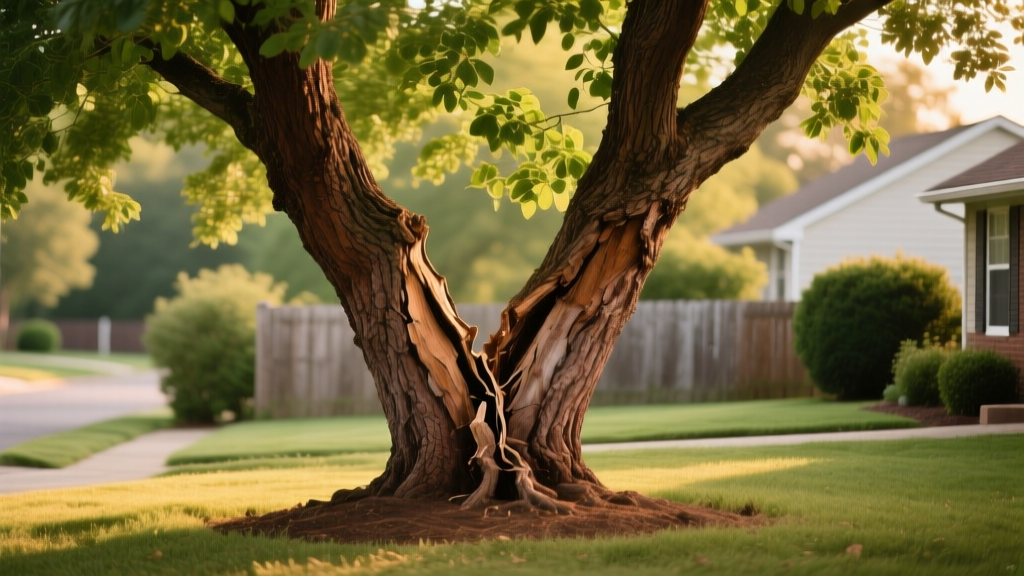
Managing Twin Trees in North Syracuse: Diagnosing Co-Dominant Stem Hazards
The Hidden Danger of Twin Trunks in Central New York
When homeowners plant or inherit a tree with two main trunks growing from a single base, they are looking at a structural anomaly known in arboriculture as co-dominant stems. While these twin trees in North Syracuse may look majestic during the summer, they represent one of the most severe structural hazards in a landscape. North Syracuse sits in USDA Hardiness Zone 5b, a region characterized by heavy lake-effect snow loads, severe freezing-and-thawing cycles, and devastating ice storms. When a mature tree with a weak, twin-trunk union is subjected to the lateral weight of wet snow or the radial expansion of freezing ice, the likelihood of catastrophic failure increases exponentially.
Diagnosing the exact failure potential of a co-dominant union requires moving beyond visual guesswork. Understanding the internal wood anatomy, recognizing the signs of included bark, and implementing targeted mechanical or pruning solutions are critical steps to protect your property and preserve the tree's lifespan.
The Anatomy of a Weak Union: Why Twin Trees Split
To diagnose a twin tree hazard, you must first understand why the union is inherently weak. In a structurally sound tree, a single central leader dominates, and lateral branches form a strong "U"-shaped crotch. The wood fibers (xylem) interlock and wrap continuously around the branch collar, creating a unified load-bearing structure.
The "V"-Crotch and Included Bark
Twin trees typically form a tight "V"-shaped crotch. Because both stems are growing upward and outward at roughly the same rate and diameter, they push against one another. Instead of wood fibers interlocking, the bark of both stems gets folded inward into the joint. This phenomenon is called included bark.
Arborist Insight: Included bark acts as a physical wedge. It prevents the wood of the two trunks from fusing together. Essentially, a twin tree with included bark is not one tree with two trunks; it is two separate trees leaning against each other, held together only by the tension of the outer wood and the friction of the trapped bark.
As the tree adds annual growth rings, the trapped bark continues to accumulate inside the crotch, acting as an expanding wedge that pushes the stems further apart. According to research from the UMass Urban Tree Program, unions with included bark are up to four times more likely to fail under wind or snow loads compared to unions with normal wood interlocking.
Diagnosing the Failure Risk in Your Yard
Not all twin trees require immediate removal. Diagnosing the severity of the hazard involves a systematic visual inspection of the union and the surrounding canopy. Look for the following critical indicators:
- The Seam Ridge: Look at the top of the crotch. If you see a prominent ridge of bark and wood pushing upward between the two stems, this is a primary indicator of included bark.
- Vertical Cracks: Inspect the bark directly below the crotch. Hairline vertical cracks or open seams indicate that the union is already failing under the tension of the twin canopies.
- Reaction Wood: Look for abnormal bulging or swelling at the base of the trunks. Trees attempt to compensate for weak upper unions by laying down dense "reaction wood" at the base. While this stabilizes the lower trunk, it does not fix the weak upper crotch.
- Fungal Fruiting Bodies: The presence of shelf fungi (like Ganoderma applanatum) near the base or inside the crotch seam indicates internal decay. If decay is present in a co-dominant union, the structural integrity is critically compromised, and cabling is no longer a viable option.
⚠️ Winter Hazard Warning: If your twin tree exhibits an open seam or visible crack at the crotch, do not wait for a North Syracuse winter storm to take action. The radial expansion of ice forming inside an open crack can generate thousands of pounds of outward pressure, splitting the tree in half overnight.
Proven Solutions: Subordination, Cabling, and Removal
Once the hazard is diagnosed, certified arborists typically recommend one of three interventions, depending on the tree's age, health, and the targets (homes, driveways, power lines) located beneath it. The International Society of Arboriculture (ISA) provides strict guidelines for these remedial actions.
1. Subordination Pruning (Best for Young to Middle-Aged Trees)
Subordination involves selectively reducing the size and wind-sail area of one of the twin leaders to force the other leader to become dominant. This shifts the tree's growth hormones and structural reinforcement to the stronger stem.
- Identify the weaker leader: Choose the stem that is smaller, has poorer branch attachment, or leans more dangerously over a target.
- Execute reduction cuts: Do not "top" the tree. Make precise reduction cuts by pruning lateral branches back to a side branch that is at least 1/3 the diameter of the removed stem.
- Limit canopy removal: Never remove more than 15% to 20% of the live crown in a single year. Spread the subordination process over 3 to 5 years to allow the tree to compartmentalize the wounds and shift its center of gravity gradually.
2. Dynamic Cabling and Bracing (Best for Mature, Healthy Trees)
If both leaders are massive, mature, and structurally vital to the tree's overall health, pruning one out would leave a massive wound and ruin the tree's symmetry. In these cases, installing a supplemental support system is required. Modern arboriculture has moved away from rigid steel cables and J-lags, which can girdle the tree and fail abruptly. Instead, dynamic synthetic rope systems (such as the Cobra 8mm or 10mm braided polyester systems) are the industry standard.
- Installation Height: The cable must be installed at approximately 2/3 the height of the canopy, measured from the weak crotch to the top of the branches. Installing it too low restricts natural movement; installing it too high provides inadequate leverage.
- Dynamic Movement: Synthetic ropes allow the twin trunks to sway naturally in light winds, which stimulates the tree to continue growing reaction wood. During severe ice storms, the rope's elasticity absorbs the shock load, preventing the crotch from snapping.
- Lifespan: Dynamic cables degrade under UV light and must be inspected annually and replaced every 8 to 12 years.
Intervention Comparison Matrix
| Intervention Method | Average Cost (2026) | Best Application | Lifespan / Maintenance |
|---|---|---|---|
| Subordination Pruning | $350 - $800 | Young/mature trees where one leader can be sacrificed safely. | Permanent structural fix; requires follow-up pruning every 3-5 years. |
| Dynamic Cabling (Cobra) | $600 - $1,200 | Mature twin trunks of equal size over high-value targets. | 8-12 years; requires annual visual inspections by an ISA Certified Arborist. |
| Complete Removal | $1,500 - $3,500+ | Trees with internal decay, deep cracks, or leaning over roofs/power lines. | N/A; eliminates the hazard entirely. |
High-Risk Species in the North Syracuse Landscape
While any tree can develop co-dominant stems, certain species commonly planted in Central New York are genetically predisposed to weak, twin-trunk structures. Homeowners should be highly vigilant if they have the following species on their property:
- Silver Maple (Acer saccharinum): Notorious for rapid growth, brittle wood, and multi-stemmed structures. Silver maples are the most common source of catastrophic tree failures in North Syracuse during ice storms.
- Callery / Bradford Pear (Pyrus calleryana): Almost all mature Bradford pears develop tight, bark-included V-crotches. They rarely survive past 25 years in New York without splitting.
- River Birch (Betula nigra): Often planted as multi-stemmed clumps. While the individual stems are smaller, the central union where three or four stems meet is highly prone to water accumulation and internal heart rot.
- Hackberry (Celtis occidentalis): A tough native shade tree, but when left unpruned in its youth, it frequently develops co-dominant leaders that fail under heavy wet snow loads.
When to Call a Professional
Diagnosing and treating twin trees is not a DIY project. Incorrect pruning cuts can introduce decay pathogens directly into the weak crotch, and improperly installed hardware can girdle the tree or fail under load. If you have twin trees in North Syracuse that overhang your home, driveway, or neighboring property, hire an ISA Certified Arborist with Tree Risk Assessment Qualification (TRAQ). They will use resistograph drilling or sonic tomography if internal decay is suspected at the union, ensuring that your intervention strategy is based on hard data rather than guesswork.

