
Tree Care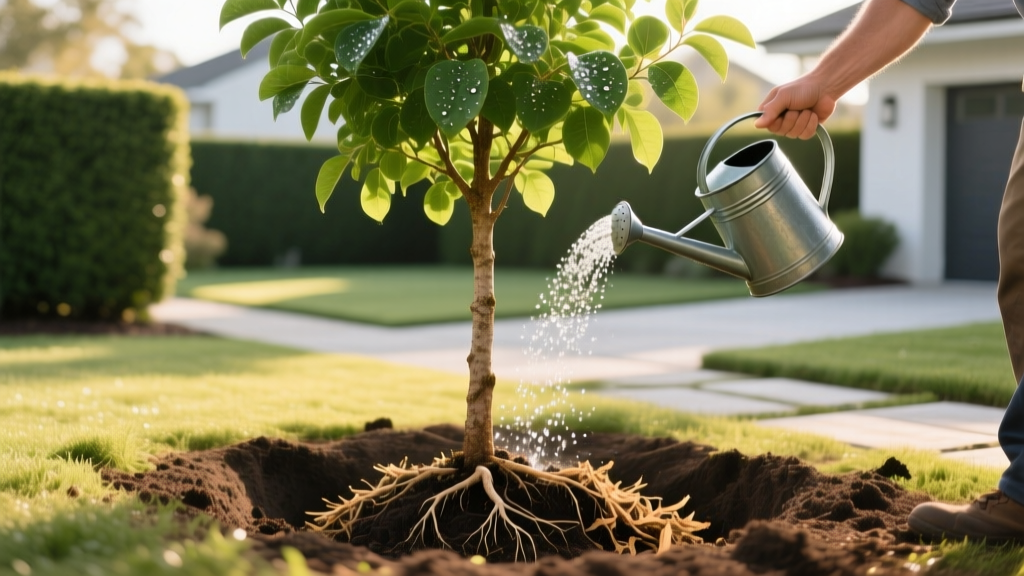
How Often to Water Newly Planted Trees: Dosage & Cost Guide
The Exact Dosage: Gallons per Inch of Trunk Caliper
A newly planted tree’s root system is almost entirely confined to the original nursery pot or burlap root ball. Until those roots expand into the surrounding native soil, the tree is essentially living in a isolated container buried in the ground. Guessing the watering amount leads to either drought stress or fatal root rot. The industry standard for precision watering is based on trunk caliper.
The 10-Gallon Rule: Apply 10 gallons of water per inch of trunk caliper at each watering session. Caliper is the diameter of the trunk measured exactly 6 inches above the soil line for trees up to a 4-inch caliper, and 12 inches above the soil line for larger specimens.
If you plant a 2-inch caliper Red Maple, it requires 20 gallons of water per session. If you plant a 3-inch caliper Burr Oak, it requires 30 gallons. This volume ensures the water penetrates deeply through the dense nursery soil, which often repels water differently than the surrounding native earth.
Trunk Caliper to Gallon Dosage Matrix
| Trunk Caliper (Inches) | Water Volume per Session | Estimated Hose Time (5/8" Hose at 10 GPM) | Establishment Timeframe |
|---|---|---|---|
| 1.0" | 10 Gallons | 1 Minute | 1 Year |
| 2.0" | 20 Gallons | 2 Minutes | 2 Years |
| 3.0" | 30 Gallons | 3 Minutes | 3 Years |
| 4.0"+ | 40+ Gallons | 4+ Minutes | 4+ Years |
Note: GPM (Gallons Per Minute) varies by household water pressure. To find your exact flow rate, time how long it takes to fill a 5-gallon bucket with your hose at your standard watering pressure.
Watering Frequency by Season and Soil Type
Knowing how often to water newly planted trees depends heavily on your soil's percolation rate and the current evapotranspiration (ET) demand. Sandy soils drain rapidly and require more frequent, lower-volume applications, while heavy clay soils hold moisture longer and are highly susceptible to waterlogging.
The Soil Probe Test
Never water on a rigid calendar schedule without verifying soil moisture. Use a 12-inch stainless steel soil probe or a long screwdriver. Push it into the root ball. If it slides in easily and comes out with moist soil attached, do not water. If it meets heavy resistance or comes out dry and dusty, it is time to water.
Frequency Schedule for the First Year
- Weeks 1–2: Water daily or every other day. The root ball dries out rapidly as the tree recovers from transplant shock.
- Weeks 3–12: Water 2 to 3 times per week. Roots are beginning to push into the native soil.
- Months 4–12: Water weekly. Shift the watering zone slightly outward to encourage lateral root expansion.
- Winter Dormancy: Water once a month during dry winter spells when temperatures are above 40°F, especially for evergreens.
Root Zone Coverage: Where to Apply the Water
A critical mistake homeowners make is piling water directly against the trunk. The trunk flare must remain dry to prevent fungal pathogens and bark decay. According to the Morton Arboretum, water should be applied in a donut shape, starting a few inches away from the trunk and extending to the edge of the root ball and slightly beyond.
Warning: Do not rely on lawn sprinkler systems to water newly planted trees. Turfgrass requires frequent, shallow watering (0.5 inches per session), while new trees require infrequent, deep soaking. A sprinkler system will overwater your lawn while severely underwatering your new tree's deep root ball.
The True Cost of Watering New Trees
Understanding the financial impact of tree establishment helps you choose the right irrigation method. Municipal water rates in the US average between $2.00 and $5.00 per 1,000 gallons, though tiered pricing in drought-prone regions like California can push this over $10.00 per 1,000 gallons.
Seasonal Water Cost Breakdown
Assuming a 2-inch caliper tree requiring 20 gallons per session, watered twice a week for a 26-week growing season:
- Total Volume: 1,040 gallons
- Cost at $2.50/1k gal (Midwest Average): $2.60 per tree
- Cost at $8.00/1k gal (Tiered Coastal): $8.32 per tree
The raw water cost is negligible. The true cost is labor and hardware.
Hardware Comparison: Manual vs. Automated vs. Slow-Release
| Method | Specific Product Example | Upfront Cost | Labor Requirement | Best For |
|---|---|---|---|---|
| Manual Hose | Standard 5/8" Garden Hose | $25 - $40 | High (10+ mins per tree) | 1-2 trees, budget-conscious |
| Slow-Release Bag | Treegator Original (20 gal) | $32 - $38 | Low (Fill once a week) | Multi-trunk trees, busy schedules |
| Drip Irrigation | Rain Bird XFD Dripline | $60 - $120 | Zero (Automated timer) | Landscapes with 5+ new trees |
| Soaker Hose | Dramm ColorStorm (Recycled) | $35 - $45 | Medium (Move hose manually) | Hedges and closely spaced shrubs |
Troubleshooting Watering Errors: Decision Tree
Transplant shock mimics both overwatering and underwatering. Use this diagnostic framework before adjusting your dosage.
Symptom 1: Wilting Leaves in Mid-Afternoon
- Cause A: Heat stress (transpiration exceeds root uptake). Fix: Check soil at 4 inches. If moist, do not water. The tree will recover by evening.
- Cause B: Dry root ball. Fix: Apply full caliper-based dosage immediately.
Symptom 2: Yellowing Lower Leaves and Premature Drop
- Cause: Hypoxia (oxygen deprivation) from waterlogged clay soil. The roots are suffocating and cannot uptake nutrients. Fix: Halt watering for 7 days. Pull back mulch to allow the soil surface to dry. Consider installing a vertical aeration tube if drainage is severely compromised.
Symptom 3: Crispy Brown Leaf Margins (Scorch)
- Cause A: Underwatering. Fix: Increase frequency, ensure water is penetrating the hydrophobic nursery soil.
- Cause B: Fertilizer burn. Fix: Never apply synthetic fertilizer to a newly planted tree in its first year. Flush the soil with a massive volume of water to leach excess salts.
Frequently Asked Questions
Should I water newly planted trees in the fall?
Yes. Deciduous trees drop their leaves, but their root systems continue to grow and establish in cool autumn soil until the ground freezes. Reduce frequency to once a week, but maintain the full gallon dosage based on trunk caliper until the soil temperature drops below 40°F.
Does mulch affect how often I need to water?
A 2-to-3-inch layer of hardwood mulch reduces soil surface evaporation by up to 70%, allowing you to stretch the time between waterings. However, keep mulch at least 3 inches away from the trunk flare to prevent bark rot and rodent damage. Never pile mulch in a "volcano" shape against the trunk.

