
Tree Care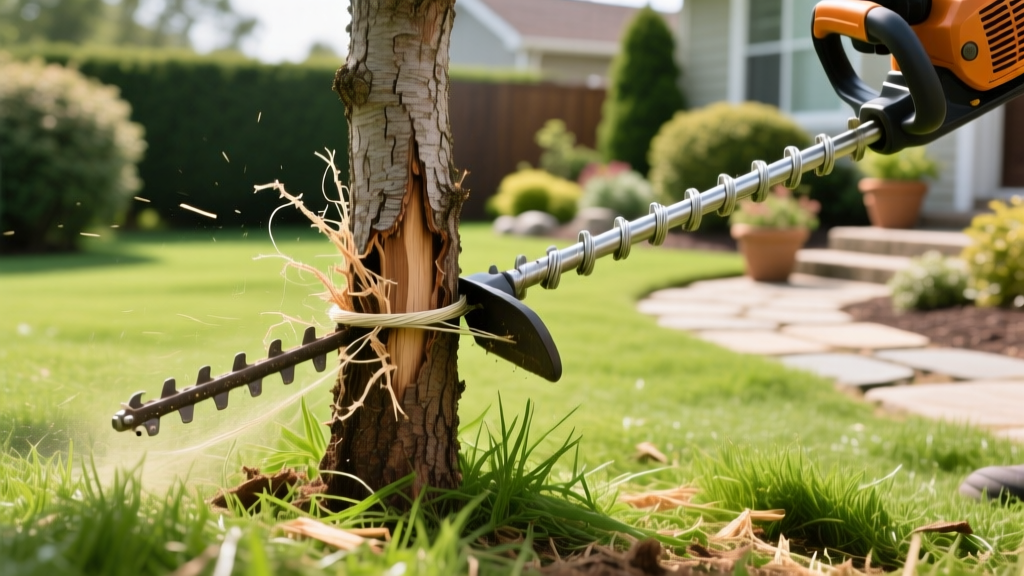
Can Weed Whackers Cut Limbs? Why String Trimmers Damage Trees
The Mechanical Reality: Why Nylon Fails Against Wood
When homeowners ask, "can weed whackers cut limbs?", the short answer is a definitive no. Standard string trimmers (weed whackers) are engineered exclusively for herbaceous, non-woody vegetation like grass and soft weeds. Attempting to cut woody tree limbs or thick shrub branches with a nylon string trimmer results in immediate mechanical failure, severe safety hazards, and catastrophic biological damage to the tree.
The core issue lies in the physics of the cutting mechanism. A standard gas-powered string trimmer operates at between 7,000 and 8,500 RPM. The cutting force is generated by the centrifugal stiffness of the nylon string and its high-velocity impact. Nylon monofilament has a relatively low melting point (approximately 400°F to 450°F for standard trimmer line). When the string strikes the dense, lignified cellular structure of a woody tree limb, the immense friction generates heat instantly. Instead of shearing through the wood fibers, the nylon melts, frays, and snaps, often within seconds of contact.
⚠️ WARNING: The Projectile Hazard
When a 0.095-inch nylon string spinning at 8,000 RPM strikes a hard tree limb, the string doesn't just break—it shatters. The resulting high-velocity nylon shrapnel and splintered wood chips can easily penetrate standard clothing and cause severe ocular injuries. Always wear ANSI Z87.1-rated safety glasses and a face shield when operating any rotary cutting equipment near woody obstacles.
Severe Tree Damage: Girdling and Cambium Destruction
Beyond the mechanical failure of the tool, using a weed whacker near the base of a tree or against low-hanging limbs causes irreversible biological harm. Just beneath the outer bark of a tree lies the vascular cambium, a microscopic layer of actively dividing cells responsible for generating the phloem (inner bark) and xylem (wood). The phloem transports essential sugars from the canopy down to the root system.
When a high-speed trimmer string strikes a tree limb or trunk, it acts like a blunt rasp, stripping away the protective outer bark and pulverizing the delicate cambium layer beneath. This process, known as mechanical girdling, severs the tree's vascular pathways. According to Penn State Extension, even partial girdling compromises the tree's structural integrity and starves the root system, leading to a slow decline that can take years to manifest. Furthermore, the open, ragged wounds left by trimmer strings do not heal cleanly like precise pruning cuts. They become primary entry points for opportunistic pathogens, including Armillaria root rot and Cytospora canker, as well as wood-boring insects.
Tool Capability Matrix: What Actually Cuts Limbs?
To safely manage woody tissue, you must use tools designed to shear wood fibers cleanly rather than bludgeon them at high speeds. The following matrix outlines the maximum cutting capacities for common yard tools, demonstrating exactly where weed whackers fall short and what you should use instead.
| Tool Type | Cutting Mechanism | Max Limb Diameter | Suitability for Woody Limbs |
|---|---|---|---|
| Standard String Trimmer (0.080" - 0.095" Nylon) | High-RPM Blunt Impact | 0.25" (Herbaceous only) | Unacceptable. Causes severe bark stripping and string failure. |
| Heavy-Duty Trimmer (0.155" Braided Nylon) | High-RPM Blunt Impact | 0.5" (Soft green stems) | Poor. Will still fray and damage cambium on mature wood. |
| Dedicated Brush Cutter (Metal Tri-Blade) | Low-RPM Shearing Teeth | 2.0" (Woody brush) | Acceptable. Designed for woody stems, requires harness and guard. |
| Bypass Loppers (e.g., Felco 200) | Manual Scissor Shear | 2.5" | Excellent. Provides clean, flush cuts that heal rapidly. |
| Japanese Pruning Saw (e.g., Silky Gomboy 240) | Manual Tooth Shear | 6.0"+ | Excellent. Essential for limbs too thick for loppers. |
The Brush Cutter Exception: Clarifying the Terminology
Confusion often arises because the term "weed whacker" is sometimes used colloquially to describe heavy-duty brush cutters. It is vital to understand the mechanical distinction between the two. A standard string trimmer uses a flexible nylon line and a high-speed gear head optimized for lightweight vegetation. A brush cutter, however, features a lower gear ratio (providing higher torque at lower RPMs), a solid metal drive shaft, and is designed to spin rigid steel blades (such as tri-blades or circular saw teeth).
If you are using a dedicated brush cutter equipped with a steel blade and a proper shoulder harness, you can cut small woody limbs up to 2 inches in diameter. However, even brush cutters should not be used for precision pruning. The tearing action of a brush cutter blade leaves rough wounds on tree limbs that violate the principles of proper target pruning outlined by the University of Minnesota Extension. Brush cutters are meant for clearing overgrown, invasive brush (like honeysuckle or multiflora rose), not for maintaining the structural health of landscape trees.
Safe Practices for Tree Base and Limb Maintenance
To maintain a clean yard without destroying your equipment or your trees, implement the following professional landscaping protocols.
Step 1: Establish a Protective Mulch Ring
The most common reason homeowners attempt to use weed whackers near trees is to cut grass right up to the trunk. Eliminate this need entirely by creating a mulch ring. Clear a 3-to-4-foot diameter circle around the base of the tree. Apply 2 to 3 inches of organic hardwood mulch, keeping it 3 inches away from the actual trunk (avoiding "volcano mulching"). This creates a physical buffer zone where the trimmer string only hits loose mulch and bare soil, entirely eliminating the risk of trunk strikes.
Step 2: Hand-Pull or Use Herbicide for Edge Weeds
For stubborn weeds growing inside the mulch ring or directly against low-hanging limbs, do not use the trimmer. Hand-pull the weeds, or use a targeted, shielded application of a non-selective herbicide (like glyphosate) using a foam brush or a spray bottle with a cardboard shield to prevent drift onto the tree's bark or leaves.
Step 3: Execute Proper Pruning Cuts on Low Limbs
If low-hanging limbs are interfering with your mowing or trimming paths, remove them entirely using the correct tools. Use a sharp bypass hand pruner for limbs under 1 inch, and a pruning saw for larger branches. Make the cut just outside the branch collar—the swollen area where the branch meets the trunk. This allows the tree to compartmentalize the wound and grow callus tissue over the cut, sealing out disease.
Frequently Asked Questions
Can I use metal wire instead of nylon string in my weed whacker to cut limbs?
No. Retrofitting a standard string trimmer with metal wire or chains is exceptionally dangerous and violates all manufacturer safety guidelines. Standard trimmer heads and gearboxes are not rated for the kinetic energy and shock loads of metal striking wood. The head will shatter, sending metal fragments flying at lethal velocities, and the engine or motor will likely stall and suffer internal damage.
My weed whacker accidentally hit the tree trunk. Is the tree going to die?
A single, minor nick will not kill a mature, healthy tree; it will compartmentalize the small wound. However, repeated strikes over several seasons create a continuous ring of damaged tissue (girdling). Once the cambium layer is severed completely around the circumference of the trunk, the roots will starve, and the tree will die. If you notice bark damage, do not apply wound sealants (which trap moisture and fungi). Simply use a sterilized, sharp knife to carefully trim away the ragged, torn bark edges to create a smooth, clean oval perimeter around the wound, allowing the tree to heal naturally.
What is the best string trimmer line for cutting thick, woody weeds?
For thick, semi-woody weeds (like mature thistles or blackberry canes), use a multi-sided or braided nylon line in a heavier gauge, such as 0.130-inch to 0.155-inch. Lines with a twisted or square profile have sharper edges that slice through fibrous stems more effectively than round lines. However, remember that even heavy-duty line will instantly snap if it strikes a hardened, mature tree limb.

