
Tree Care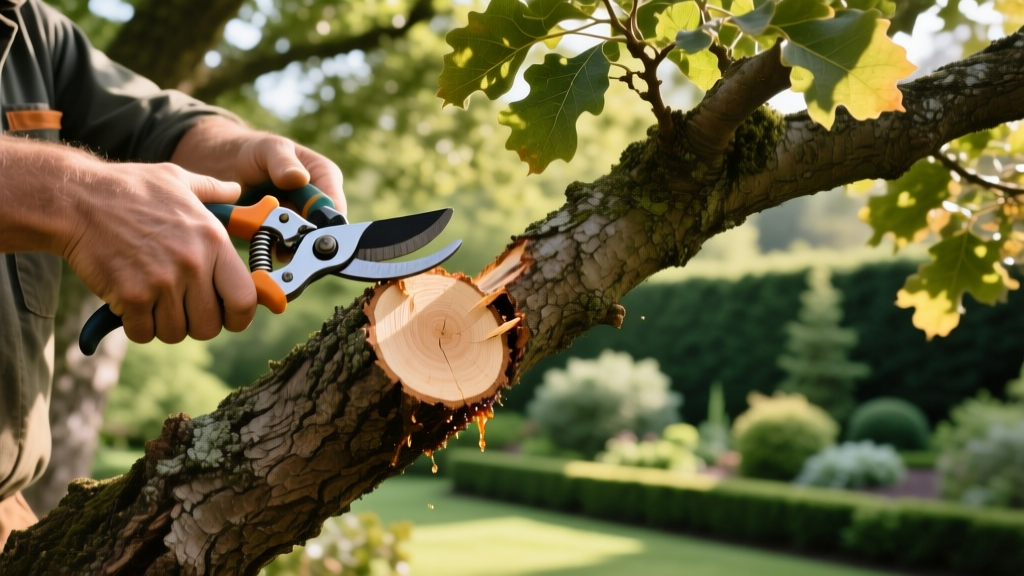
What Does Pruning Mean? The Science of Tree Cut Types
Defining the Practice: Trimming vs. Pruning
Homeowners frequently use the terms interchangeably, but understanding what does pruning mean in a botanical context requires distinguishing it from trimming. Trimming is an aesthetic practice applied to hedges and shrubs to maintain a specific geometric shape or size. Pruning, conversely, is a targeted, structural intervention. It involves the deliberate removal of specific plant parts—branches, buds, or roots—to direct future growth, improve structural integrity, remove compromised tissue, or manage the tree’s energy reserves.
Core Definition: Pruning is the surgical manipulation of a tree’s apical dominance and carbohydrate allocation through strategic wounding, forcing the tree to compartmentalize decay and redirect growth hormones (auxins) to remaining lateral buds.
The Botanical Reality: Trees Do Not Heal
To understand pruning, you must understand how trees respond to injury. Unlike human tissue, trees do not regenerate or "heal" over a wound. Instead, they "seal" it through a process identified by Dr. Alex Shigo as the Compartmentalization of Decay in Trees (CODIT). When a branch is removed, the tree initiates chemical boundaries to wall off the decay from the rest of the trunk.
According to research published by the University of Minnesota Extension, improper pruning cuts that damage the branch collar destroy the tree’s natural chemical barriers (specifically Wall 1 and Wall 4 of the CODIT model). This allows pathogenic fungi to enter the heartwood, leading to internal rot and eventual structural failure. Therefore, every cut you make is a permanent wound that the tree must expend stored carbohydrates to seal.
The Four Primary Pruning Cuts Explained
Not all cuts yield the same physiological response. The angle, location, and type of cut dictate whether a tree will produce vigorous water sprouts or gracefully redirect its canopy growth. Below is a breakdown of the four fundamental cut types used by certified arborists.
| Cut Type | Anatomical Target | Effect on Apical Dominance | Best Use Case |
|---|---|---|---|
| Thinning | Removes entire branch at the collar | Maintains dominance of remaining branches | Crown cleaning, removing deadwood, improving airflow |
| Reduction | Cuts back to a lateral branch at least 1/3 the diameter of the removed part | Transfers dominance to the lateral branch | Clearing utility lines, reducing wind sail, lowering canopy height |
| Heading | Cuts between internodes (nodes) | Breaks dominance, triggers dense water sprouts | Hedge shaping, pollarding (rarely recommended for shade trees) |
| Bench | Removes central leader to a lateral branch | Creates codominant stems (high failure risk) | Orchard management, fruit production (avoid in shade trees) |
Tool Selection Matrix by Branch Diameter
Using the wrong tool crushes the cambium layer, tearing the bark and creating a massive wound that takes years to seal. As of 2026, professional-grade arborist tools feature high-carbon steel blades that maintain sharp edges longer, ensuring clean cuts that respect the tree's anatomy. Here is the exact tool matrix you should follow based on branch caliper:
- Under 0.5 inches: Use a high-quality bypass hand pruner. The Felco F-2 Classic (approx. $65) features a hardened steel blade and sap groove that prevents sticking. Never use anvil pruners on live wood; they crush the tissue.
- 0.5 to 1.5 inches: Transition to a folding pull-saw. The Silky Gomboy 210mm with a medium-teeth blade (approx. $48) cuts on the pull stroke, preventing the blade from binding in the kerf and tearing the bark on the underside.
- 1.5 to 4.0 inches: Use a long-stroke hand saw or a battery-powered pole saw. The Silky Bigboy 360mm (approx. $75) or the Husqvarna 120i battery pole pruner (approx. $250) provides the reach and power necessary without requiring a chainsaw.
- Over 4.0 inches: Branches of this size possess immense kinetic energy. Improper removal can cause the limb to "barber chair" (split vertically down the trunk), destroying the tree and posing a lethal hazard. Hire an ISA Certified Arborist.
Timing Frameworks: When to Make the Cut
The physiological state of the tree and the activity of local pathogens dictate the optimal pruning window. The Penn State Extension emphasizes that dormant-season pruning is generally safest, but species-specific vectors require strict adherence to timing calendars.
Disease-Vector Avoidance (Oaks and Elms)
Never prune oaks or elms during the spring and summer months. Fresh pruning wounds emit volatile organic compounds (VOCs) that attract Nitidulid sap beetles, which carry the spores for Oak Wilt and Dutch Elm Disease. Restrict all pruning on these species to deep dormancy (November through February) when beetle activity is zero and temperatures are consistently below 40°F.
Spring-Flowering Shrubs and Trees
Species like lilacs, forsythia, and crabapples set their flower buds on "old wood" during the previous summer. Pruning them in the winter removes the impending spring bloom. The correct protocol is to prune these species within three weeks immediately after their flowers fade in late spring, allowing them the entire summer to generate next year's buds.
Conifer Candle Pruning
Pines and spruces do not produce adventitious buds on old wood. If you cut a pine branch back to bare wood, it will not sprout new growth; it will simply die. To control the size of pines, you must practice "candle pruning." In late May or early June, when the new growth (candles) has elongated but before the needles have fully opened, pinch or cut the candle back by one-half to one-third.
The Anatomy of a Flush Cut Failure
The most destructive mistake a homeowner can make is the "flush cut"—removing a branch completely flush against the trunk, eliminating the branch collar. The branch collar contains specialized trunk tissue that overlaps the branch base. This tissue is rich in the chemical compounds required to initiate woundwood (callus) formation.
Warning: When you make a flush cut, you remove the tree's only mechanism for sealing the wound. The resulting decay will bypass the chemical barriers and enter the main trunk, potentially hollowing out the core of the tree within 5 to 10 years, leading to catastrophic failure during high winds.
Always locate the bark ridge (the raised line of bark in the crotch) and the branch collar (the swollen base of the branch). Make your cut just outside the collar, leaving the swollen ring intact on the tree. The cut should be angled slightly away from the trunk to match the perpendicular angle of the collar. By understanding exactly what pruning means at a cellular level, you transition from merely hacking away overgrown branches to actively engineering the long-term structural health of your landscape.

