
Tree Care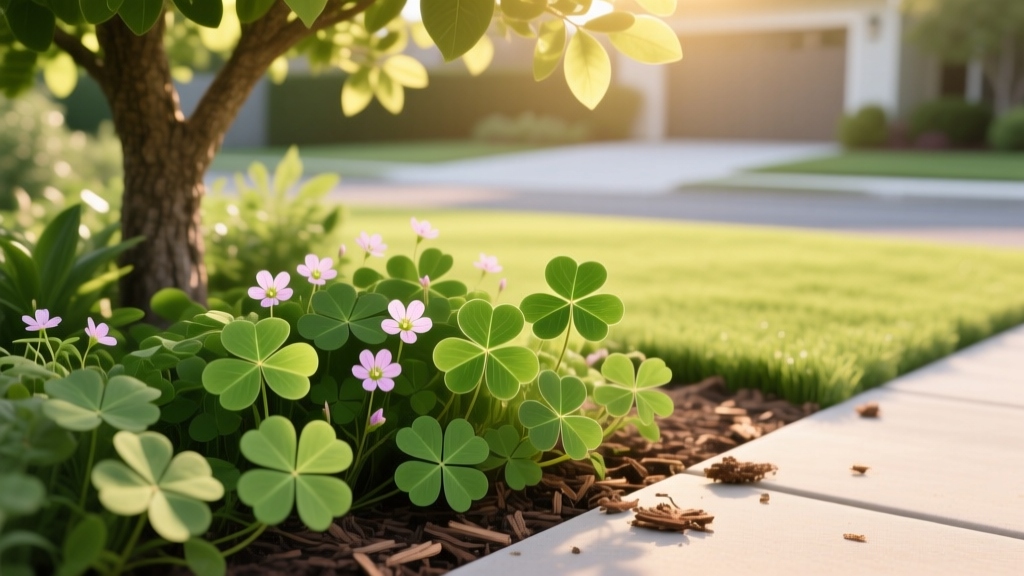
Wood Sorrel vs Clover: Spot-Treatment Guide for Tree Beds
The Botanical Showdown: Identifying the Invaders in Your Tree Beds
Managing weeds in tree rings and shrub borders requires a fundamentally different approach than lawn care. When evaluating wood sorrel vs clover in the drip line of your trees, misidentification can lead to ineffective treatments or, worse, fatal herbicide uptake by your tree's shallow feeder roots. Both weeds thrive in the moist, shaded microclimates typical of mulched tree beds, but their reproductive strategies and root structures dictate entirely different eradication protocols.
Wood sorrel (Oxalis stricta or Oxalis corniculata) and white clover (Trifolium repens) are frequently confused by homeowners due to their similar trifoliate leaf structures. However, according to the University of California Integrated Pest Management program, their underlying biology makes wood sorrel a much more aggressive threat to ornamental landscapes due to its explosive seed dispersal and deep taproots.
Visual Identification Matrix
| Feature | Wood Sorrel (Oxalis) | White Clover (Trifolium) | Impact on Tree Beds |
|---|---|---|---|
| Leaf Shape | Heart-shaped leaflets, folded down the center at night | Oval/teardrop leaflets, often with a white 'V' chevron mark | Clover mats trap moisture against tree bark; Oxalis shades out tree seedlings. |
| Flowers | Small, 5-petal yellow flowers | Globe-shaped white or pale pink flower clusters | Clover flowers attract bees to high-traffic yard areas; Oxalis flowers year-round in mild climates. |
| Root System | Deep taproot or underground bulbils | Shallow fibrous roots spreading via above-ground stolons (runners) | Oxalis taproots compete directly with young tree taproots for deep soil moisture. |
| Reproduction | Explosive seed pods shooting seeds up to 10 feet | Stolons and secondary seed production | Oxalis easily colonizes adjacent shrub borders and container plants. |
Why These Weeds Threaten Tree and Shrub Health
While clover is often praised in turfgrass for its nitrogen-fixing abilities, its presence in a tree bed is problematic. Clover forms a dense, impenetrable mat of stolons that traps excess moisture against the root flare and trunk of the tree. This constant dampness creates an ideal environment for Phytophthora root rot and invites vole activity, as rodents use the dense clover mat for cover while girdling tree bark in winter.
Wood sorrel, conversely, does not form mats but instead establishes dense colonies via bulbils that break off when you attempt to pull them. If a tree is young and establishing its root system, a heavy Oxalis infestation will aggressively siphon water and phosphorus from the top 12 inches of soil—the exact zone where a newly planted tree's feeder roots are trying to expand.
Spot-Treatment Protocols: Protecting Tree Roots While Killing Weeds
Treating weeds near trees requires extreme caution. Trees absorb water and nutrients through fine feeder roots located in the top 6 to 12 inches of soil, often extending well past the drip line. Systemic herbicides applied to the soil or absorbed through weed roots can easily translocate into the tree's vascular system.
Organic Iron HEDTA Applications (Safe for Tree Roots)
For spot-treating both wood sorrel and clover near sensitive tree species (like Dogwoods, Magnolias, and Japanese Maples), chelated iron (Iron HEDTA or FeHEDTA) is the gold standard. Products like Fiesta Turf Weeder utilize a 4.4% FeHEDTA concentration. Broadleaf weeds absorb the iron rapidly, causing massive cellular oxidation and rapid desiccation, while trees and grasses possess a natural biological mechanism to regulate iron uptake.
- Mixing Ratio: 2.5 to 3.5 fluid ounces per gallon of water.
- Application Timing: Apply when temperatures are between 60°F and 80°F. Avoid application if rain is expected within 3 hours.
- Tree Safety: Iron HEDTA is non-systemic in woody plants. Even if overspray hits the tree trunk or drips into the root zone, it will not cause phytotoxicity.
- Cost Expectation: Approximately $50 to $65 per gallon of concentrate, yielding up to 50 gallons of mixed solution.
Pro-Tip: Wood sorrel requires two applications of Iron HEDTA spaced 14 days apart, as the initial spray will kill the foliage but may leave the deep taproot intact. Clover typically succumbs to a single, thorough application.
Synthetic Spot-Treatments (Use with Extreme Caution)
If you opt for synthetic herbicides containing Triclopyr or 2,4-D (such as Ortho GroundClear or Bayer Advanced), you must establish a strict buffer zone. According to University of Wisconsin-Madison Extension, Triclopyr is highly effective on Oxalis species but can be absorbed by tree roots if applied too close to the trunk.
The DBH Buffer Rule: Never apply synthetic broadleaf herbicides within a radius of 12 inches for every 1 inch of the tree's Diameter at Breast Height (DBH). For a tree with a 4-inch trunk, maintain a minimum 4-foot herbicide-free zone around the base.
The Decision Matrix: Which Treatment to Choose?
Treatment Selection Framework
- Scenario A: Weeds are within 3 feet of the tree trunk.
Action: Use Iron HEDTA (organic) or manual extraction. Never use synthetics here. - Scenario B: Weeds are at the outer edge of the mulch ring (past the DBH buffer).
Action: Spot-spray with Triclopyr/2,4-D using a shielded wand to prevent drift onto tree bark. - Scenario C: Heavy Wood Sorrel infestation in a newly planted tree bed.
Action: Hand-pull the central taproot before seed pods form, followed by a 3-inch layer of arborist wood chips to block sunlight from germinating residual seeds.
Cultural Controls: Outcompeting Weeds in the Drip Line
Chemical and organic treatments are only temporary fixes if the underlying environment favors weed germination. Penn State Extension notes that clover thrives in compacted, low-nitrogen soils, while wood sorrel exploits thin or degraded mulch layers.
To permanently suppress both species in tree beds, implement the following cultural controls:
- Proper Mulching Depth: Maintain a 2 to 3-inch layer of coarse arborist wood chips. Do not exceed 4 inches, as deep mulch suffocates tree roots and creates a spongy medium where Oxalis bulbils thrive.
- Avoid Volcano Mulching: Keep mulch at least 3 inches away from the actual tree trunk. Exposing the root flare prevents rot and removes the prime germination zone for moisture-loving clover.
- Pre-Emergent Barriers: In early spring, apply a pre-emergent containing isoxaben (e.g., Gallery) to the tree bed. Isoxaben is safe for use around established ornamental trees and effectively halts the germination of wood sorrel seeds before their explosive pods can populate the bed.
Frequently Asked Questions
Does pulling wood sorrel by hand make it worse?
Yes, if done at the wrong time. If the plant has already developed mature seed pods (which look like tiny green okra), pulling the plant triggers the pods to burst, shooting seeds up to 10 feet across your landscape. Only hand-pull wood sorrel when the soil is moist and before the yellow flowers begin to fade.
Will vinegar kill clover in my shrub beds?
Horticultural vinegar (20% to 30% acetic acid) will burn the foliage of clover, but it is a contact-only herbicide. It will not kill the stolon network. Furthermore, spraying high-concentration vinegar near the shallow surface roots of shrubs like Azaleas and Hydrangeas can temporarily acidify the soil and damage the fine root hairs of your desired plants.
Is clover fixing nitrogen in my tree bed actually helping the tree?
No. While clover fixes atmospheric nitrogen via Rhizobium bacteria in its root nodules, the vast majority of this nitrogen is retained within the clover's own tissue. It is only released into the soil when the clover dies and decomposes. Meanwhile, the living clover is actively competing with your tree for water and creating a habitat for bark-gnawing voles.

