Home & Garden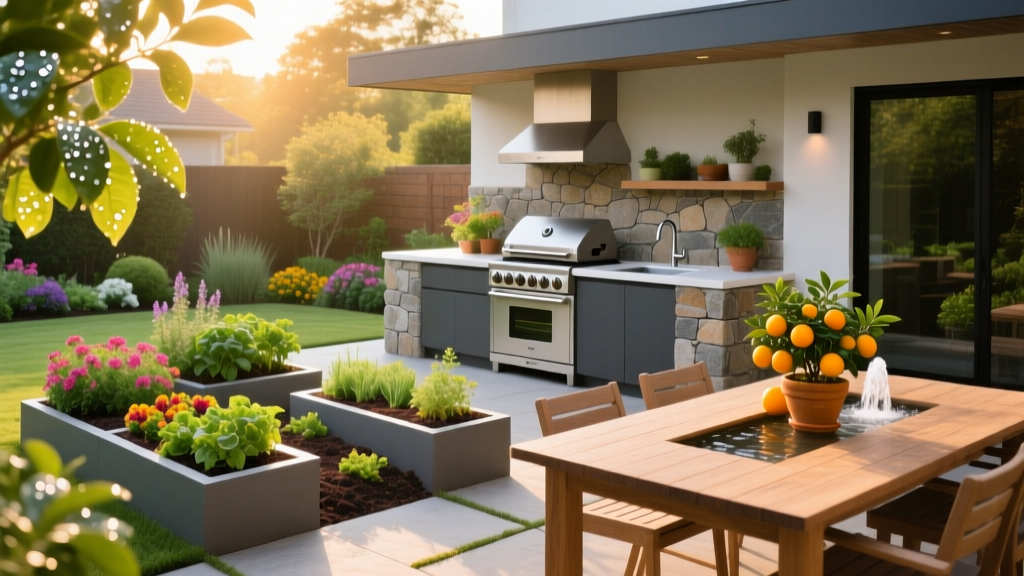
Backyard Outdoor Kitchen Garden Integration Ideas
Blending Culinary Function with Horticultural Beauty
Integrating an outdoor kitchen with a productive and ornamental garden transforms a standard backyard into a cohesive living space where cooking, dining, and plant cultivation coexist harmoniously. This approach goes beyond aesthetics—it supports ecological balance, extends seasonal harvests, and enhances sensory engagement through scent, texture, and color. Successful integration requires thoughtful zoning, structural coordination, and plant selection grounded in regional horticultural science—not just visual appeal.
Structural Framework: Anchoring Kitchen and Garden
Garden structures serve both practical and aesthetic roles when paired with outdoor kitchens. A pergola draped with edible vines like hardy kiwi (Actinidia arguta) provides shade over a grill station while yielding fruit. Raised beds built from reclaimed cedar or corten steel must align physically and visually with countertop heights—standard outdoor kitchen countertops range from 36 to 42 inches, so adjacent planting beds should be no taller than 30 inches to maintain ergonomic flow.
Material Compatibility and Drainage
Stone pavers used for kitchen flooring should extend beneath adjacent garden beds to create a unified base layer. Ensure at least 12 inches of compacted gravel sub-base beneath all hardscaped areas to prevent settling and root intrusion. Permeable pavers rated for 8,000 psi compressive strength allow water infiltration while supporting foot traffic and light equipment.
Vertical Integration Strategies
Wall-mounted herb towers and trellised espalier fruit trees (e.g., dwarf ‘Golden Delicious’ apple trained flat against a south-facing brick wall) maximize space without sacrificing yield. These structures require anchoring into load-bearing walls or freestanding frames embedded at least 24 inches deep in undisturbed soil.
Plant Selection by Hardiness and Bloom Timing
Selecting plants that thrive in your USDA Hardiness Zone ensures longevity and reduces maintenance. For example, lavender (Lavandula angustifolia ‘Hidcote’) thrives in Zones 5–9, blooms from late June through August, and prefers alkaline soil (pH 6.7–7.3). In contrast, coral bells (Heuchera americana) tolerate Zones 4–9 but peak in early spring and fall, with foliage color intensifying in cooler temperatures.
The Missouri Botanical Garden’s 2022 Plant Evaluation Report confirms that Rodgersia podophylla exhibits exceptional heat tolerance and consistent flowering in Zone 6b when planted in consistently moist, humus-rich soil (pH 5.5–6.5). Its large, bronze-tinted leaves provide textural contrast near stainless-steel appliance housings.
- ‘Blue Prince’ holly (Ilex x meserveae): Zones 5–7, dioecious, requires male pollinator within 50 feet, pH 4.5–6.5
- ‘Black Magic’ taro (Colocasia esculenta): Tender perennial in Zones 8–11; grown as annual elsewhere; needs pH 5.5–6.5 and 6+ hours daily sun
- ‘Lemon Queen’ helianthus (Helianthus debilis): Drought-tolerant annual in Zones 3–11, blooms July–October, pH 6.0–7.5
- ‘Munstead’ lavender: Mature height 12–18 inches, bloom window June–August, ideal spacing 24 inches apart
- ‘Sensation’ lilac (Syringa vulgaris): Zones 3–7, matures to 12 feet tall, requires winter chill ≥ 800 hours below 45°F
Soil Science Meets Culinary Design
Soil pH directly affects nutrient availability for both edibles and ornamentals. Blueberries (Vaccinium corymbosum) demand acidic conditions (pH 4.5–5.5), whereas rosemary (Rosmarinus officinalis) flourishes between pH 6.0–7.8. When designing adjacent zones, avoid cross-contamination: install 8-inch-deep HDPE root barriers between beds with divergent pH requirements. Incorporate elemental sulfur at 1.2 lbs per 100 sq ft to lower pH by one unit in loam soils, per University of Vermont Extension guidelines (2021).
“The most resilient backyard integrations treat soil not as a uniform medium but as a series of micro-zones—each calibrated to the biochemical needs of its dominant species.” — Chicago Botanic Garden, *Home Landscape Management Handbook*, 2020
Ornamental-Edible Synergy in Practice
Pairing ornamental plants with culinary function expands design flexibility while supporting pollinators and pest control. Nasturtiums (Tropaeolum majus) act as trap crops for aphids while adding peppery blossoms to salads. Their vigorous growth suits trellises beside pizza ovens, where radiant heat deters fungal issues common in cooler, damper microclimates.
At the Brooklyn Botanic Garden’s Edible Academy, raised beds interplanted with ‘Purple Ruffles’ basil, ‘Redbor’ kale, and ‘Fireworks’ gomphrena demonstrate how staggered bloom times (basil: June–September; gomphrena: July–frost) sustain visual interest across seasons. All three thrive in pH 6.0–7.0 and require full sun—making them ideal companions for west-facing kitchen zones.
Seasonal Succession Planning
Design for year-round structure using evergreen anchors: ‘Sky Pencil’ holly (Ilex crenata ‘Sky Pencil’) reaches 8–10 feet tall at maturity but only 2 feet wide—ideal for narrow flanking positions beside gas line enclosures. Underplant with ‘Bowles’ Mauve’ chives (Allium schoenoprasum), which bloom April–June and persist as grassy foliage through winter in Zones 3–9.
Microclimate Utilization
South- and west-facing kitchen walls radiate heat, creating microclimates up to two USDA zones warmer. This allows gardeners in Zone 6a (e.g., Columbus, OH) to successfully overwinter ‘Variegated’ ginger (Alpinia zerumbet) with mulch and wind protection—a strategy validated by trials at the Atlanta Botanical Garden’s Sustainable Home Gardens Program (2023).
| Plant | USDA Zone | Bloom/Harvest Window | Soil pH Range | Mature Height/Spread |
|---|---|---|---|---|
| ‘Fragrant Cloud’ rose | 6–10 | May–October | 6.0–6.5 | 5' H × 3' W |
| ‘Red Ace’ rhubarb | 3–8 | April–June (harvest) | 6.0–6.8 | 2' H × 3' W |
| ‘Lemon Gem’ marigold | Annual everywhere | June–first frost | 6.0–7.5 | 12" H × 12" W |
Interplanting ‘Lemon Gem’ marigolds among tomato cages repels whiteflies and nematodes while contributing citrus-scented petals to grilled vegetable dishes. Its shallow root system (max depth 8 inches) avoids competition with deeper-rooted vegetables.
For gardeners in coastal Zone 9b (e.g., San Diego), consider ‘Kaleidoscope’ abelia (Abelia × grandiflora), which flowers May–November and tolerates pH 5.5–7.5. Its arching branches soften the angular lines of concrete countertops without obstructing access paths.
‘Tuscan Blue’ rosemary reaches 4–6 feet tall and spreads 6–8 feet wide at maturity—ideal for screening utility boxes behind grills. Its silver foliage reflects light onto darker kitchen surfaces, reducing glare while requiring minimal irrigation once established.
When siting compost bins near outdoor kitchens, locate them at least 10 feet from food prep surfaces and downwind of prevailing summer breezes. Use enclosed tumblers with internal aeration fins rotating every 48 hours to achieve thermophilic decomposition (>131°F) within 14 days—critical for pathogen reduction per guidelines from the Rodale Institute (2022).
Install drip irrigation lines under mulch at 12-inch spacing for herbs and 18-inch spacing for shrubs. Pressure-compensating emitters deliver 0.5–1.0 gallons per hour, preventing runoff on sloped sites near stone patios.
Use native groundcovers like ‘Blue Star’ creeper (Azorella trifurcata) in Zone 8–10 to stabilize soil between stepping stones leading from kitchen to herb garden. Its dense mat (2-inch height) suppresses weeds and tolerates light foot traffic.
For fire safety compliance, maintain a minimum 36-inch non-combustible clearance zone around all propane connections and grill vents. Fill this band with decomposed granite stabilized with polymer binder—tested to withstand 2,500°F radiant heat exposure per ASTM E136 standards.
Finally, integrate lighting thoughtfully: low-voltage LED path lights (3000K color temperature) placed 8 feet apart along garden-to-kitchen transitions improve nighttime usability without disrupting pollinator circadian rhythms, as recommended by the Xerces Society for Invertebrate Conservation (2023).
