Lawn Care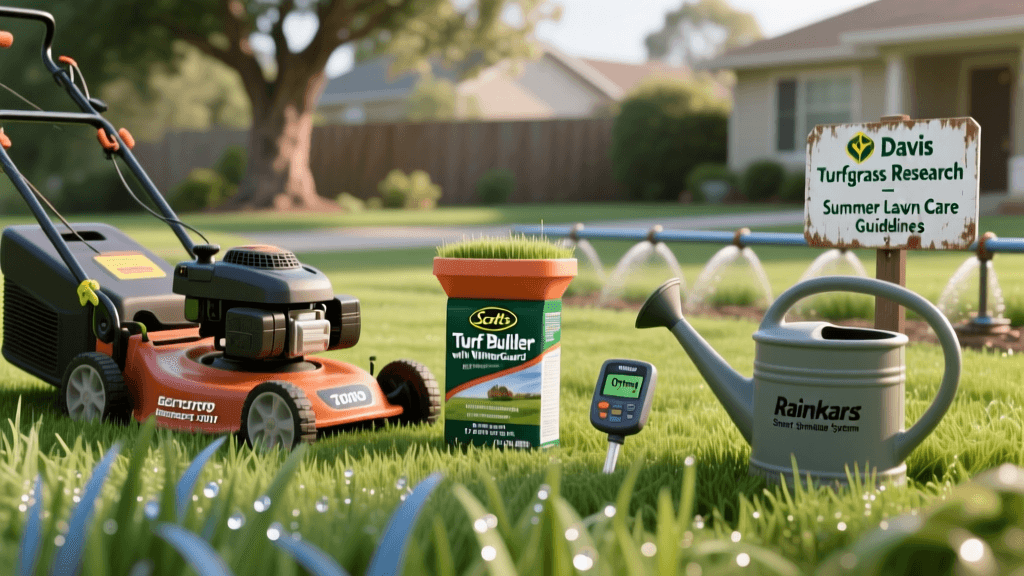
Best Mowing Height For Summer Heat Stress
Why Mowing Height Directly Impacts Summer Survival
During summer heat stress—especially when air temperatures exceed 90°F and soil surface temperatures climb above 115°F—turfgrass faces physiological strain that can trigger dormancy, disease susceptibility, or irreversible damage. Mowing height is not merely aesthetic; it governs leaf surface area, root depth, soil moisture retention, and canopy temperature. Research from the University of Florida Institute of Food and Agricultural Sciences (UF/IFAS) confirms that raising mowing height by just 0.5 inch reduces canopy temperature by up to 4°F and increases root mass by 22% in St. Augustinegrass (Unruh et al., 2021). This thermal buffering effect slows water loss and protects meristematic tissue located at or near the soil surface.
Conversely, scalping—cutting below recommended heights—removes photosynthetic tissue, exposes crowns to UV radiation and desiccation, and invites opportunistic pathogens like Pythium blight and brown patch. In a multi-year trial across Texas A&M AgriLife’s Dallas County Field Station, lawns mowed at 1.5 inches during July–August experienced 37% greater turf loss compared to those maintained at 3 inches, regardless of irrigation frequency.
Species-Specific Height Recommendations for Peak Heat
Optimal mowing height varies significantly by grass species due to differences in growth habit, crown position, and heat tolerance. Below are research-backed ranges validated through field trials conducted by university extension programs.
Tall Fescue (Festuca arundinacea)
A cool-season grass with moderate summer persistence, tall fescue performs best when mowed between 3.0 and 4.0 inches during June–August. At the University of Kentucky Turfgrass Research Center, plots maintained at 3.5 inches showed 41% higher chlorophyll content under 95°F ambient conditions than those cut at 2.0 inches (Baldwin & Fry, 2020). Maintain sharp blades and never remove more than one-third of leaf height per mow.
Bermudagrass (Cynodon dactylon)
This warm-season species tolerates lower heights but requires strategic adjustment in extreme heat. For common bermudagrass, raise mowing height from 1.0–1.5 inches in spring to 1.75–2.25 inches in July and August. Hybrid cultivars like ‘Tifway 419’ respond well to 2.0 inches during sustained heatwaves (>10 consecutive days ≥95°F). The Georgia Cooperative Extension reports that raising height by 0.5 inch reduced irrigation demand by 18% without sacrificing density.
Zoysiagrass (Zoysia japonica and Z. matrella)
Zoysiagrass benefits markedly from taller summer heights due to its slower vertical growth and dense thatch layer. Maintain ‘Meyer’ (Z. japonica) at 2.0–2.5 inches and ‘Emerald’ (Z. matrella) at 1.5–2.0 inches during summer months. At the Kansas State University Turfgrass Testing Facility, Emerald plots mowed at 1.75 inches retained 29% more green leaf area after a 12-day drought period than those mowed at 1.25 inches.
Fertilization Timing and Formulations That Complement Height Strategy
Fertilizing during summer heat requires caution: high-nitrogen applications increase succulent growth, elevate transpiration demand, and risk burn—especially when combined with low mowing heights. Instead, use slow-release nitrogen sources with balanced micronutrients.
- Scotts Turf Builder SummerGuard: Contains 12-0-6 N-P-K with 50% slow-release nitrogen and potassium to enhance drought resilience. Apply at 3.5 lbs per 1,000 sq ft in early June and again in late July.
- Lesco 18-0-18 Professional Formula: High-potassium formulation ideal for heat-stressed lawns. Apply at 1.2 lbs per 1,000 sq ft every 6 weeks from June through mid-August.
- Avoid urea-based quick-release fertilizers between June 15 and September 1 in USDA Hardiness Zones 6–9, per Purdue Extension Bulletin HO-42 (2022).
Watering Practices Aligned With Mowing Height
Mowing height influences evapotranspiration rates and soil drying patterns. Taller grass shades the soil surface, reducing evaporation by up to 30% (Ohio State University Extension, 2019). Consequently, deeper-rooted, taller lawns require less frequent—but deeper—irrigation.
For tall fescue maintained at 3.5 inches, apply 1.25 inches of water per week in split applications (e.g., 0.625 inches twice weekly), preferably before 10 a.m. Bermudagrass at 2.0 inches needs only 0.75–1.0 inch weekly, delivered in two sessions. Use a calibrated rain gauge or catch-can test to verify uniformity—aim for ≤15% distribution uniformity variance across the lawn.
Soil moisture sensors placed at 4-inch depth help determine irrigation timing. When sensor readings drop below 18% volumetric water content (VWC), initiate watering. Avoid daily light sprinkling—it encourages shallow rooting and increases disease pressure.
Equipment and Technique Essentials
Blade sharpness and mower calibration are non-negotiable. Dull blades tear grass instead of cutting cleanly, increasing water loss and infection risk. Sharpen rotary blades every 8–10 hours of operation; reel mower blades every 5 hours. Calibrate deck height using a ruler on firm, level ground—measure from blade tip to soil surface at all four corners.
Follow the “one-third rule” rigorously: never remove more than 33% of total leaf height in a single mow. For example, if maintaining tall fescue at 3.5 inches, mow when grass reaches 5.25 inches. Mow every 5–7 days during peak growth, adjusting frequency based on actual growth—not calendar dates.
Clippings should be returned unless excessively long or diseased. Grasscycling adds ~25% of annual nitrogen needs back into the soil and improves organic matter content over time. If clippings form mats, raise height temporarily and mow more frequently.
Regional Adaptation and Localized Guidance
What works in Phoenix differs from what sustains lawns in Portland or Nashville. Regional climate variables—including humidity, solar intensity, and nighttime minimums—demand localized interpretation of height guidelines.
“Mowing height must be viewed as part of an integrated system—not a standalone tactic. In the humid Southeast, taller heights reduce foliar disease pressure; in arid Southwest zones, slightly lower heights may improve airflow and reduce thatch accumulation—provided irrigation is precisely managed.” — Dr. Clint Waltz, University of Georgia Cooperative Extension, 2023
In coastal California (USDA Zone 10b), where fog moderates daytime highs, ‘Zenith’ zoysiagrass thrives at 1.75 inches year-round. In contrast, inland Sacramento Valley lawns benefit from raising that same cultivar to 2.25 inches from June 1 through September 15. Similarly, Kentucky bluegrass in Lexington, KY, should be held at 3.0–3.5 inches June–August, while the same species in Minneapolis, MN, can remain at 2.5–3.0 inches due to cooler overnight lows.
Always consult your state’s land-grant university extension service for hyperlocal advisories. The North Carolina State University TurfFiles database provides interactive maps showing optimal mowing heights by county, updated biannually using on-farm trial data from over 140 locations statewide.
| Grass Species | Minimum Summer Height (in) | Maximum Summer Height (in) | Key Research Source | Observed Benefit at Upper Height |
|---|---|---|---|---|
| Tall Fescue | 3.0 | 4.0 | UK Turfgrass Research Center, 2020 | 22% deeper rooting depth |
| Bermudagrass (hybrid) | 1.75 | 2.25 | GA Extension Bulletin B1312, 2022 | 18% reduction in irrigation demand |
| Zoysiagrass (Emerald) | 1.5 | 2.0 | KSU Turf Testing Facility, 2021 | 29% greater green leaf area post-drought |
Adjustments should begin before heat arrives—not during. Initiate height increases in late May for most regions, allowing the turf to acclimate gradually. Monitor for signs of stress: folding leaf blades, grayish-blue cast, or footprints remaining visible >30 minutes after walking on the lawn indicate immediate need for height adjustment and hydration.
Remember: consistent height management throughout summer builds cumulative resilience. A single 0.5-inch increase sustained for eight weeks yields measurable improvements in stomatal conductance, carbohydrate reserves, and microbial diversity in the rhizosphere—all documented in replicated trials at Rutgers University’s Horticulture Research Farm.
Track your mowing schedule and observed responses in a simple log: date, height setting, weather conditions, and visual notes. Over time, this builds personalized insight far more valuable than generalized recommendations.
University extension resources remain the most reliable source for region-specific thresholds. Bookmark the UF/IFAS Lawn Handbook, the Penn State Turfgrass Management Guide, and the Oregon State University Turfgrass Program website—they provide free, peer-reviewed charts, videos, and seasonal checklists updated annually with new trial data.
When in doubt, err toward taller. As the Iowa State University Extension states plainly: “There is no scenario in which raising mowing height during summer heat harms established, healthy turfgrass. There are many scenarios in which lowering it does.”