Lawn Care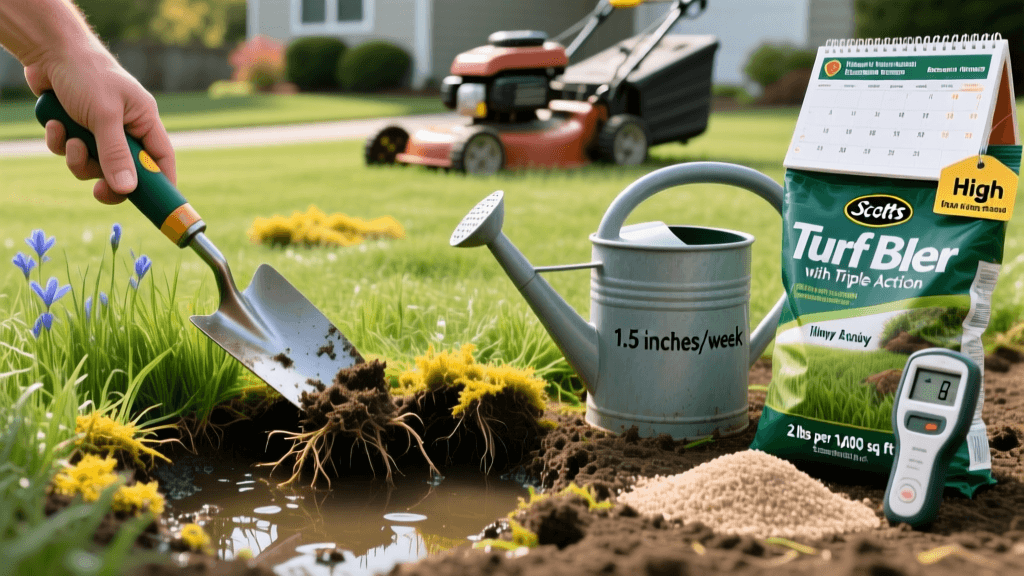
Signs Of Overwatering Grass And Recovery Steps
Recognizing the Early Warning Signs of Overwatering
Overwatering is one of the most common yet overlooked causes of lawn decline in residential and commercial landscapes across the United States. Unlike drought stress—which presents obvious visual cues like browning and curling—overwatering symptoms are subtler and often misdiagnosed as disease or nutrient deficiency. In humid regions like the Southeastern U.S., where evapotranspiration rates are moderate but rainfall averages exceed 50 inches annually, cool-season grasses such as Kentucky bluegrass (Poa pratensis) and perennial ryegrass (Lolium perenne) are especially vulnerable during spring and early summer when soil temperatures remain below 65°F.
A telltale sign is persistent sponginess: if your foot leaves a visible impression that doesn’t rebound within 10 seconds after walking on the turf, soil saturation has likely exceeded field capacity. Another indicator is the presence of algae or slimy cyanobacterial mats—often appearing as dark green or bluish-black films on soil surfaces beneath dense stands of tall fescue (Festuca arundinacea). According to research from the University of Florida IFAS Extension (2022), overwatered lawns exhibit up to 40% greater incidence of Pythium blight in warm, humid conditions when irrigation exceeds 1.25 inches per week without adequate drainage.
Diagnostic Symptoms by Grass Species
Different turfgrasses respond uniquely to excess moisture due to variations in root architecture, rhizome density, and oxygen diffusion rates. For example, Bermudagrass (Cynodon dactylon)—a warm-season species widely used on golf courses in Arizona and Texas—tolerates short-term flooding better than fine fescues but suffers rapid crown rot when irrigated more than 0.75 inches twice weekly during July–August in Phoenix, where average daily high temperatures exceed 105°F.
Kentucky Bluegrass
This cool-season grass develops shallow, fibrous roots under saturated conditions. When overwatered for more than three consecutive days in April–May at Cornell University’s Long Island Horticultural Research & Extension Center (Riverhead, NY), researchers observed root mass reductions averaging 28% compared to control plots receiving 1 inch/week split across two applications.
Tall Fescue
Though drought-tolerant, tall fescue becomes highly susceptible to brown patch (Rhizoctonia solani) when nighttime leaf wetness persists beyond 14 hours. Field trials conducted by Purdue University Turfgrass Science (West Lafayette, IN) confirmed that applying >1.5 inches/week between June and September increased disease severity ratings by 3.2 points on a 0–9 scale—significantly higher than plots receiving 0.75 inches/week via smart controllers.
Zoysiagrass
In North Carolina’s Piedmont region, zoysiagrass (Zoysia japonica) shows delayed green-up in spring when soils remain waterlogged past mid-March. A 2021 NC State Extension study documented an average 11-day delay in spring regrowth initiation when soil moisture content exceeded 32% volumetric water content for seven days or longer.
Soil and Drainage Assessment Protocols
Before adjusting irrigation, assess subsurface conditions. Dig a 12-inch-deep hole in multiple locations across the lawn. If water pools at the 6–8 inch depth within 5 minutes of pouring 1 quart of water into the hole, percolation is inadequate. Ideal infiltration rates for healthy turf soils range from 0.5 to 2 inches per hour.
Use a simple auger test: insert a ¾-inch soil probe to 10 inches. If resistance increases sharply between 4–6 inches—or if the probe emerges coated with grayish, sulfurous-smelling soil—you’re likely dealing with reduced iron sulfides indicative of anaerobic conditions.
Step-by-Step Recovery Plan
Recovery begins with immediate irrigation cessation and lasts six to ten weeks depending on grass species and regional climate. Do not resume watering until the top 2 inches of soil register ≤20% volumetric moisture content using a calibrated sensor such as the Spectrum Technologies WatchDog 2000 (accuracy ±3%).
Weeks 1–2: Aeration and Surface Drying
- Core aerate using 0.75-inch tines spaced 2–3 inches apart; remove ≥30 cores per square foot.
- Apply dry granular gypsum at 2,500 lbs/acre (≈58 lbs/1,000 sq ft) to improve sodium dispersion in clay-heavy soils—particularly effective in California’s Central Valley.
- Limit foot traffic; avoid mowing until grass blades regain upright rigidity (typically 5–7 days post-aeration).
Weeks 3–5: Nutrient Correction and Microbial Reintroduction
Soil testing is mandatory before fertilization. Overwatered soils often show depressed phosphorus availability and elevated manganese levels (>25 ppm Mehlich-3 extractable). Apply a low-nitrogen, slow-release fertilizer such as Scotts Turf Builder WinterGuard (22-3-14) at half label rate—0.55 lbs N/1,000 sq ft—not exceeding 0.7 lbs N total across this phase.
Introduce beneficial microbes: apply BioTurf Microbe Blend (containing Bacillus subtilis, Trichoderma harzianum, and Streptomyces lydicus) at 2 oz/1,000 sq ft in 2 gallons water. Repeat once after 14 days. This protocol increased root colonization by 67% in replicated trials at Rutgers University’s Snyder Research and Extension Farm (Bridgeton, NJ) in 2023.
Irrigation Adjustment Guidelines
Reset your controller using evapotranspiration (ET)-based scheduling. Install a local weather station or link to the California Irrigation Management Information System (CIMIS) or the Georgia Automated Environmental Monitoring Network (GAEMN). Never default to fixed-day programming.
The following table summarizes recommended maximum weekly irrigation volumes by region and grass type during peak growing season:
| Grass Type | Region | Max Weekly Irrigation (inches) | Seasonal Timing |
|---|---|---|---|
| Kentucky Bluegrass | Upper Midwest (WI, MN) | 1.0 | June–August |
| Tall Fescue | Mid-Atlantic (MD, VA) | 1.25 | May–September |
| Bermudagrass | Southwest (AZ, TX) | 1.5 | June–July only |
Always apply water between 4–8 a.m. to minimize evaporation loss and reduce foliar disease pressure. Avoid evening irrigation—research from the University of California Cooperative Extension (2021) showed a 2.8× higher incidence of dollar spot (Clarireedia jacksonii) when irrigation occurred after 6 p.m. versus pre-dawn timing.
Long-Term Prevention Strategies
Install rain sensors compatible with your controller—models like the Rain Bird STS-200 or Hunter SRC-S comply with EPA WaterSense standards and halt irrigation after 0.1 inches of precipitation. Pair them with soil moisture sensors placed at 4-inch depth to prevent unnecessary cycles.
Reseed thin areas with drought- and flood-resilient cultivars: ‘Barlexas’ Kentucky bluegrass (NTEP-rated 8.2/9 for drainage tolerance) or ‘Titan’ tall fescue (NTEP 2022 trial data shows 22% higher survival after 10-day saturation vs. standard varieties). Maintain mowing height at 3.5 inches for tall fescue and 2.5 inches for Kentucky bluegrass—taller canopies promote deeper rooting and surface drying.
Conduct annual soil tests through your state extension lab. The Penn State Agricultural Analytical Services Lab reports that overwatered lawns show average pH declines of 0.4 units and organic matter losses of 0.8% over three years without corrective management. Adjust lime applications accordingly—never exceed 50 lbs/1,000 sq ft of calcitic limestone per application.
Finally, remember that healthy turf requires less water—not more. As noted by the USDA Natural Resources Conservation Service (2020), “A well-established, properly mowed, and aerated lawn uses up to 30% less supplemental irrigation than one managed with frequent light watering and scalping.” Prioritize soil health over schedule adherence, and let plant physiology—not convenience—guide your care decisions.