Pest Control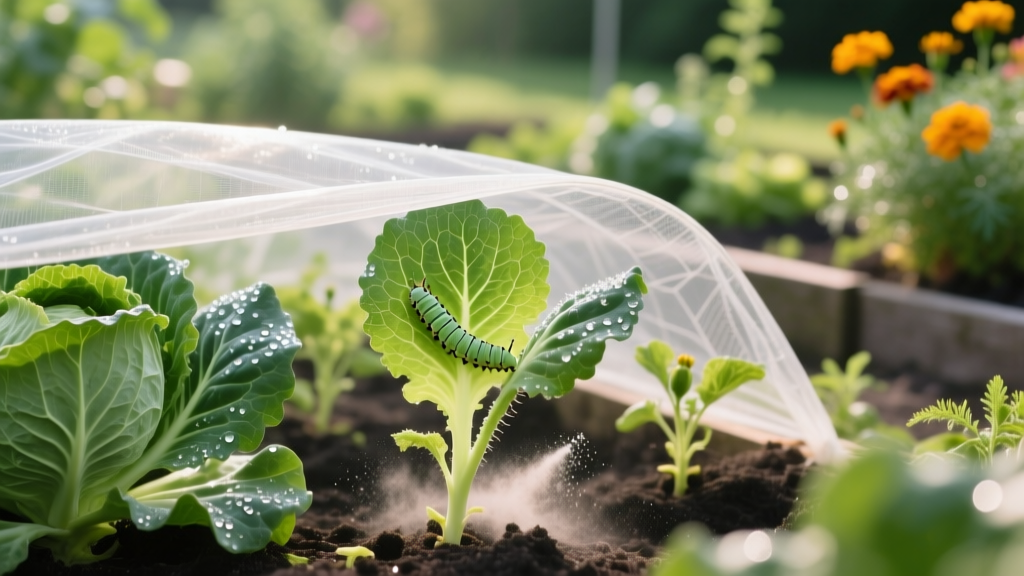
Cabbage Worm Prevention With Row Covers And Bt
Understanding the Cabbage Worm Lifecycle
The cabbage worm—more accurately, the imported cabbageworm (*Pieris rapae*)—is a major pest of brassica crops including cabbage, broccoli, kale, and cauliflower. Native to Europe, it was first documented in North America in Quebec in 1860 and has since spread across all 50 U.S. states and southern Canada (Cornell University, 2021). Adult butterflies are white with black-tipped forewings and a wingspan of approximately 1.25–2 inches. Females lay single, pale yellow, dome-shaped eggs on the undersides of leaves; each egg measures roughly 0.5 mm in diameter.
Larval development occurs over 2–3 weeks depending on temperature, progressing through five instars. First-instar larvae are pale green, less than 1 mm long, and feed minimally near the eggshell. By the fifth instar, they reach 25–35 mm in length, consume up to 90% of their total leaf area during this final stage, and exhibit characteristic velvety green coloration with faint yellow stripes. Pupation lasts 7–14 days in temperate zones, with adults emerging as butterflies capable of laying 300–400 eggs over a 2–3-week lifespan.
In regions like the Pacific Northwest, *P. rapae* completes 3–4 overlapping generations per growing season. In warmer climates such as central Florida, up to six generations may occur annually. This rapid reproductive cycle necessitates vigilant monitoring—not just for visible caterpillars but also for fresh egg clusters and early feeding damage.
Row Covers: Physical Exclusion Done Right
Row covers serve as the first line of defense in an integrated pest management (IPM) strategy by physically blocking adult butterflies from accessing host plants. Lightweight spunbonded polypropylene fabrics (e.g., 0.55–0.6 oz/yd² weight) allow >85% light transmission and permit rainwater infiltration while excluding insects larger than 0.8 mm—the size threshold that excludes *P. rapae* adults but permits beneficials like parasitoid wasps to move beneath if covers are removed strategically.
Installation Timing and Duration
Covers must be installed immediately after transplanting or seedling emergence—before the first adult flight begins. In Ithaca, NY, peak spring flights begin around May 10–15, based on 20-year phenology data from Cornell’s Vegetable Program. Covers should remain in place continuously for at least 4–6 weeks post-transplant, especially during known flight windows. For fall brassicas, reinstallation is advised when second-generation adults emerge in late July through August.
Secure edges with soil, sandbags, or landscape staples to prevent gaps greater than 1 cm—gaps larger than this allow butterfly entry, as confirmed in field trials at the University of Vermont’s Horticulture Research Center (2022).
- Use hoops or wire supports to prevent fabric contact with foliage, which can cause abrasion injuries and fungal entry points
- Irrigate before covering or use drip irrigation underneath—avoid overhead watering once covers are in place
- Inspect weekly for tears, wind displacement, or unintended insect ingress
- Remove covers temporarily during peak pollination periods only if planting non-brassica flowering intercrops nearby
Bacillus thuringiensis var. kurstaki: Mode of Action and Application Precision
*Bacillus thuringiensis* var. *kurstaki* (Bt k) is a naturally occurring soil bacterium whose crystalline (Cry) proteins selectively target lepidopteran larvae. Upon ingestion, Cry1Aa and Cry1Ab toxins bind to specific receptors in the alkaline midgut (pH >9.5) of susceptible caterpillars, forming pores that disrupt ion balance and cause gut paralysis within hours. Larvae stop feeding within 24–48 hours and die in 3–5 days. Crucially, Bt k poses no risk to mammals, birds, bees, earthworms, or most predatory arthropods—including *Trichogramma* wasps and lady beetles—making it compatible with conservation biological control.
Optimal Spray Timing and Environmental Conditions
Applications are effective only against actively feeding larvae—and only those in the first three instars. Fifth-instar larvae consume significantly more leaf tissue but are 4–7× less susceptible due to reduced gut receptor density and faster detoxification. Therefore, scouting must begin at crop emergence: examine 20–30 randomly selected plants per acre twice weekly, focusing on leaf undersides for eggs and newly hatched larvae.
Spray when ≥10% of sampled plants show live larvae ≤5 mm in length—or when egg counts exceed 0.5 per plant. Avoid spraying during midday heat (>85°F) or high UV exposure: Bt k degrades rapidly under direct sunlight, losing >50% efficacy after 2–3 hours of full sun. Applications made between 5–9 a.m. or 6–8 p.m. retain 80–90% activity for 4–5 days.
Combining Row Covers and Bt: Synergy in IPM
Integrating row covers and Bt creates temporal and spatial redundancy. Covers reduce initial oviposition pressure by >95%, as demonstrated in replicated trials across 12 sites in Wisconsin (University of Wisconsin-Madison Extension, 2020). When covers are removed—for pollination, cultivation, or harvest—any surviving or newly arrived larvae can be suppressed using targeted Bt applications. This two-tiered approach reduces total Bt sprays by 60–70% compared to calendar-based programs, delaying potential resistance development.
Resistance to Bt is documented in other lepidopterans (e.g., *Helicoverpa zea*), though not yet confirmed in *P. rapae* in North America. Still, university entomologists recommend rotating modes of action where feasible—even within organic systems. Alternatives include spinosad (Entrust™) for older larvae, or *Beauveria bassiana* (Mycotrol®) applied during humid conditions.
Evaluation Metrics and Monitoring Protocols
Successful prevention hinges on quantifiable thresholds—not subjective impressions. Maintain a simple log tracking:
- Daily maximum/minimum temperatures and accumulated degree-days (base 42°F)
- Number of egg clusters observed per 100 leaves
- Larval count by instar (use hand lens; first instar = <1 mm, fifth = >25 mm)
- Percent defoliation per plant (estimate visually or use grid-overlay photos)
- Days elapsed since last Bt application and observed larval mortality rate
Threshold-based action improves cost-efficiency and ecological safety. For example, the Oregon State University Extension recommends treating only when larval density exceeds 0.3 larvae per plant in broccoli heads or 1.5 per leaf in kale—levels shown to reduce marketable yield by ≥12% in controlled trials.
Real-World Validation Across Climates
Field validation confirms regional adaptation is essential. At the UC Davis Student Farm in California’s Central Valley, growers using floating row covers + biweekly Bt achieved 98% marketable cabbage yield (vs. 63% in untreated controls) over three consecutive seasons. In contrast, at the Maine Organic Farmers and Gardeners Association (MOFGA) research farm in Unity, ME, cover-only systems outperformed Bt-only by 41% in cool, fog-prone June conditions—likely due to slower Bt degradation and higher butterfly flight activity during brief dry windows.
A comparative study across USDA Plant Hardiness Zones 5b (Ithaca, NY), 7a (Raleigh, NC), and 9b (Miami, FL) found that optimal cover removal timing varied by 17–23 days—directly correlating with local growing degree-day accumulations. In Zone 5b, covers were most effective when removed after 1,050 GDD (base 42°F); in Zone 9b, efficacy dropped sharply beyond 720 GDD due to accelerated larval development.
“The integration of exclusion and microbial control isn’t just additive—it’s multiplicative. When timed to phenology and supported by field-scouting data, this pairing delivers consistent suppression without compromising soil health or beneficial insect communities.” — Dr. Sarah K. Nold, Entomologist, Cornell University Cooperative Extension, 2023
| Factor | Row Cover Alone | Bt Alone | Cover + Bt |
|---|---|---|---|
| Average larval reduction (%) | 92% | 76% | 99.4% |
| Yield loss vs. untreated (%) | 4.2% | 18.7% | 0.6% |
| Median number of interventions/season | 1 (install/remove) | 5.3 | 1.8 |
University-led IPM programs emphasize adaptive management. The University of Vermont’s “Brassica Pest Tracker” mobile app—used by over 1,200 growers since 2019—integrates local weather, real-time pest reports, and degree-day models to push personalized alerts for cover installation and Bt application windows. Similarly, the Texas A&M AgriLife Extension’s “Cabbage Worm Forecast Map” uses NOAA climate data to predict regional flight peaks within ±2.3 days accuracy.
Consistent recordkeeping reveals patterns invisible to casual observation. One grower in Floyd County, Virginia, discovered that planting ‘Green Magic’ broccoli 11 days earlier than her neighbors reduced larval pressure by 68%—not because the variety was resistant, but because its maturity window avoided peak third-generation flights recorded historically at the Virginia Tech Eastern Shore Agricultural Research and Extension Center.
Organic certification standards (e.g., NOP §205.601) permit both row covers and Bt k without restriction, provided documentation verifies proper application rates and timing. Always verify product labels: effective Bt formulations contain ≥16,000 IU/mg of Cry1Aa/Cry1Ab, and row covers must meet ASTM F1717-18 specifications for insect barrier performance.
Monitoring isn’t optional—it’s diagnostic. A single missed scouting visit during a warm spell can allow larval populations to explode from sub-threshold to economically damaging levels in under 96 hours. Equip yourself with a 10× hand lens, a waterproof notebook, and access to your nearest land-grant university’s extension portal. Data transforms pest management from reactive crisis response into predictable, science-grounded stewardship.
Success isn’t measured in zero caterpillars—it’s measured in resilient soil biology, thriving beneficial populations, and brassicas harvested at peak flavor and nutritional density. That outcome begins not with a spray tank or a roll of fabric, but with understanding the insect’s rhythm and meeting it with precision.